
PTC Inc.: Schneider Electric Acquisition Looms as AI-Driven PLM and ALM Platforms Navigate Market Transition
PTC Inc. enters a pivotal phase with a pending Schneider Electric acquisition, robust AI- and cloud-enabled product lifecycle platforms, and recent divestitures reshaping its revenue mix. The company's strategy hinges on sustaining ARR growth, executing integration, and maintaining cybersecurity leadership amid evolving industrial software competition.
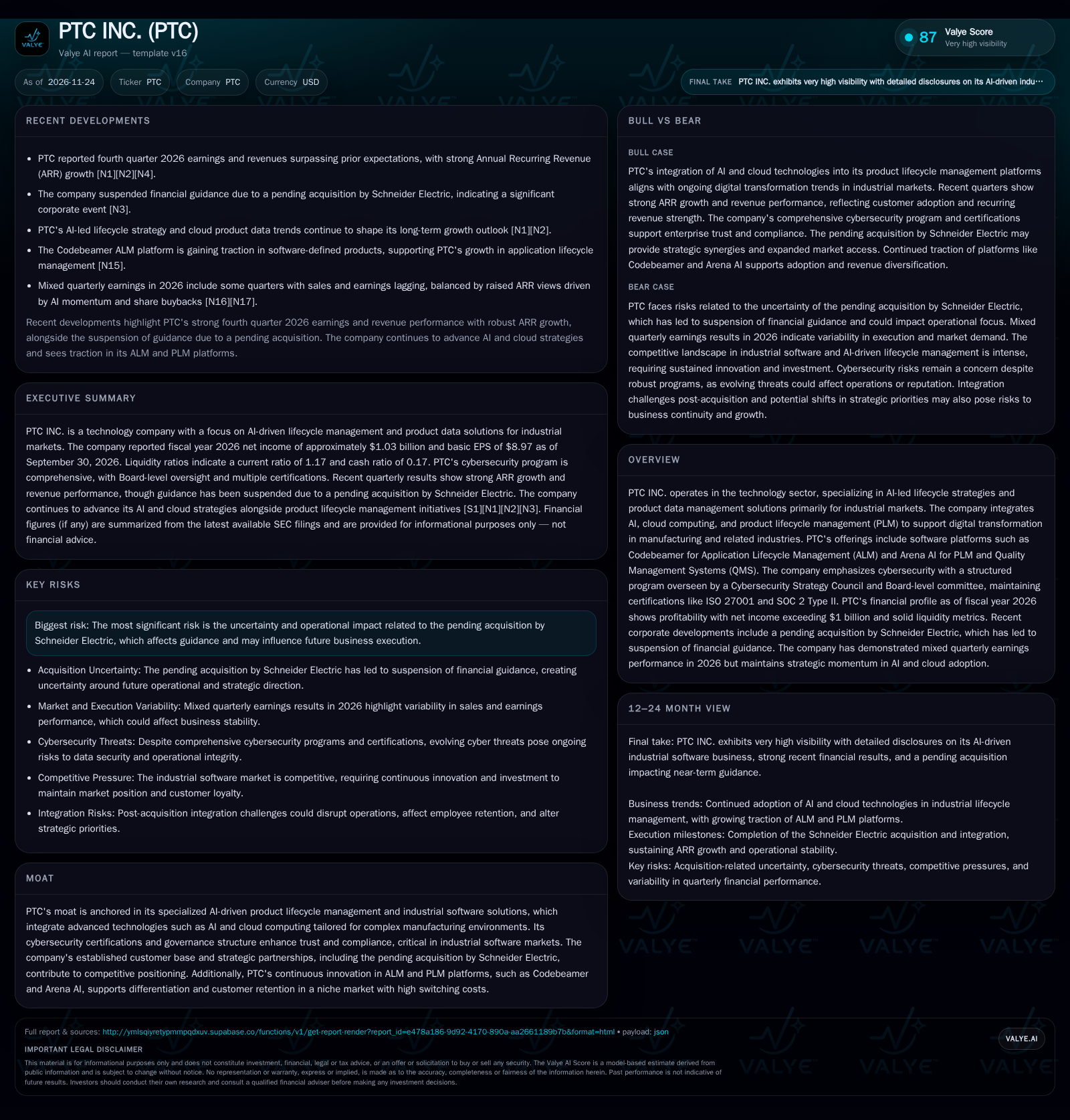
PTC Inc. has suspended guidance due to Schneider Electric’s pending acquisition, after a year marked by solid profitability, ARR growth (excluding divested businesses), and a sharpened focus on core PLM and ALM platforms. The company’s future will be shaped by integration execution, continued traction of AI/cloud-enabled offerings, and its ability to withstand competitive and cybersecurity pressures.
PTC Inc. stands at a crossroads: the pending Schneider Electric acquisition has paused financial guidance and heightened strategic scrutiny, while the company’s core business—AI-powered product lifecycle management and application lifecycle management for industrial clients—continues to evolve. Fiscal 2026 delivered robust profitability and ARR growth after adjusting for significant divestitures, as PTC sharpened its focus on cloud-native, AI-enabled platforms such as Codebeamer and Arena AI. The next chapter will depend on successful integration, ARR momentum, and the company’s ability to defend its niche against intensifying competition and cyber threats.
Acquisition Uncertainty and Shifting Revenue Mix Define PTC’s Present
PTC suspended financial guidance following Schneider Electric’s pending acquisition, signaling a period of heightened uncertainty and strategic transition [N3] [N5]. This corporate event comes on the heels of fiscal 2026 results that showed net income of $1.03 billion and basic EPS of $8.97, even as headline revenue declined due to the divestiture of the Kepware and ThingWorx businesses [S1] [S2]. Importantly, the company’s ARR—excluding those divested segments—grew 7% (9% constant currency), highlighting the resilience of its subscription-based model and the growing traction of its core platforms such as Codebeamer for ALM and Arena AI for PLM and QMS [S2]. PTC’s cybersecurity program, governed at the Board level and supported by industry certifications, continues to serve as a critical pillar of trust for enterprise customers [S1].
How Subscription Economics and Platform Focus May Shape Profitability
PTC’s business model is centered on recurring software revenue, with ARR as a key metric. The transition away from perpetual licenses toward subscription-based contracts provides greater revenue visibility and smoother cash flows, albeit with upfront margin compression during periods of transition. The divestiture of Kepware and ThingWorx reflects a deliberate pivot to higher-value, cloud-native platforms where AI and application lifecycle management drive differentiation. This focus can support higher average contract values and potentially reduce churn, particularly as industrial clients embed PLM and ALM platforms deeply into core processes.
Fixed costs—primarily R&D and platform support—are significant but can be leveraged across a growing subscriber base, suggesting potential for operating margin expansion if ARR growth outpaces cost inflation. The company reported free cash flow growth of 3% in Q3 2026, although this was tempered by higher capital expenditures related to R&D center relocation [S2]. The ability to maintain pricing power will hinge on continued product innovation, integration depth, and regulatory compliance, especially in highly regulated verticals where cybersecurity and data residency requirements are stringent.
The recent $525 million share repurchase, partially funded by net debt, suggests management sees value in capital return, but the pending acquisition may signal a shift in capital allocation priorities going forward [S2].
Industrial Software Landscape: Defensible Niche or Intensifying Crosswinds?
PTC’s competitive position is rooted in its specialization: AI-enabled PLM and ALM for industrial and manufacturing sectors, where process complexity and regulatory scrutiny create high switching frictions. The company’s platforms—particularly Codebeamer and Arena AI—are designed to integrate with complex engineering workflows, which may raise customer lock-in and lower price sensitivity. The moat is further reinforced by a comprehensive cybersecurity posture (ISO 27001, SOC 2 Type II, TISAX, FedRAMP certifications) and governance structure, which bolster trust with large enterprise customers [S1].
However, competition remains fierce. Large enterprise software vendors, industrial automation specialists, and emerging cloud-native SaaS providers are all targeting digital transformation in manufacturing. Some rivals may have deeper vertical integration, broader product suites, or greater scale to invest in AI. The recent divestitures could be interpreted as a narrowing of scope, which may strengthen focus but also exposes PTC to more direct competition in its remaining core. The question is whether PTC’s innovation cadence and existing customer relationships can offset these counterforces, especially if the Schneider Electric acquisition introduces integration risk or strategic drift.
If Integration Delivers and AI/Cloud Platforms Scale, Value Could Compound
The most favorable scenario for PTC involves smooth execution of the Schneider Electric acquisition, with minimal customer or employee attrition and clear alignment around product strategy. If Codebeamer and Arena AI continue to gain traction—driven by AI-enabled features, cloud scalability, and deep workflow integration—ARR growth could accelerate as industrial clients expand usage across divisions and geographies. Successful cross-selling into Schneider’s industrial automation base could further expand TAM.
Confirmation would come from sustained double-digit ARR growth (excluding divested segments), margin expansion as operating leverage kicks in, and evidence of customer wins against larger enterprise software rivals. Additional signals would include new partnerships, expanded AI capabilities, and a stable or improving cybersecurity incident record. If disclosed, customer retention rates and average contract value growth would further validate the thesis.
Platform Adoption Continues, but Integration and Competition Temper the Pace
The most plausible outcome is continued, albeit moderate, ARR growth in core platforms as manufacturing clients incrementally adopt AI and cloud features, offset by some customer churn or slower expansion due to macro uncertainty and post-acquisition integration distractions. Operating margins may remain under pressure if cost synergies from the Schneider deal are delayed or if R&D investment is required to keep pace with competitors.
This scenario would be confirmed by ARR growth in the mid-single digits, stable free cash flow, and a steady cadence of AI/cloud feature releases. Any prolonged suspension of guidance, missed execution milestones, or evidence of customer defection would suggest downside risks are materializing. External validation—such as analyst upgrades or continued industry recognition for cybersecurity—would support the base case.
Integration Friction, Customer Churn, or Cyber Breach Could Derail Momentum
The adverse scenario involves significant integration challenges following the Schneider acquisition—such as cultural clashes, talent loss, or conflicting product roadmaps—leading to delayed innovation and customer uncertainty. If competitors successfully poach key accounts or undercut on price, ARR could stagnate or decline. A major cybersecurity incident could further erode trust, particularly if regulatory penalties or customer lawsuits follow.
Downside confirmation would include declining ARR or bookings, spike in customer churn (if disclosed), cost overruns tied to integration, or adverse headlines involving security breaches. A drop in free cash flow, negative analyst commentary, or a prolonged delay in restoring financial guidance would reinforce a bearish interpretation.
Milestones and Metrics That Will Shape PTC’s Strategic Outcome
Progress and timeline for closing the Schneider Electric acquisition, including regulatory approvals and stakeholder communications.
ARR growth rates for Codebeamer, Arena AI, and core PLM/ALM platforms, especially excluding recently divested businesses.
Customer retention and expansion rates—if disclosed—particularly in strategic verticals and large enterprise accounts.
Pace and impact of AI/cloud feature releases and evidence of increased customer adoption of these modules.
Reported cybersecurity incidents, regulatory findings, or certification renewals that could affect customer trust.
Operating margin and free cash flow trends post-acquisition, as a signal of cost discipline and integration success.
Employee turnover or leadership changes, especially in R&D and cybersecurity functions, as a proxy for integration health.
Resumption of financial guidance and transparency in forward-looking commentary as integration progresses.
Disclaimer: This is research-only, informational analysis and not investment advice. It may include AI-generated interpretation and general industry context. Always verify important details using primary sources.

Comments