
Cabot Corp: Specialty Chemicals Leverage, EV Battery Ambitions, and the Weight of Legal Contingencies
Cabot Corp’s recent earnings underscore its strength in Performance Chemicals and its push into electric vehicle battery materials, but legal and environmental liabilities loom large. How sustainable is its margin profile as it balances innovation, industry cycles, and exposure to regulatory risk?
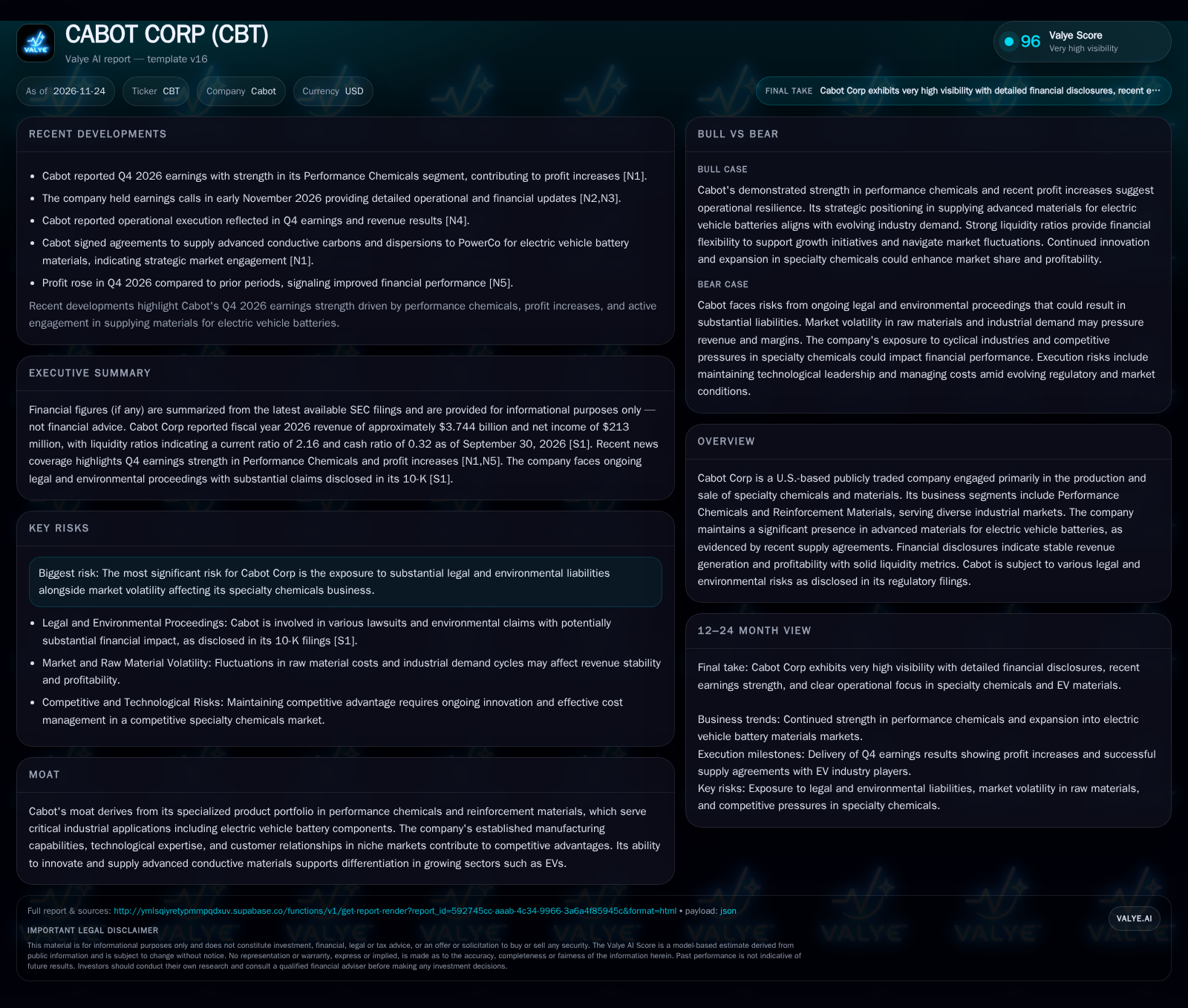
Cabot Corp delivered fiscal 2026 revenue of $3.744 billion and net income of $213 million, with Q4 results highlighting outperformance in Performance Chemicals and new supply deals in EV battery materials. While financials suggest operational resilience, persistent legal and environmental claims and exposure to volatile industrial cycles present material risks to margin durability and capital deployment flexibility. The company’s trajectory in advanced materials markets, especially for EVs, could reshape its growth profile if it can contain liabilities and sustain innovation [S1] [N1].
Cabot Corp stands at a crossroads: its robust Performance Chemicals business and recent entry into the electric vehicle battery supply chain have underpinned strong fiscal 2026 results. Yet, persistent legal and environmental proceedings cast uncertainty over its long-term capital flexibility and margin profile. As the company leverages specialized materials expertise for industrial and mobility megatrends, the central question is whether its innovation and operational execution can consistently outpace the drag of cyclical risks and contingent liabilities.
Current Operating Profile and Material Developments
Fiscal 2026 saw Cabot Corp post $3.744 billion in revenue and $213 million in net income, with basic EPS of $4.04, reflecting stable profitability and scale [S1]. Q4 performance was notably lifted by the Performance Chemicals segment, which contributed to profit increases and was highlighted in multiple earnings reports [N1] [N5]. The company signed agreements to supply advanced conductive carbons and dispersions to PowerCo for EV battery materials, signaling a strategic push into high-growth, technology-driven end markets [N1]. [S1]
How Cabot Makes Money: Segment Mix, Margin Drivers, and Capital Structure
Cabot's revenue model is anchored in the sale of specialty chemicals and materials, divided primarily between Performance Chemicals and Reinforcement Materials [S1]. Performance Chemicals, covering products like specialty carbons and fumed silica, tend to command higher margins due to their critical applications in coatings, batteries, and advanced industrial products. Reinforcement Materials, historically tied to carbon black for tire and rubber manufacturing, are more exposed to cyclical commodity pricing and industrial demand swings.
The company's recent expansion into advanced conductive carbons and dispersions for EV batteries suggests a shift toward higher-value, technology-intensive applications. If Cabot can secure multi-year supply agreements or recurring contracts in this segment, it could improve revenue visibility and margin stability. However, the capital intensity of specialty chemical production, coupled with regulatory compliance and environmental remediation costs, means that fixed costs are substantial. This structure can generate operating leverage during upcycles but also amplifies downside risk if demand softens or if legal liabilities materialize.
Specialty Materials Edge and the Threat of Substitution
Cabot’s competitive positioning relies on its specialized product portfolio, established manufacturing processes, and deep customer relationships in niche industrial markets. In Performance Chemicals, differentiation is built on product quality, consistency, and technical support—factors that enable premium pricing and customer stickiness, particularly in applications like EV batteries, coatings, and electronics.
However, competitive intensity remains high. Large diversified chemical producers, as well as smaller pure-play specialty firms, are investing in similar advanced materials, especially for EVs and renewable energy. Technology substitution risk is real: advances in battery chemistry or alternative conductive materials could erode Cabot’s addressable market or force margin concessions.
Switching costs for customers can be significant due to qualification requirements and performance assurance, but if competitors can offer comparable or superior materials at lower cost, pricing pressure may mount. Regulatory requirements around environmental impact and sustainability are also raising the bar for differentiation and compliance costs.
Margin Expansion and Growth Through EV Battery Materials Penetration
A favorable trajectory for Cabot would see its Performance Chemicals and advanced materials offerings gaining increasing share in high-growth sectors like electric vehicles and energy storage. If recent supply agreements for conductive carbons/dispersions with EV battery makers such as PowerCo translate into multi-year, scalable contracts, Cabot could benefit from recurring revenue streams and improved gross margins due to the premium nature of these materials [N1].
Operating leverage would amplify profit growth if fixed manufacturing assets are utilized more efficiently, and if innovation continues to yield differentiated products with limited direct substitutes. Successful navigation of legal and environmental proceedings—either through favorable settlements or effective risk management—would further free up capital for reinvestment.
Confirmation of this scenario would require disclosure of contract durations, recurring revenue metrics, and evidence of sustained margin improvement in Performance Chemicals. Upward revisions to guidance based on new advanced materials business, alongside manageable legal costs, would also support the thesis.
Incremental Gains Amid Cyclical and Regulatory Headwinds
The most plausible near-term path for Cabot is continued stable performance in its core industrial and specialty chemical segments, with incremental growth from new market entries like EV battery materials. Revenue and profit may rise modestly as the Performance Chemicals segment expands, but cyclical swings in Reinforcement Materials and raw material input costs could offset some gains.
Legal and environmental liabilities are likely to remain overhangs, with periodic charges or settlements impacting net income and capital allocation.
This scenario would be confirmed by steady revenue growth in both segments, stable or gradually improving margins, and manageable legal expenses relative to operating cash flow. Absence of major contract wins or disruptive legal outcomes would keep results in line with historical norms.
Legal and Regulatory Shocks Undermine Capital Flexibility
The most significant risk to Cabot’s outlook is the crystallization of substantial legal or environmental liabilities. If ongoing lawsuits or regulatory actions result in large adverse judgments or remediation requirements, the company could face a significant drain on cash and resources. This could force reductions in growth investment, dividend payments, or even necessitate asset sales or debt issuance.
Simultaneously, if cyclical downturns in industrial demand—especially in the Reinforcement Materials segment—coincide with rising raw material costs, margins could compress rapidly. Loss of key customers or technological obsolescence in advanced materials would further exacerbate revenue and profit declines.
Downside confirmation would come from major legal settlements or regulatory fines that materially exceed reserves, negative working capital trends, or evidence of market share loss in core or growth segments. Unexpected weakness in Performance Chemicals margins or public disclosure of lost contracts would also be red flags.
Milestones That Will Reveal Cabot’s Margin Durability and Growth Trajectory
Disclosure of contract durations, renewal rates, and recurring revenue in advanced materials—particularly in EV battery supply—would help gauge the stickiness and scalability of new business lines.
Gross margin and segment profit trends in Performance Chemicals, if broken out, would clarify the sustainability of recent gains and the impact of product mix shifts.
Updates on the status, scope, and financial magnitude of legal and environmental proceedings—especially any settlements, reserves, or new claims—are critical for assessing contingent liability risk.
Raw material input cost trends and the company’s ability to pass through increases to customers would signal pricing power and margin resilience.
Market share developments in core and new application areas—a useful metric would be customer concentration or share of wallet in EV battery materials, if disclosed.
New product launches or announced technology partnerships in specialty chemicals or advanced materials would indicate ongoing innovation and competitive positioning.
Evidence of customer switching or loss of contracts, particularly in high-margin segments, would help test the durability of Cabot’s competitive moat.
Disclaimer: This is research-only, informational analysis and not investment advice. It may include AI-generated interpretation and general industry context. Always verify important details using primary sources.

Comments