
Epsilon Energy: Multi-Basin Growth Ambitions Confront Liquidity Constraints and Sector Volatility
Epsilon Energy’s pursuit of production expansion across multiple basins signals operational ambition, but current liquidity shortfalls and sector-wide volatility present immediate hurdles. Assessing the interplay between growth initiatives, cash flow dynamics, and commodity price exposure will be central to understanding the company’s near-term trajectory.
While recent insider buying hints at management conviction, continued exposure to commodity price swings and regulatory complexity could amplify financial risks. The company's ability to convert production growth into sustainable cash flows will be pivotal.
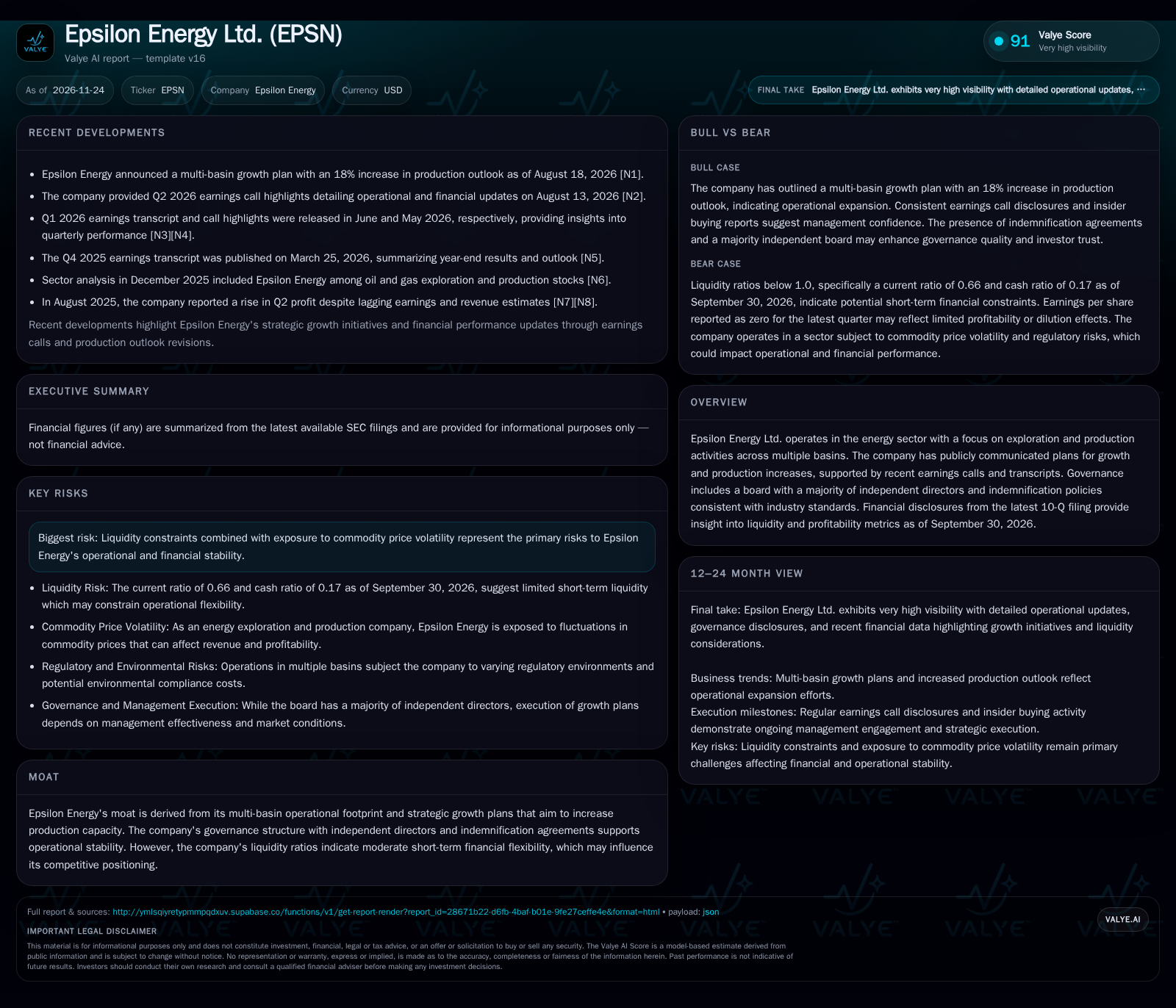
Epsilon Energy Ltd. is pushing for growth through an ambitious multi-basin production expansion, seeking to increase output by 18% as recently announced. Navigating the balance between scaling production, managing cash flow, and contending with commodity price swings will be critical for Epsilon’s ability to deliver on its operational aspirations and maintain financial stability.
Growth Initiatives Advance as Liquidity Tightens
Epsilon Energy’s most significant recent move is its announced multi-basin growth plan, projecting an 18% increase in production as of August 2026 [N1]. This signals a clear operational expansion agenda and a willingness to deploy capital in pursuit of scale. Yet, the September 30, 2026, balance sheet tells a cautionary tale: current assets of $31.1 million against current liabilities of $47.4 million result in a current ratio of just 0.66, while cash and cash equivalents are $7.86 million, yielding a cash ratio of 0.17 [S2]. Net income for the quarter stood at $90,663, with EPS reported as zero, suggesting that while the company remains marginally profitable, there is little cushion for error [S2]. Insider buying and routine operational updates indicate management is active and engaged, but these factors alone do not mitigate the material short-term liquidity risk.
Production Scaling and the Economics of Cash Flow Conversion
Epsilon’s core revenue stream is tied to the exploration and production (E&P) of hydrocarbons, with cash generation directly linked to production volumes and realized commodity prices. The multi-basin strategy could, in theory, diversify geological risk and provide optionality in capital allocation, potentially smoothing cash flows if production is well-managed across different basins. However, the capital intensity of ramping up output—via drilling, completion, and infrastructure investment—requires substantial up-front expenditures. [S2]
Operating leverage in E&P can be high: fixed costs (leasing, infrastructure, G&A) are spread across produced volumes, so production growth can, in a stable price environment, improve margins. But this leverage works both ways—declining prices or operational setbacks can quickly erode profitability. Furthermore, the company's recent net income and zero EPS for the quarter suggest that recent growth has not yet translated into material per-share profitability, raising questions about the efficiency of capital deployment [S2]. If Epsilon is funding expansion primarily from operating cash flow, near-term liquidity becomes a gating factor for further growth.
Capital allocation decisions within a multi-basin strategy must carefully weigh the marginal returns of incremental investments against the liquidity constraints. If Epsilon’s operational teams can identify basins or projects with shorter development cycles or lower capital intensity, prioritizing these could enhance cash flow conversion efficiency. Conversely, committing significant capital to longer lead-time projects without secured financing could strain liquidity further. Additionally, the volatility of commodity prices implies that sensitivity analyses and scenario planning are essential to anticipate cash flow fluctuations and adjust drilling or completion schedules accordingly, preserving potential financial flexibility.
How Multi-Basin Exposure Shapes Competitive Standing
Epsilon’s multi-basin footprint could offer competitive advantages by providing flexibility to allocate capital to the most attractive plays and reduce dependence on any single regulatory regime or geological profile. This operational diversity may also help manage local supply/demand imbalances and mitigate region-specific operational risks. However, Epsilon operates in a highly fragmented and competitive sector, facing not only other independent E&Ps but also larger integrated energy companies with deeper balance sheets and established infrastructure.
Commodity price risk is a major equalizer: even with operational execution, realized margins are highly sensitive to market prices for oil and gas. Larger competitors may also have access to lower-cost capital, better hedging programs, and more diversified revenue streams, enabling them to weather downturns more robustly. Epsilon’s liquidity constraints could limit its ability to respond quickly to market opportunities or to invest in operational efficiencies that drive long-term cost advantages.
The multi-basin approach also introduces complexity in regulatory compliance and operational execution, which can influence competitive positioning. Each basin may have distinct permitting requirements, environmental standards, and local stakeholder expectations, potentially increasing administrative overhead and time-to-market. Competitors with more concentrated operations might benefit from streamlined processes and cost efficiencies. However, if Epsilon can leverage basin diversification to optimize capital deployment dynamically—shifting focus to basins with more favorable regulatory or market conditions—it could partially offset these challenges. The ability to manage this complexity effectively could become a differentiator in a fragmented and capital-constrained sector.
When Production Growth Delivers Cash Flow and Strategic Optionality
If Epsilon successfully executes its 18% production increase and commodity prices remain supportive, the company could generate improved operating cash flow, allowing it to address short-term liquidity gaps and reinvest in further growth. The diversified basin approach could also reduce volatility in realized prices and production, providing a more stable foundation for long-term planning. In this scenario, positive cash flow conversion and evidence of margin expansion would be key confirming signals—such as rising per-share earnings, increased free cash flow, or a strengthening current ratio.
Additional confirmation would come from the company reporting successful well results, operational cost reductions, and perhaps the ability to secure non-dilutive financing or partnerships to support expansion.
Managing Growth Ambitions Against Financial Constraints
The most plausible near-term path for Epsilon is one where it incrementally grows production in line with its multi-basin plan but remains constrained by tight liquidity. Operating cash flow may be sufficient to fund only maintenance capex and limited growth, forcing management to prioritize projects with the quickest payback or lowest risk. Periodic commodity price volatility could swing quarterly results between modest profitability and breakeven.
Evidence confirming this scenario would include continued low or zero EPS, a current ratio that remains below 1.0, and a lack of substantial changes in the company’s asset or capital structure. Any progress in operational efficiency or modest improvement in realized prices could provide incremental support, but without a step-change in cash generation or access to new capital, the company is likely to remain in a holding pattern—progressing, but not breaking out.
Liquidity Stress Amplified by Commodity Price Downturns
In an adverse scenario, Epsilon’s liquidity constraints are exacerbated by a decline in commodity prices or operational disruptions, leading to negative operating cash flow. [S2] Prolonged weakness in realized prices would further erode margins, potentially resulting in net losses and a deteriorating balance sheet.
Missed production or growth targets and a lack of progress on previously announced operational milestones would also be warning signs.
Benchmarks for Testing Epsilon’s Growth and Resilience Thesis
Sequential production growth: Actual output increases in line with the 18% target would confirm operational follow-through [N1].
Net income and EPS trends: Repeated quarters of zero or negative EPS would highlight persistent profitability challenges.
Commodity price realization: Tracking the company’s realized oil and gas prices versus benchmarks would indicate exposure and hedging effectiveness.
Capital structure changes: New debt, equity raises, or asset sales (if disclosed) would signal how Epsilon is bridging liquidity gaps.
Operational cost per barrel or per Mcf (if disclosed): Declining unit costs would suggest efficiency gains and margin improvement.
Regulatory and environmental developments: Material changes in permitting, compliance costs, or basin-specific rules could impact both growth and risk.
Disclaimer: This is research-only, informational analysis and not investment advice. It may include AI-generated interpretation and general industry context. Always verify important details using primary sources.

Comments