
IIOT-OXYS, Inc.: Edge Computing Ambitions Confront Severe Liquidity and Scale Hurdles
IIOT-OXYS, Inc. develops proprietary edge computing solutions for industrial IoT, targeting smart manufacturing and infrastructure monitoring. Despite technical differentiation, the company faces existential challenges from minimal cash, outsized liabilities, and an ultra-lean operational structure, placing its ability to commercialize and scale in acute doubt.
IIOT-OXYS, Inc. positions itself at the intersection of edge computing and industrial IoT, offering flexible, minimally invasive monitoring solutions powered by proprietary AI algorithms.
IIOT-OXYS, Inc. embodies the technical promise and existential risk of early-stage industrial IoT ventures. Without meaningful revenue or a clear path to sustaining operations, IIOT-OXYS’s journey now hinges as much on its ability to secure funding and execute at scale as on its technical merit. This analysis explores the mechanisms, counterforces, and scenarios that will determine whether IIOT-OXYS can convert its technological vision into a viable business.
Acute Liquidity Stress and Operational Thinness Define Today’s Reality
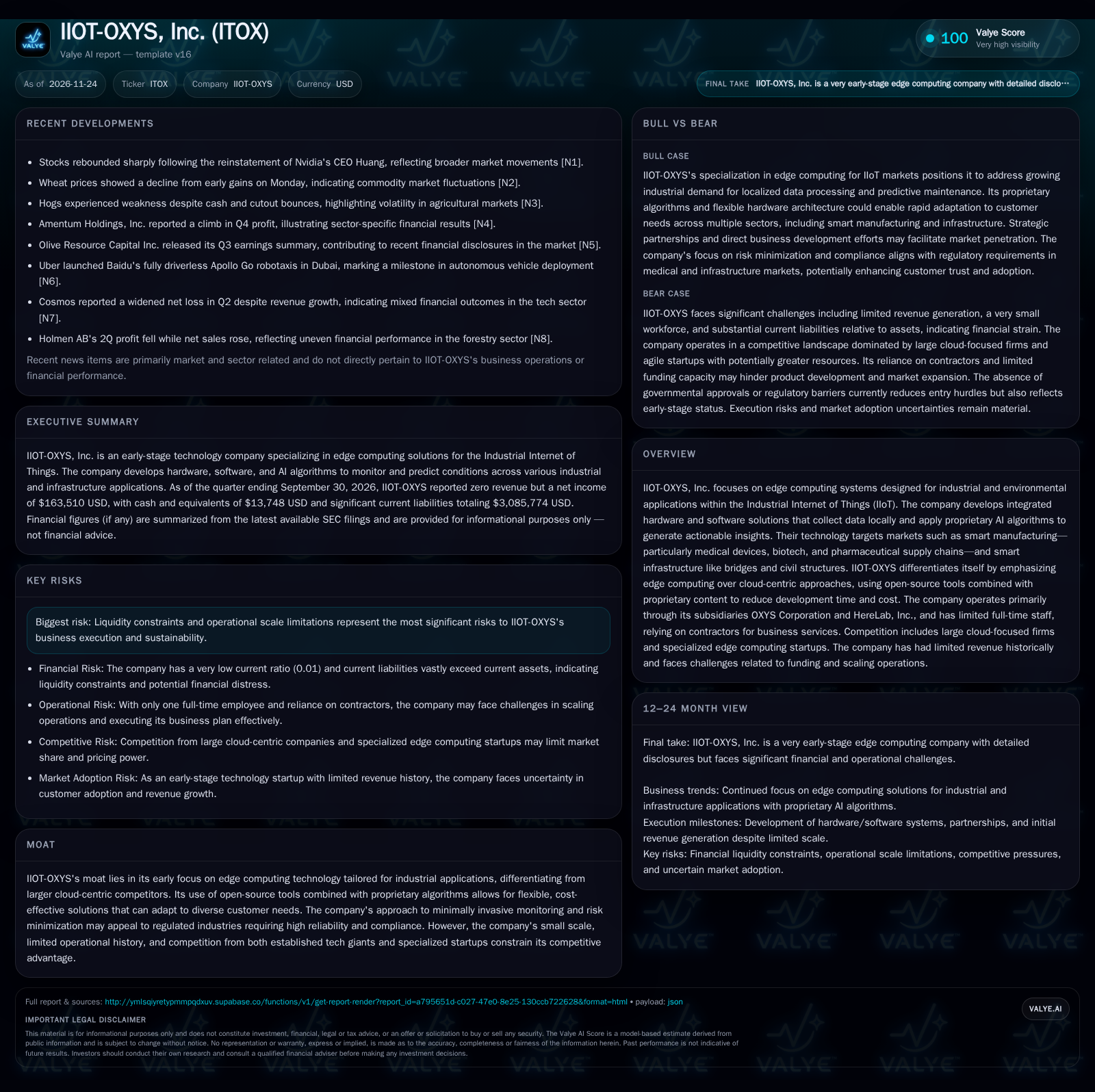
As of September 30, 2026, IIOT-OXYS reported zero revenue for the quarter, despite continued engagement in business development and partnerships [S2]. The company’s net income of $163,510 for the same period likely reflects non-operational or extraordinary items rather than sustainable core business profitability, given the absence of revenue. Most critically, the company held only $13,748 in cash and cash equivalents, with total current assets of $23,817 against current liabilities of $3,085,774, resulting in a current ratio of just 0.01 and a cash ratio of 0 [S2]. This extreme imbalance signals severe liquidity strain and a precarious ability to meet short-term obligations. Operationally, IIOT-OXYS has only one full-time employee (the CEO), with the bulk of functions outsourced to contractors, further highlighting the company’s ultra-lean and fragile structure [S2].
The extreme liquidity constraints not only inhibit daily operations but also impair the company’s strategic flexibility. For instance, the inability to prepay suppliers or invest in inventory buffers may lead to operational disruptions or higher costs. Moreover, the reliance on a single full-time employee creates significant key-person risk; any unforeseen absence or departure could stall critical decision-making and execution. This fragility extends to investor confidence, as potential backers may perceive the company’s financial and operational state as too risky without clear mitigation plans or near-term infusions of capital.
Edge Computing for IIoT: Where Could Profits Come From?
IIOT-OXYS’s core business thesis is to deliver value through edge computing devices and AI-powered analytics for industrial and infrastructure applications. The edge-first model allows for real-time, local data processing, minimizing latency and bandwidth costs compared to cloud-only solutions. The company’s offering combines off-the-shelf hardware components, reconfigurable architectures, open-source software, and proprietary algorithms, aiming to reduce development costs and accelerate customization for specific use cases.
In theory, IIOT-OXYS could monetize its technology through a mix of hardware sales, software licensing, analytics-as-a-service, or recurring subscriptions for predictive maintenance and monitoring. The economics would depend on achieving sufficient scale to spread fixed R&D and software costs over multiple deployments, building a sticky installed base, and securing multi-year contracts with industrial or municipal customers. However, with zero revenue and limited resources, the company remains in the pre-commercialization phase, making it difficult to validate margins, pricing power, or recurring revenue potential.
The company’s heavy reliance on contractors instead of a full-time technical and commercial workforce may keep fixed costs low but could also limit its ability to capture complex, high-value projects, constrain knowledge retention, and impede the development of scalable support or customer success processes.
A critical factor influencing potential profitability lies in the balance between upfront hardware costs and the recurring revenue streams from software and analytics services. If IIOT-OXYS can successfully architect its solution to maximize software-driven value, it could shift the business model toward higher-margin, subscription-based revenues that scale more efficiently. However, this transition requires substantial investment in software development, customer support, and continuous algorithm refinement—areas that are capital-intensive and demand sustained funding. Additionally, the company must navigate the trade-off between customization for specific clients and maintaining a standardized platform to preserve economies of scale.
Navigating a Crowded Field: Giants, Startups, and the Edge Niche
IIOT-OXYS operates in a competitive landscape that bifurcates between cloud-centric technology giants (such as Siemens, IBM, GE, Amazon, and Google) and specialist edge-computing startups (like FogHorn Systems, Tulip Interfaces, and MachineSense). The company seeks to differentiate by focusing on edge-first, minimally invasive solutions tailored to regulated sectors—such as medical device manufacturing and civil infrastructure—where reliability, compliance, and non-disruptive monitoring are paramount.
While this technical positioning could resonate with risk-averse industrial customers, the company’s small scale, limited operational resources, and lack of established customer relationships are significant disadvantages. Larger incumbents offer deep R&D budgets, integration capabilities, and brand trust, while startups may outpace IIOT-OXYS in agility and fundraising. The absence of regulatory barriers or exclusive IP leaves the company exposed to rapid competitive shifts and price competition. Ultimately, IIOT-OXYS’s competitive edge hinges on its ability to convert technical flexibility and speed into real deployments before rivals can replicate or outspend it.
Another dimension of competitive risk involves the pace of technological innovation and adoption cycles within target industries. Industrial customers often exhibit long procurement and validation timelines due to stringent safety and reliability requirements, which can delay revenue recognition and increase sales cycle costs. IIOT-OXYS must therefore demonstrate not only technical superiority but also compliance with industry standards and interoperability with existing systems. Failure to meet these criteria could cede ground to better-resourced competitors who can offer turnkey solutions with established trust and support ecosystems. Conversely, a nimble startup like IIOT-OXYS could exploit niche applications or emerging standards where incumbents have less presence, but this requires precise market focus and rapid execution.
If Funding Arrives: From Technical Pilot to Commercial Traction
The bull case for IIOT-OXYS depends on securing a near-term capital infusion—whether from equity, strategic partners, or non-dilutive grants—that enables the company to invest in productization, pilot deployments, and targeted sales efforts. With incremental funding, IIOT-OXYS could leverage its proprietary algorithms and reconfigurable hardware to win initial contracts in niche industrial or infrastructure monitoring markets, validating its value proposition and generating early reference customers.
Evidence that would confirm this scenario includes the announcement of significant funding events, the award of commercial pilot projects, or the disclosure of signed contracts with industrial or municipal customers. Early revenue, even at modest scale, and the hiring of technical and commercial staff would indicate real momentum.
Survival Mode: Minimal Operations and Slow Progress Without New Capital
In the most plausible middle scenario, IIOT-OXYS continues to operate at subsistence levels, relying on sporadic business development and partnerships but lacking the resources to scale. The company might secure small consulting or pilot projects, generating some revenue, but without substantial funding, these efforts would be insufficient to cover operating costs or reduce liabilities. Product development and commercial expansion would proceed slowly, constrained by the ultra-lean team and working capital shortages.
Confirmation of this scenario would include continued disclosures of zero or minimal revenue, persistent liquidity strain, and limited staff growth. Falsification would require either a dramatic improvement in funding or the emergence of meaningful revenue and new customers, pointing to a break from the subsistence pattern.
Liquidity Exhaustion Forces Restructuring or Cessation
In this scenario, the company could be forced to suspend operations, pursue a distressed asset sale, or restructure its obligations. Contractors may disengage due to non-payment, and even minimal business development activity could grind to a halt.
Evidence confirming this scenario would include disclosures of default, layoffs, cessation of operations, or bankruptcy filings. Conversely, any announcement of bridge financing, debt restructuring, or a strategic investment would indicate that the company has bought more time to pursue its business plan.
Milestones That Will Determine Whether IIOT-OXYS Moves Beyond Survival
Announcement of new funding rounds, bridge loans, or strategic investments to address the acute liquidity shortfall.
Disclosure of signed contracts, commercial pilot projects, or reference customers in the industrial or infrastructure sectors.
First instances of recognized revenue—however modest—that would validate the company’s ability to commercialize its technology.
Material increases in full-time headcount or technical hires, showing a move beyond the current single-employee structure.
Updates on product development milestones or new hardware/software releases targeting specific verticals.
Evidence of extended payment terms, debt restructuring, or supplier/contractor disengagement that might signal operational distress.
Any regulatory, legal, or compliance developments that could either open new markets or impose additional barriers.
Sustained participation in trade shows, industry partnerships, or pilot programs that could build credibility and pipeline.
Disclaimer: This is research-only, informational analysis and not investment advice. It may include AI-generated interpretation and general industry context. Always verify important details using primary sources.

Comments