
Splash Beverage Group’s Pivot: Strategic Transaction Urgency Meets Liquidity Constraints
The company’s recent product moves and analyst support highlight possible pathways, but execution and capital remain the critical hurdles.
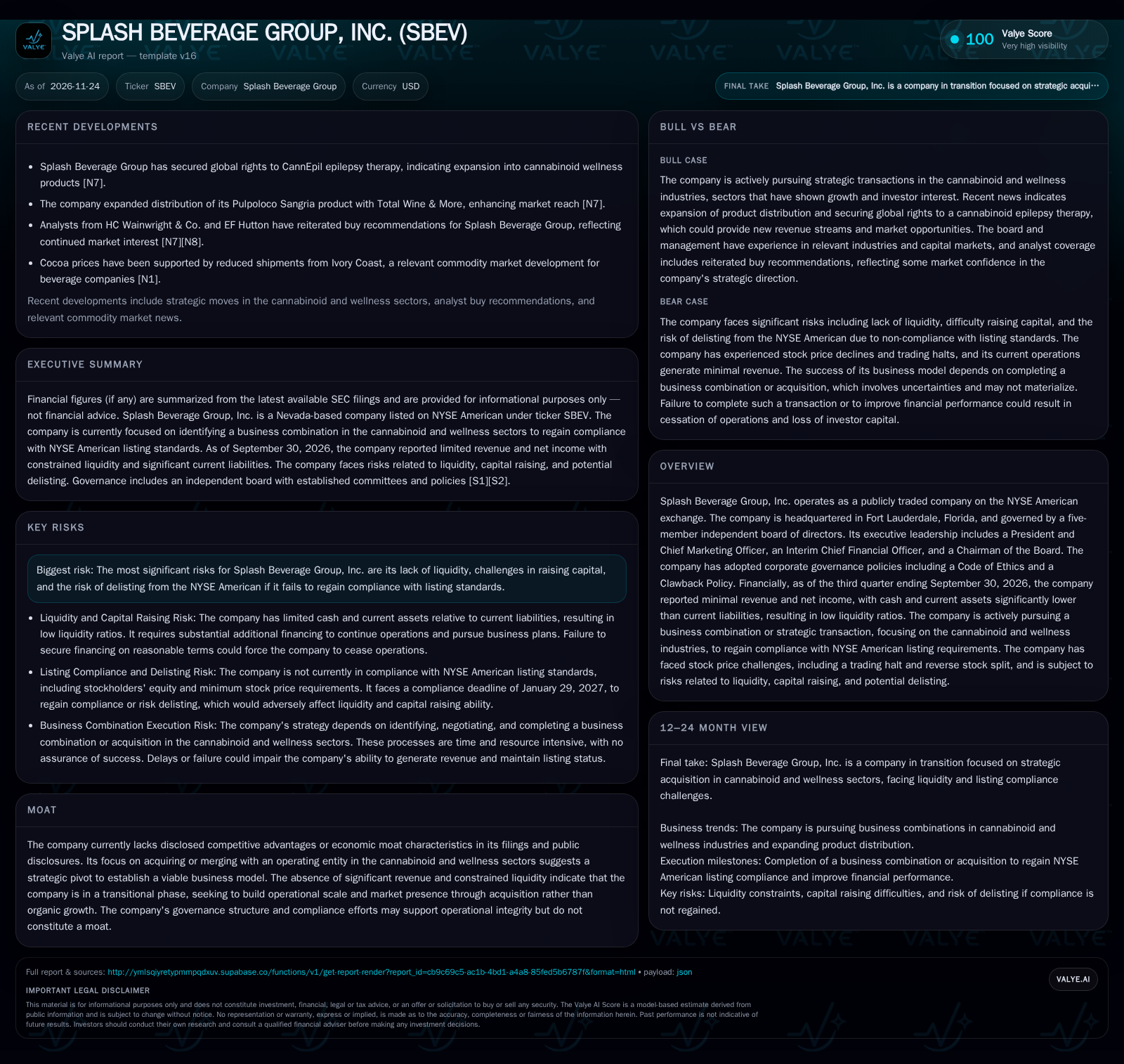
Splash Beverage Group has minimal cash and a large working capital deficit, with a compliance deadline from NYSE American. Recent efforts to secure cannabinoid wellness assets and expand product distribution show strategic intent, but the company’s future hinges on completing a transformative transaction and raising capital before January 2027 [S2] [N7] [N8].
Splash Beverage Group stands at a critical juncture, confronting a severe liquidity crisis while racing to execute a strategic pivot into the cannabinoid and wellness markets. Recent product distribution expansions and cannabinoid therapy licensing efforts illustrate a shift away from its legacy beverage focus, but the underlying economics and timeline for transformation remain highly uncertain.
Liquidity Crunch and Listing Deadline Define Near-Term Reality
As of September 30, 2026, Splash Beverage Group reported cash and cash equivalents of just $1,075,314, current assets of $1,881,615, and current liabilities totaling $15,621,463, yielding a current ratio of 0.12 and a cash ratio of 0.07 [S2]. This acute liquidity shortfall places the company at immediate risk of being unable to meet its obligations. NYSE American has issued a compliance plan, giving Splash until January 29, 2027, to regain listing standards, including stockholders’ equity and minimum share price requirements [S2]. The company recently underwent a trading halt and a reverse stock split in July 2026, reflecting the seriousness of its compliance and market-perception challenges [S2]. Recent strategic actions include securing global rights to a cannabinoid epilepsy therapy and expanding Pulpoloco Sangria distribution, signaling a pivot toward wellness and cannabinoid markets [N7] [N8].
The company reported cash and liquidity metrics for the period; these figures do not by themselves establish operating runway, investment capacity, financial flexibility, or financing capacity. In such scenarios, companies often face a trade-off between pursuing transformative deals that require time and resources versus opting for expedient but potentially suboptimal capital raises or asset sales. The pressure to meet NYSE American’s compliance deadline intensifies this dilemma, as failure to comply can trigger a cascade of negative market reactions, further impairing access to capital. Consequently, Splash’s management must balance the urgency of near-term survival with the long-term viability of its strategic pivot, a challenge compounded by limited financial runway and market skepticism.
Strategic Transaction as the Revenue Engine: Economics and Constraints
Splash Beverage’s current operating economics are unsustainable, with minimal revenue ($4,224 in the September 2026 quarter) and net income of $362,900 that likely reflects non-recurring items or accounting effects rather than robust underlying earnings [S2]. The company’s business model is in flux, with future economics hinging entirely on the nature and terms of a prospective business combination or acquisition in the cannabinoid and wellness sectors.
If Splash succeeds in acquiring rights to valuable cannabinoid therapies or wellness products, revenue generation could shift toward higher-margin, IP-driven models—such as licensing, royalties, or branded product sales—rather than traditional beverage distribution. However, such transitions typically require significant upfront investment in regulatory approvals, product development, and go-to-market buildout. The company’s current capital constraints severely limit its ability to fund these initiatives organically, making external financing or a merger with a cash-generative partner essential.
Operating leverage may be attainable if the acquired business has scalable digital or intellectual property elements, but fixed costs—especially those related to compliance, product development, and distribution infrastructure—could outpace revenue growth without swift execution and capital infusion.
A critical factor in evaluating Splash’s prospective business combination is the scalability and defensibility of the acquired asset’s revenue model. Licensing and royalty streams tied to proprietary cannabinoid therapies can offer attractive gross margins and recurring revenue profiles, but depend heavily on intellectual property protection and regulatory exclusivity. Conversely, branded product sales in wellness markets often require substantial marketing spend and distribution investments to achieve meaningful scale and consumer loyalty. Given Splash’s capital constraints, the economics of any acquisition will likely necessitate a partner or investor willing to underwrite upfront costs and commercialization risks. Additionally, the company’s ability to integrate new assets efficiently will influence operating leverage, as duplicative overhead or misaligned cost structures could dilute anticipated synergies.
Strategic Pivot Faces Crowded Wellness and Cannabinoid Landscape
Splash Beverage is attempting to reposition itself from a traditional beverage distributor toward the cannabinoid and wellness markets, both of which are highly competitive and rapidly evolving. In the cannabinoid sector, barriers to entry include regulatory uncertainty, IP protection, and the need for medical or scientific validation—factors that favor incumbents with established clinical data, distribution, and compliance infrastructure.
In beverage distribution, scale, brand equity, and shelf-space access are critical. The expansion of Pulpoloco Sangria distribution with Total Wine & More may provide incremental reach, but does not in itself confer a sustainable competitive advantage unless backed by strong consumer pull and favorable economics [N7].
Competitor categories include large wellness conglomerates, established pharmaceutical firms (for cannabinoid therapeutics), and diversified beverage companies with deeper pockets and more stable balance sheets. Without a defensible moat—such as proprietary IP, regulatory exclusivity, or unique distribution arrangements—Splash’s position will remain precarious, especially given its funding disadvantage.
The crowded nature of the wellness and cannabinoid markets implies that differentiation is paramount for Splash to establish a sustainable foothold. This differentiation could stem from unique clinical data supporting efficacy, exclusive licensing arrangements, or innovative delivery mechanisms that resonate with consumers or medical practitioners. However, regulatory environments remain fluid and fragmented across jurisdictions, potentially complicating product approvals, marketing claims, and distribution channels. Splash’s success will therefore depend not only on securing compelling assets but also on navigating complex compliance landscapes and forging strategic partnerships that enhance market access. Without such advantages, the company risks being marginalized amid better-capitalized incumbents with entrenched brand recognition and regulatory expertise.
Transformative Deal and Capital Raise: The Only Plausible Escape Velocity
The most favorable scenario for Splash Beverage involves the successful completion of a strategic business combination or acquisition that brings substantial revenue, cash flow, and access to new markets in the cannabinoid and wellness sectors. If the company is able to secure a differentiated asset—such as a cannabinoid therapy with regulatory approval or strong clinical prospects—and concurrently raises sufficient capital to fund development and commercialization, it could rapidly regain listing compliance and establish a credible growth narrative.
Confirmation of this scenario would require public disclosure of a signed acquisition agreement, evidence of new capital infusions (through equity or debt), and regulatory milestones or partnership announcements related to the newly acquired asset. Additional analyst upgrades or institutional investor participation would further validate the turnaround.
Interim Survival: Transaction Delays and Ongoing Cash Burn
The most plausible near-term outcome is a protracted search for a suitable business combination, characterized by continued cash burn and incremental strategic announcements (such as new product distribution deals or licensing agreements). In this scenario, Splash Beverage may announce letters of intent or non-binding term sheets but struggle to close a transformative deal before the January 2027 NYSE American deadline.
The company might pursue bridge financing or short-term capital raises to extend its runway, but these are likely to be dilutive and costly given its weak bargaining position. Evidence supporting this scenario would be the absence of a definitive acquisition or capital raise, continued low revenue, and persistent working capital deficits reported in subsequent filings.
Failure to Transact: Delisting and Potential Dissolution
If Splash Beverage is unable to secure a business combination, raise capital, or deliver a credible compliance plan by January 2027, the company will likely face delisting from NYSE American. In this scenario, access to public capital markets would be severely impaired, and the company might be forced to wind down operations or pursue a distressed sale of remaining assets.
Confirmation of this downside would be a public delisting notice, cessation of trading, or the announcement of liquidation or bankruptcy proceedings. Persistent inability to pay vendors, missed SEC filing deadlines, or the resignation of key executives would also signal imminent distress.
Milestones That Will Determine Splash Beverage’s Strategic Outcome
Public disclosure of a signed binding agreement for a business combination or acquisition in the cannabinoid or wellness sectors.
Announcement of a material capital raise or new financing arrangement sufficient to address near-term liquidity shortfalls.
Evidence of regulatory progress or clinical data releases related to the newly acquired cannabinoid therapy, if disclosed.
Updates on NYSE American compliance status, including any extensions or termination of the compliance plan.
Changes in board or executive leadership that signal strategic realignment or distress.
Material changes in product distribution footprint or licensing arrangements, especially with large-scale partners.
Subsequent quarterly filings showing improvement (or further deterioration) in working capital and revenue trajectory.
If disclosed, metrics on customer adoption, retention, or sales ramp for any acquired or newly launched wellness products.
Disclaimer: This is research-only, informational analysis and not investment advice. It may include AI-generated interpretation and general industry context. Always verify important details using primary sources.

Comments