
XWELL, Inc.: Strategic Divestitures Reshape the Wellness Platform’s Future
XWELL’s decision to divest its flagship XpresSpa and XpresTest businesses for $13 million marks a turning point, with implications for its business model, capital structure, and competitive positioning in the evolving wellness market.
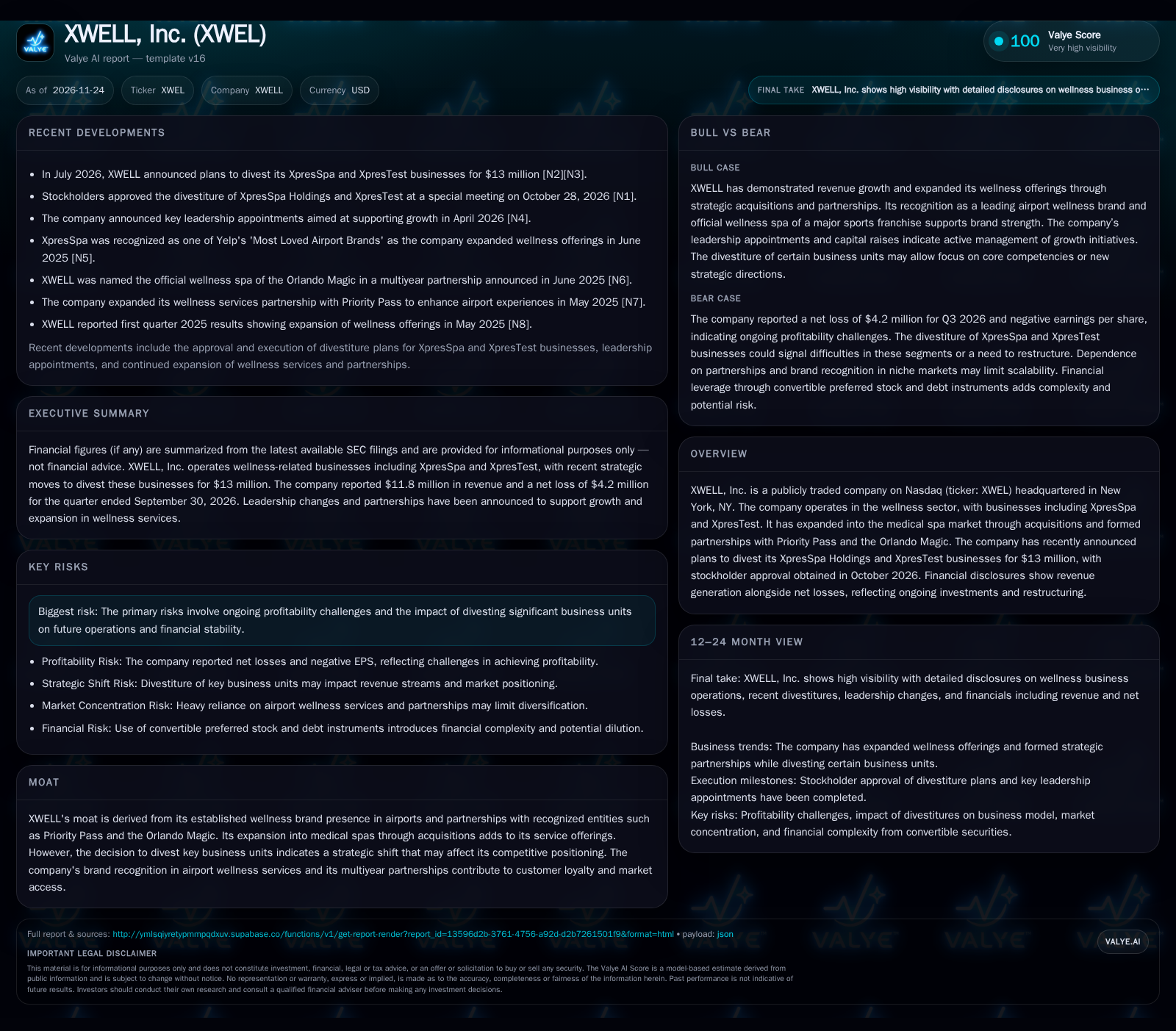
XWELL, Inc. (Nasdaq: XWEL) is undergoing a major transformation by selling its XpresSpa and XpresTest units for $13 million, following ongoing net losses and leadership changes. This divestiture shifts the company’s focus, potentially freeing capital and management bandwidth for new growth initiatives or further restructuring. The outcome will hinge on XWELL’s ability to leverage its remaining wellness assets, execute new partnerships, and address profitability challenges in a competitive, service-driven sector. [N2] [N3] [S2]
XWELL, Inc.’s announced sale of its foundational XpresSpa and XpresTest businesses for $13 million is a watershed event, redefining its operational and financial trajectory. This move arrives against a backdrop of persistent net losses, a reported cash balance, and ongoing efforts to broaden its wellness footprint through partnerships and acquisitions. The central question is whether XWELL can transition from a legacy airport wellness model to a nimbler, more profitable platform—leveraging new strategic directions, partnerships, and leadership, while managing the balance between capital needs and commercial opportunity.
Divestiture of Core Business Units Signals Strategic Overhaul
The most material development for XWELL is its July 2026 announcement to divest its primary XpresSpa and XpresTest businesses for $13 million, with shareholder approval following in October 2026. This transaction represents a decisive pivot away from the company’s long-standing focus on airport-based wellness and COVID-19 testing services. For Q3 2026, XWELL reported $11.8 million in revenue and a net loss of $4.2 million, reflecting ongoing profitability challenges. As of September 30, 2026, the company held $9.5 million in cash and equivalents, and reported liquidity-ratio trends of 1.56. These facts underscore that XWELL is in the midst of a major strategic and financial reset, with the outcome likely dependent on how it redeploys the proceeds and repositions its remaining assets. [N2] [N3] [S2]
Economic Model in Transition: From Foot Traffic to Flexible Wellness
Historically, XWELL’s economics were tied to transaction-driven services in high-traffic airport locations, where revenue per square foot, occupancy costs, and labor utilization drove profitability. The company’s foray into COVID-19 testing temporarily boosted volumes, but pandemic-era tailwinds have waned. The sale of XpresSpa and XpresTest removes these core revenue streams, leaving the economic model in flux.
Post-divestiture, XWELL's revenue sources may shift toward medical spa services, non-airport wellness offerings, and potentially new digital or partnership-driven models. The capital-light nature of some wellness services—such as franchised or pop-up spa concepts, or digitally mediated wellness experiences—could reduce fixed costs and increase operating leverage if executed efficiently. However, success in these areas typically requires strong brand equity, customer acquisition capabilities, and effective integration of technology or partnerships.
The company reported cash and liquidity metrics for the period; these figures do not by themselves establish operating runway, investment capacity, financial flexibility, or financing capacity. The use of convertible preferred stock and debt adds another layer of complexity, as future dilution or interest costs could erode returns if profitability does not improve.
Brand Equity and Partnerships: Strengths Tempered by Market Realities
XWELL’s competitive edge has historically come from its brand presence in airports and partnerships with organizations such as Priority Pass and the Orlando Magic. The recognition of XpresSpa as a top airport wellness brand attests to customer loyalty and market access, but these advantages are now at risk with the divestiture of core assets.
In the broader wellness industry, competition is intense and fragmented, ranging from boutique medical spas and fitness studios to large health club chains and digital wellness platforms. Barriers to entry are moderate, but differentiation often hinges on brand, service quality, and strategic partnerships. If XWELL can leverage its remaining brand equity and forge new alliances, it may carve out a niche in medical spa or experiential wellness markets.
On the other hand, the company faces the challenge of reestablishing its value proposition outside the airport channel and must contend with established local and national wellness brands, as well as emerging digital-first competitors. The success of partnerships such as the Orlando Magic deal will be instructive in gauging XWELL’s ability to attract new clientele and diversify its revenue base.
Strategic Reinvestment Unlocks Higher-Margin Wellness Opportunities
The most optimistic scenario for XWELL is that the $13 million in proceeds from divestitures, combined with a leaner operating structure, enables reinvestment into higher-margin, scalable wellness businesses. This could include expanding into the medical spa segment, pursuing asset-light franchising models, or developing proprietary wellness products and digital services.
Confirmation of this scenario would include evidence of new revenue streams ramping quickly, improved gross and operating margins, and successful execution of additional partnerships or acquisitions that complement the company’s strategic direction. Announcements of contracts with major brands or the rollout of new service concepts in high-traffic, non-airport locations would further validate the pivot.
Key falsifiers would be a lack of revenue traction post-divestiture, continued net losses without clear path to profitability, or inability to deploy capital in ways that create sustainable differentiation.
Pivot Yields Transitional Volatility and Uncertain Revenue Rebuild
The most plausible near-term outcome is that XWELL experiences a period of operational and financial volatility following the divestiture of its principal businesses. Revenue is likely to decline in the short term as the company rebuilds its portfolio, while costs may remain elevated due to restructuring, integration of new initiatives, or legacy obligations tied to preferred stock and convertible debt.
If XWELL can leverage its existing partnerships and brand recognition to secure new wellness contracts—particularly in the medical spa or experiential wellness sectors—revenue could gradually recover. However, success is far from assured, and the company’s ability to execute on new business models, control costs, and avoid excessive dilution will be critical.
Evidence confirming this scenario would be stabilization of cash burn, modest revenue growth from new business lines, and incremental margin improvement. Persistent losses, failure to launch new initiatives, or strategic drift would suggest a weaker base case.
Divestiture Proceeds Depleted Without Sustainable Profit Model
In a negative scenario, XWELL fails to replace the divested revenue streams with profitable new operations, burning through the $13 million windfall and existing cash without establishing a viable growth engine. Integration missteps, underwhelming demand for new services, or intensifying competition could all contribute to this outcome.
Compounding risks include the drag of convertible preferred stock and debt, which could lead to further dilution or financial strain if losses persist. Market concentration in niche wellness offerings or overreliance on a narrow set of partnerships could expose the company to sudden revenue shocks.
Confirmation of this scenario would be continued net losses, declining cash balances, inability to secure new contracts or partnerships, and adverse changes to capital structure (e.g., forced financings or unfavorable conversions).
Milestones That Will Reveal XWELL’s Post-Divestiture Direction
Evidence of new revenue streams replacing the divested XpresSpa and XpresTest businesses, including the pace and mix of medical spa, partnership, or digital service launches.
Gross and operating margin trends in new business lines—if disclosed—that would indicate improved unit economics or operating leverage.
Cash burn rate and changes in cash and equivalents quarter over quarter, as a measure of financial runway and capital deployment efficiency.
Announcements of major partnerships, contracts, or acquisitions that expand XWELL’s wellness platform beyond airport-centric offerings.
Updates on the structure and terms of convertible preferred stock and debt, including any conversions, redemptions, or new issuances.
Management commentary or disclosures on strategic priorities, capital allocation, and timeline for achieving break-even or profitability.
Retention and effectiveness of recently appointed leadership team members, and their impact on execution and culture.
Disclaimer: This is research-only, informational analysis and not investment advice. It may include AI-generated interpretation and general industry context. Always verify important details using primary sources.

Comments