
CID Holdco: AI-Driven Asset Tracking Meets Scale Ambitions and Severe Financial Constraints
CID Holdco operates a SaaS asset tracking platform integrating RFID and AI-enabled cameras for real-time, precision tracking in sectors like construction, military, and logistics.
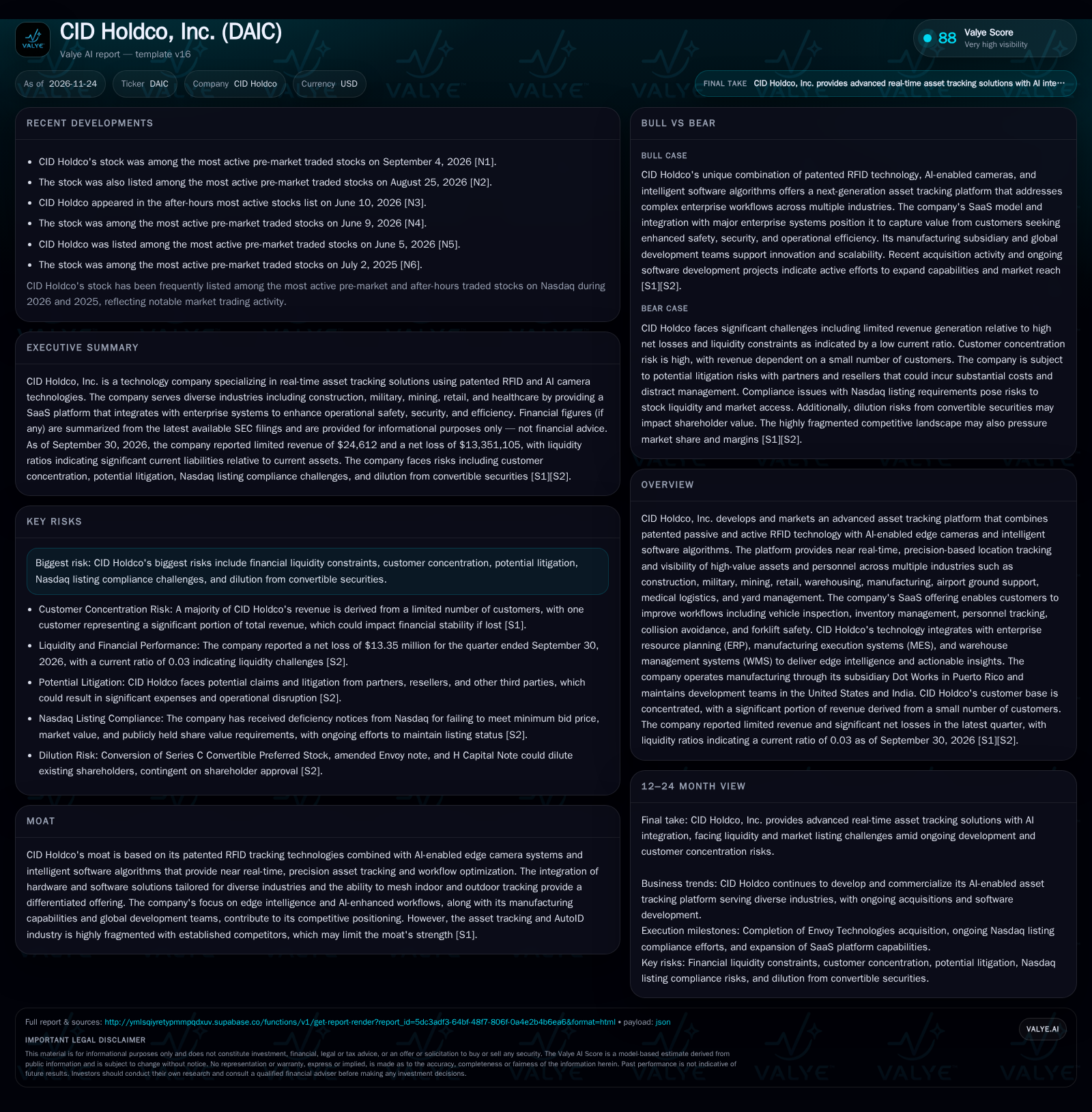
CID Holdco operates a SaaS asset tracking platform integrating RFID and AI-enabled cameras for real-time, precision tracking in sectors like construction, military, and logistics. Despite technological differentiation and recent acquisition of Envoy Technologies, the company is severely constrained by high net losses, a current ratio of 0.03, and extreme customer concentration. Nasdaq listing compliance and potential dilution from convertible securities add further risk, making commercial scaling and financial stabilization urgent priorities [S1] [S2].
CID Holdco, Inc. exemplifies the promise and peril of next-generation asset tracking: its patented blend of RFID, AI-enabled edge cameras, and SaaS workflow software aims to transform how industries manage and secure high-value assets in real time. Yet, while the technology stack and integration breadth are compelling, the company faces an existential financial squeeze—revenue remains minimal versus persistent, outsized net losses, and its current ratio of just 0.03 signals acute liquidity distress. Layered atop this are customer concentration risks, looming dilution from recent acquisitions, and ongoing Nasdaq compliance struggles, all of which force the question: Can CID Holdco commercialize its innovation before financial headwinds overwhelm its runway?
Acquisition, Liquidity Crisis, and Customer Concentration Shape Immediate Outlook
Several material facts define CID Holdco’s current position. First, the company closed the acquisition of Envoy Technologies in October 2026, issuing both common and Series C Convertible Preferred Stock in the process—a move that could dilute existing shareholders if conversion occurs upon shareholder approval [S2]. The company reported a current ratio of 0.03 for the period. [S2] Third, revenue remains modest, with just $24,612 reported for the latest quarter and a net loss of $13.35 million, indicating a business that is still in early commercialization relative to its cost base [S2]. Finally, customer concentration is pronounced, with one client accounting for a significant share of revenue—a structure that leaves CID Holdco highly vulnerable to any customer churn or renegotiation [S1].
How the SaaS-Plus-Hardware Model Could Scale—And Where It Strains
CID Holdco’s core business model blends SaaS recurring revenue with hardware sales and integration, leveraging patented RFID and AI-enabled edge devices to provide real-time asset visibility. The company’s revenue sources likely include upfront hardware (RFID tags, readers, AI cameras), ongoing SaaS fees for platform access, and possibly professional services for deployment and integration. If SaaS adoption scales, the recurring element could drive attractive gross margins and high operating leverage—typical in software-centric models. However, the cost structure is currently dominated by R&D and personnel, as indicated by the company’s focus on software development and global engineering teams [S1].
In practice, the economics hinge on several factors: the mix of hardware versus software revenue (hardware often lower margin), pricing power in a fragmented market, and the ability to amortize fixed engineering and infrastructure costs over a growing customer base. With current revenues minimal and losses steep, CID Holdco is not yet demonstrating positive operating leverage. High customer concentration further limits pricing flexibility and negotiating strength. [S1] [S2]
Defensible Technology Meets a Fragmented, Price-Sensitive Market
CID Holdco’s moat rests on its patented RFID innovations and the integration of AI-enhanced cameras and edge intelligence, which together offer precision tracking and workflow optimization across complex, high-value environments [S1]. The platform’s ability to mesh indoor and outdoor tracking and integrate with enterprise systems like ERP and WMS is a differentiator relative to basic RFID solutions. However, the asset tracking and AutoID sector is highly fragmented, populated by established incumbents (e.g., Honeywell, Zebra Technologies), niche specialists, and a growing cohort of software-first IoT entrants.
Switching costs for large enterprise customers can be meaningful if CID Holdco’s system is deeply integrated into operational workflows and data streams. Still, the company’s limited scale, acute customer concentration, and lack of demonstrated recurring revenue breadth undermine negotiating power and long-term retention. Competitive counterforces include rapid commoditization of RFID hardware, declining sensor costs, and the ongoing convergence of IoT, computer vision, and cloud-based analytics—areas where larger, better-funded rivals can outspend and out-integrate. The question is whether CID Holdco’s IP and workflow focus are enough to defend share and pricing as the industry matures.
Unlocking Platform Leverage: What Success Would Look Like
A favorable scenario for CID Holdco would see the successful integration of Envoy Technologies expanding the customer base and solution breadth, while the company converts pilots and early deployments into multi-site, multi-year SaaS contracts. If the platform’s integration with ERP/MES/WMS systems proves sticky and delivers quantifiable efficiency or safety gains, customers may accept higher switching costs and renew at premium pricing.
Confirmation would come from a shift in revenue mix toward recurring SaaS fees, sequential growth in contracted customers, and gross margin improvement as fixed costs are spread across more deployments. Additional signs would include customer wins in new verticals, reduction in customer concentration, and successful navigation of Nasdaq compliance, preserving public market access for further capital raises. Falsification would be evident if the Envoy acquisition fails to deliver revenue synergies, if recurring revenue remains stagnant, or if customer churn increases due to pricing or integration failures.
Survival-Driven Commercialization Amid Financial Headwinds
The most plausible near-term trajectory is one of constrained commercialization. CID Holdco may continue to develop and market its platform to a handful of key verticals, with incremental customer additions and gradual product enhancements. However, the company’s severe liquidity constraints and ongoing net losses force a focus on cost discipline, customer retention, and short-term cash generation over aggressive expansion.
Execution risk remains high: the company's ability to negotiate payment terms, secure bridge financing, or restructure obligations will likely determine operational continuity. Nasdaq Capital Market listing may be preserved, but the threat of further dilution looms if additional equity or convertible securities are issued. Evidence for this scenario would be flat or modestly rising revenues, persistent customer concentration, continued losses, and periodic regulatory or financing updates. Falsification would occur if the company either rapidly accelerates revenue growth and margin expansion (signaling upside) or fails to meet obligations, triggering forced asset sales or delisting (downside).
Liquidity Exhaustion and Customer Loss: The Double-Edged Threat
[S2] A loss or renegotiation by its largest customer could precipitate a rapid collapse in revenue, forcing layoffs, asset sales, or restructuring.
Further Nasdaq delisting could restrict access to capital markets, compound negative sentiment, and make it difficult to attract new customers or partners. In this scenario, evidence would include declining revenues, increased accounts payable or legal accruals, workforce reductions, and urgent financing or asset disposition announcements. Falsification would require a demonstrable improvement in working capital, new customer acquisitions, or a credible financing agreement that extends the company’s operational runway.
Milestones That Will Determine Whether Innovation Can Outrun Financial Gravity
Customer concentration trend: Any reduction in the share of revenue from the largest customer or announcements of new major clients would signal progress toward a more durable revenue base.
Revenue mix evolution: A shift toward higher recurring SaaS revenue and away from one-time hardware sales would help validate the long-term margin thesis, if disclosed.
Gross margin trajectory: Improvement here would indicate operating leverage and greater value capture from software and services.
Nasdaq listing status: Updates on compliance, panel decisions, or further deficiency notices will directly impact capital access and investor sentiment.
Working capital changes: Quarterly trends in current assets and liabilities will provide early warning of liquidity inflection points.
Envoy Technologies integration: Evidence of revenue synergies, customer cross-sell, or platform enhancements stemming from the acquisition would support the expansion thesis.
Litigation or partner dispute disclosures: New claims, settlements, or legal provisions could trigger unexpected expenses or operational distractions.
Dilution events: Announcements regarding conversion of preferred stock, new equity issuance, or shareholder votes on capital structure would affect per-share value and investor confidence.
Disclaimer: This is research-only, informational analysis and not investment advice. It may include AI-generated interpretation and general industry context. Always verify important details using primary sources.

Comments