
OLB Group: Merchant Services, AI Ambitions, and the Quest for Sustainable Economics
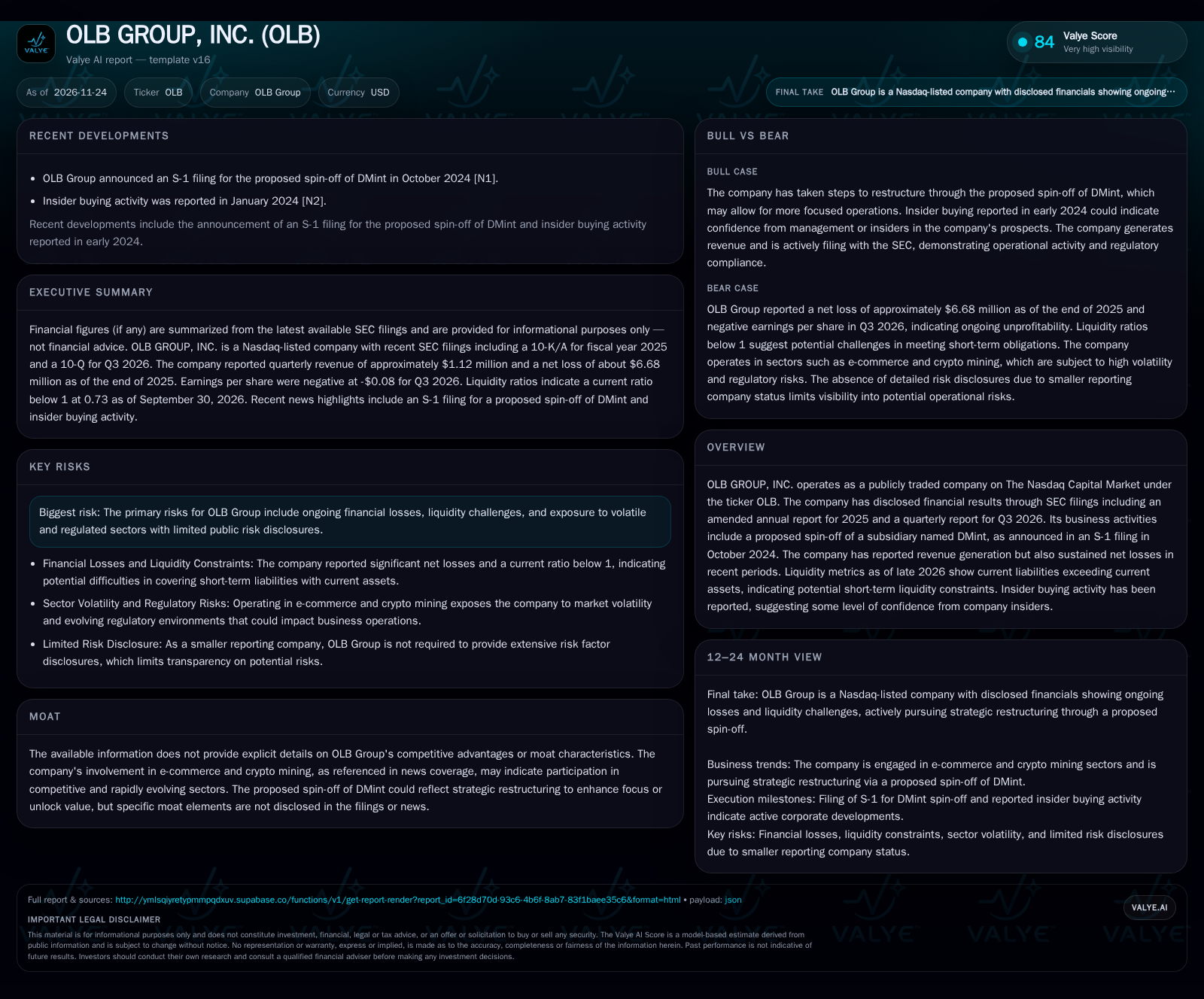
OLB Group reported $1.12 million in Q3 2026 revenue and a net loss of $6.68 million for 2025, with current liabilities exceeding current assets as of September 30, 2026.
OLB Group reported $1.12 million in Q3 2026 revenue and a net loss of $6.68 million for 2025, with current liabilities exceeding current assets as of September 30, 2026 [S2]. The company is pursuing a spin-off of its DMint subsidiary and developing AI-driven fintech solutions, but remains dependent on its eVance merchant services business.
The company is doubling down on fintech and AI-enabled solutions, while seeking to unlock value—and perhaps operational focus—by spinning off its DMint crypto mining subsidiary. The question now is whether these strategic moves can meaningfully improve economics, or whether OLB Group will remain trapped in a cycle of operational reinvention without scalable profitability.
Recent Results Reveal Persistent Losses and Liquidity Constraints
OLB Group reported $1,123,953 in revenue for the quarter ended September 30, 2026, but has not stemmed the tide of losses, recording a net loss of $6,679,681 as of December 31, 2025 [S2]. As of September 30, 2026, current assets stood at $4.29 million against current liabilities of $5.89 million, resulting in a current ratio of 0.73 and a cash ratio of zero [S2]. The company reported cash and liquidity metrics for the period; these figures do not by themselves establish operating runway, investment capacity, financial flexibility, or financing capacity. [S2] The company is actively pursuing the spin-off of its DMint subsidiary, as announced in October 2024, signaling an attempt to refocus or streamline its operations [N1]. While insider buying activity was reported in January 2024 [N2], the core financial picture is defined by sustained unprofitability and a pressing need for operational improvement.
How OLB Group’s Model Generates—and Burns—Cash
OLB Group operates primarily through two segments: Fintech Services (dominated by eVance) and Bitcoin Mining (via DMint, which is proposed for spin-off) [S2]. The Fintech Services segment generates revenue from merchant payment processing, transaction fees, hardware rentals, and value-added services such as e-commerce development and AI-driven applications. The company’s proprietary SecurePay™ payment gateway, along with AI-enabled platforms like iStores AI and ShopFast AI, are designed to provide differentiated merchant experiences and operational efficiencies.
In the current structure, OLB’s cost base appears to be a mix of fixed product development and technology costs (especially with ongoing AI and software initiatives) and variable costs tied to transaction volume and merchant acquisition. The company’s heavy losses suggest that current scale is insufficient to cover overhead or to generate operating leverage. If the AI-enabled solutions or new platform launches can attract higher-margin business or new sources of recurring revenue, this could improve gross margins and spread fixed costs; however, these initiatives are still in development or early rollout stages.
The Bitcoin Mining segment, pending the DMint spin-off, is capital-intensive and exposed to commodity-like volatility in crypto prices and mining difficulty. Spinning off DMint could reduce capital intensity and focus OLB on service-based, potentially higher-margin fintech economics—provided the core merchant services business can scale.
Positioning in a Crowded Fintech Landscape
OLB operates in highly competitive arenas: merchant payment processing and fintech software. In merchant services, it competes with established processors, integrated payment platforms, and niche SaaS providers targeting small and mid-sized businesses. The competitive environment is characterized by pricing pressure, rapid technological innovation, and frequent regulatory change.
OLB’s attempt to differentiate through proprietary AI-enabled solutions and integrated hardware/software offerings may help win or retain merchants seeking advanced fraud detection, dynamic risk scoring, or omnichannel commerce support. However, the company remains heavily dependent on its eVance business, with limited evidence so far of successful cross-sell or upsell into its newer software and AI lines. The ability to integrate AI capabilities for underwriting, risk management, and customer support could reduce friction and improve margins if adopted at scale, but larger competitors are also investing heavily in these areas.
The DMint crypto mining unit, while potentially a source of upside in favorable market conditions, exposed OLB to volatility and capital requirements that are less compatible with a SaaS or fee-based fintech model. The proposed spin-off may allow for greater focus and differentiation—but also removes a potential source of high-beta revenue in crypto upcycles.
AI-Driven Merchant Solutions Enable Profitable Scale
The bull thesis for OLB Group hinges on the successful commercial deployment of its AI-enabled fintech solutions, leading to broader merchant adoption, higher-value contracts, and improved operating leverage. If the company can demonstrate that its proprietary SecurePay™ gateway, ShopFast AI, and iStores AI platforms deliver tangible value—such as lower fraud rates, faster onboarding, or superior omnichannel commerce tools—OLB could shift its revenue mix toward higher-margin, recurring software and service fees.
Confirmation of this scenario would require evidence of accelerating merchant onboarding on the new platforms, rising average revenue per merchant, and a clear uptrend in gross margin. Successful rollout and adoption of features like real-time fraud detection, dynamic risk scoring, and integrated AI customer support could differentiate OLB from commodity processors. The DMint spin-off, if completed, could also clarify the company’s focus and free management bandwidth and capital for fintech growth.
Falsification would come from continued revenue concentration in legacy eVance services, lack of traction for new offerings, or margin compression from competitive pricing pressure.
Incremental Growth and Ongoing Liquidity Tension
The most plausible trajectory is that OLB Group continues to generate modest revenue growth from its merchant services platform, but struggles to materially improve margins or move the needle on profitability in the near term. The company’s new AI-enabled products may be adopted by some merchants or ISOs, but are unlikely to deliver rapid, transformative growth unless supported by significant sales execution, partner/channel expansion, or demonstrable differentiation.
The DMint spin-off, if completed, may streamline operations but is not guaranteed to resolve underlying profitability or working capital issues. Confirmation of this scenario would come from still-negative operating margins, lack of material diversification in revenue sources, and continued reliance on legacy eVance transaction processing.
Liquidity Pressures Force Restructuring or Strategic Retreat
If OLB fails to improve its operating economics or secure external funding, the acute liquidity shortfall could force the company into a distressed restructuring, asset sales, or even insolvency.
Further, if the DMint spin-off stalls or fails to unlock value, and new AI-driven platforms do not gain merchant adoption, OLB could be left with a shrinking, low-margin transaction processing business in a hyper-competitive landscape. Evidence for this scenario would include deepening net losses, working capital deficits, missed product development or rollout milestones, and the absence of meaningful financing or strategic alternatives.
Testing the OLB Thesis: Concrete Evidence to Track
Completion and terms of the DMint spin-off: Did the transaction close, and what financial or operational impact does it have on OLB’s balance sheet and focus?
Adoption rates for AI-enabled platforms: Merchant onboarding and retention metrics for ShopFast AI, iStores AI, and SecurePay™, if disclosed, would indicate traction beyond legacy business.
Revenue concentration by segment: A shift away from eVance dependence toward software or platform-driven revenue would support the thesis of business model transformation.
Gross margin trends: Improvement in gross margin, especially from software or value-added services, would suggest successful scaling of higher-margin offerings.
Operating cash flow and working capital movements: Sustained negative cash flow or persistent working capital deficits would signal ongoing distress; positive shifts would indicate stabilization.
Access to external financing or strategic capital: Announcements of new debt, equity, or partnership funding would be crucial for near-term survival and investment capacity.
Product development and rollout milestones: The commercial availability and merchant uptake of new AI and platform features, as evidenced by customer case studies or contract wins, would help test the adoption thesis.
Disclaimer: This is research-only, informational analysis and not investment advice. It may include AI-generated interpretation and general industry context. Always verify important details using primary sources.

Comments