
Nuburu’s Strategic Pivot: Defense Acquisition, Integration Risks, and the Burden of Complexity
Nuburu’s acquisition of a majority stake in Tekne marks a dramatic expansion from advanced lasers into military vehicles and electronic warfare, but this diversification brings formidable integration, regulatory, and financial hurdles. The company’s ability to absorb Tekne’s complexity, manage fixed obligations, and restore internal control credibility will determine if this gamble transforms Nuburu’s prospects or compounds its challenges.
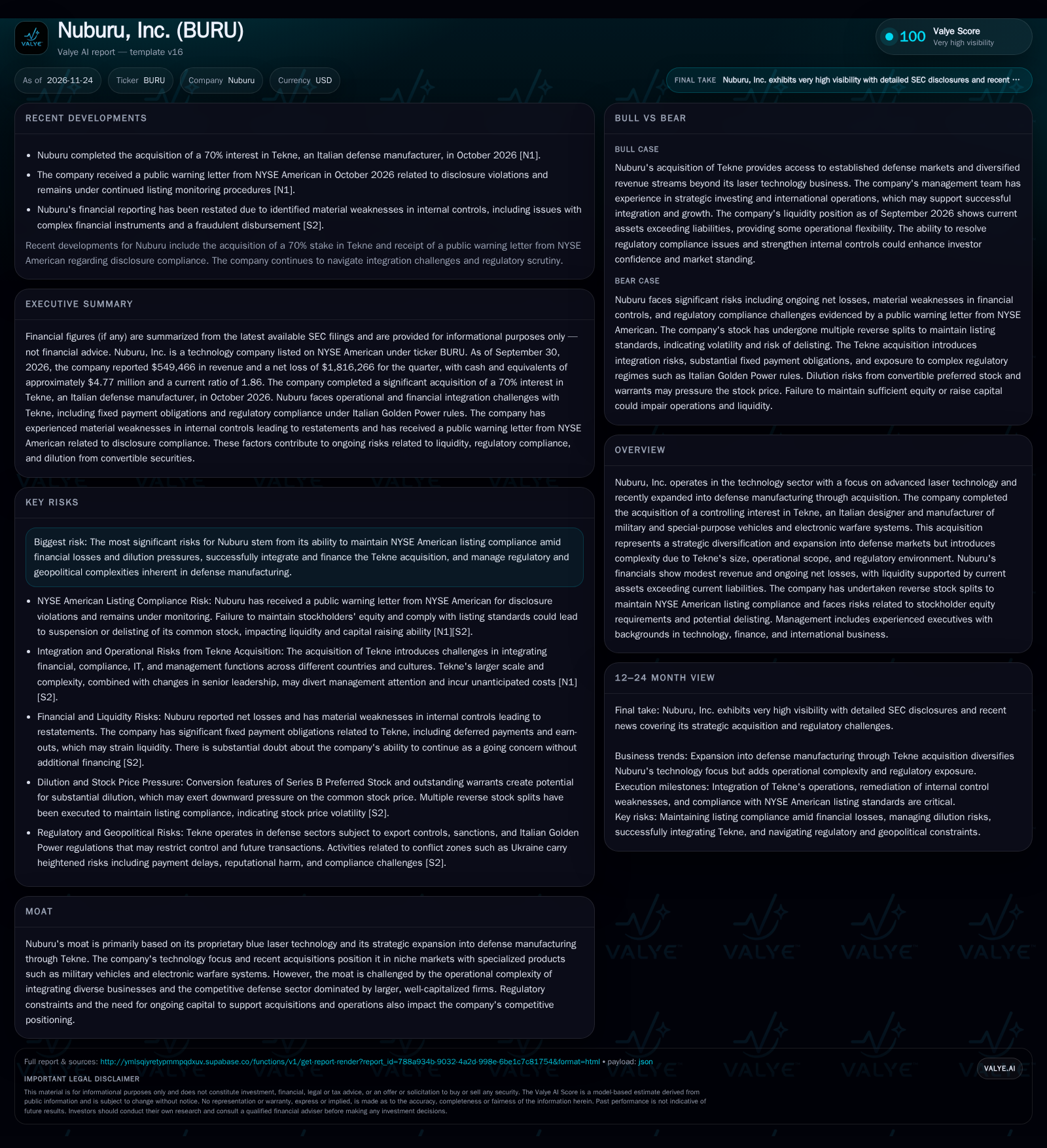
Nuburu has shifted its profile with the acquisition of a controlling interest in Tekne, an Italian defense manufacturer, adding significant scale and operational complexity. While this move offers exposure to defense markets and potential revenue diversification, it also introduces integration risk, large fixed payment obligations, and regulatory challenges under Italian Golden Power rules. Ongoing material weaknesses in financial controls and a public warning from NYSE American underscore the urgency of remediation and effective execution. The path forward will hinge on Nuburu’s ability to deliver operational integration, comply with listing standards, and manage liquidity under pressure.[S2] [N1]
Nuburu, once focused on blue laser technology, has fundamentally reshaped its business profile through the acquisition of a 70% stake in Tekne, an Italian defense manufacturer. This bold move offers access to established defense markets and the potential for diversified revenues, but it also brings daunting operational, financial, and regulatory complexity. With modest current revenues, persistent losses, and a record of internal control weaknesses, Nuburu’s future now hinges on its ability to integrate Tekne, meet new financial obligations, and satisfy demanding compliance regimes. The next year will be a critical proving ground for management’s strategic vision and execution discipline.
How Nuburu’s Acquisition of Tekne Reshapes the Risk and Opportunity Profile
Nuburu’s October 2026 acquisition of a 70% stake in Tekne, an Italian defense manufacturer specializing in military vehicles and electronic warfare, is the most consequential development for the company’s business model and risk profile.[N1] [S2] This acquisition instantly multiplies Nuburu’s operational scale and exposes it to a highly regulated, government-facing sector. The integration challenge is substantial: Tekne is not only larger than Nuburu’s historical laser business, but also operates in a different jurisdiction, with its own compliance, IT, and reporting requirements.[S2] The deal brings with it significant fixed payment obligations, including deferred and earn-out payments totaling up to €20 million, with guaranteed minimum annual outflows.[S2] Meanwhile, Nuburu continues to report modest revenue ($549,466 for Q3 2026) and ongoing losses, and remains under NYSE American listing scrutiny following a public warning about disclosure violations.[N1] [S2] The company’s internal controls have been flagged for material weaknesses and restatements, further raising the stakes for credible execution and governance.[S2]
The Economics of Diversification: From Laser Technology to Defense Contracting
Nuburu’s core economics have shifted from the uncertain, R&D-intensive world of advanced lasers to the capital-heavy, contract-driven economics of defense manufacturing. Historically, the company faced modest revenue and persistent losses, with high R&D costs and uncertain commercial traction in lasers.[S2] The Tekne acquisition introduces a new revenue engine: government and public-sector contracts, often in the form of multi-year, fixed-price arrangements for military vehicles and electronic warfare systems. These contracts can offer stable revenue streams and high barriers to entry, but also expose the company to cost overrun risk, delayed payments due to budget cycles, and the need for substantial upfront investment in capacity, compliance, and working capital.
The fixed payment obligations—up to €20 million in deferred and earn-out payments—represent a material new drain on cash flows and increase the company’s leverage and fixed-cost base.[S2] While current assets exceed current liabilities (current ratio 1.86 as of September 30, 2026), Nuburu’s cash position ($4.77 million) is thin relative to its new obligations, and the company remains loss-making at the operating level. The company reported cash and liquidity metrics for the period; these figures do not by themselves establish operating runway, investment capacity, financial flexibility, or financing capacity. [S2]
Defense Sector Entry: Competitive Stakes and Barriers for a Newcomer
Tekne’s established presence in military vehicles and electronic warfare systems gives Nuburu immediate access to defense-sector contracts, but the competitive landscape is challenging. The sector is dominated by large, entrenched incumbents with deep government relationships, established compliance processes, and scale-driven cost advantages. Winning and retaining contracts often depends not just on technological differentiation, but also on proven delivery, regulatory compliance, and political factors.
Nuburu’s historical moat—proprietary blue laser technology—may offer niche value in directed-energy or non-kinetic defense applications. However, the integration of Tekne means the company is now competing in a broader field where product breadth, reliability, and the ability to navigate government procurement cycles are critical. Regulatory constraints such as Italian Golden Power rules and EU/US export controls further complicate competitive positioning by limiting operational flexibility and strategic options for Tekne.[S2]
The company’s relatively small scale compared to major defense contractors may limit its bargaining power and ability to absorb contract overruns or delays. However, if Nuburu can leverage Tekne’s local relationships, agility, and specialized offerings, it could carve out defensible niches in European and targeted international defense markets.
What a Successful Integration and Defense Pivot Would Look Like
The most bullish scenario for Nuburu is a rapid, disciplined integration of Tekne, enabling the company to stabilize its financials and establish a credible, diversified platform in defense technology. Success would be characterized by the conversion of Tekne’s contract backlog into growing, recurring cash flows; realization of cross-selling or technology synergies between laser and defense product lines; and remediation of material weaknesses in internal controls, restoring regulatory compliance and investor confidence.
Evidence that would confirm this scenario includes: consistent revenue growth attributed to Tekne contract execution; improved gross and operating margins as integration costs are absorbed; timely fulfillment of fixed payment obligations from operating cash flow rather than external financing; and removal of NYSE American listing warnings or internal control deficiencies. Announcements of new contract wins, especially multi-year government deals, and evidence of successful navigation of Golden Power or export regulations would further validate the upside case.
Complexity and Execution Risk Dominate Near-Term Prospects
The most plausible path for Nuburu is a period of operational turbulence as the company digests the Tekne acquisition. Integration costs and deferred payment obligations are likely to weigh on cash flows, and management will be tested by the need to harmonize financial reporting, IT, and compliance across jurisdictions. Revenue may grow as Tekne contributes, but margins could remain under pressure due to integration expenses, cost overruns on fixed-price contracts, and ongoing investment in compliance and internal control remediation.
Confirmation of this scenario would include choppy or modest revenue growth, continued net losses, and persistent regulatory scrutiny or listing warnings. If Nuburu can demonstrate gradual improvement in internal controls and meet its fixed obligations without dilutive financings or asset sales, it would suggest the company is stabilizing, albeit at a lower level of profitability and with heightened risk. Failure to resolve disclosure or control issues, or to deliver on Tekne’s contract pipeline, would tilt the base case toward further distress.
Integration Failure, Regulatory Traps, and Funding Shortfalls
The negative scenario for Nuburu is defined by failed integration of Tekne, leading to operational disarray, contract losses, or cost overruns that overwhelm cash flows. If the company cannot meet its fixed payment obligations from operations, it may be forced into dilutive financings, asset sales, or even face insolvency risk. Persistent or worsening material weaknesses in internal controls could trigger further restatements, regulatory penalties, or loss of investor and customer trust.
A critical threat is the company’s exposure to government contract cycles and regulatory regimes. Adverse changes in Italian Golden Power enforcement, export controls, or local political priorities could restrict Tekne’s ability to win or execute contracts, or even force divestitures. Continued NYSE American listing violations could result in delisting, further constraining access to capital. Any evidence of missed earn-out payments, major contract losses, or new fraud/control issues would confirm the downside scenario.
Milestones and Metrics That Will Shape Nuburu’s Strategic Outcome
Progress on Tekne integration: Timely harmonization of financial, IT, and compliance systems across Nuburu and Tekne, as evidenced by improved reporting and absence of new restatements.
Government contract wins and backlog: Announcements of new defense contracts, especially multi-year or high-value awards, and disclosure of Tekne’s order book if available.
Cash flow from operations versus fixed obligations: Operating cash flow consistently exceeding required deferred and earn-out payments related to the Tekne acquisition.
Internal control remediation: Auditor or management reports confirming closure of material weaknesses in financial reporting and absence of fraudulent disbursements.
Resolution of NYSE American listing status: Formal removal of warning letters or compliance monitoring, and maintenance of required stockholders’ equity.
Dilution and capital structure: Disclosures on Series B Preferred Stock conversions, warrant exercises, and any new equity or debt financings that affect dilution risk.
Impact of Italian Golden Power and export controls: Regulatory filings or company statements on how these regimes affect Tekne’s operations, contract eligibility, or strategic options.
Recurring revenue and margin trends: Quarterly updates on revenue mix, gross margin, and whether Tekne’s contribution is offsetting integration and compliance costs.
Disclaimer: This is research-only, informational analysis and not investment advice. It may include AI-generated interpretation and general industry context. Always verify important details using primary sources.

Comments