
Sound Cave Technology: Funding Precarity and the Challenge of Smart Textile Commercialization
Sound Cave Technology Inc. is an early-stage venture aiming to merge wearable tech with mainstream apparel through a Bluetooth-enabled hoodie.
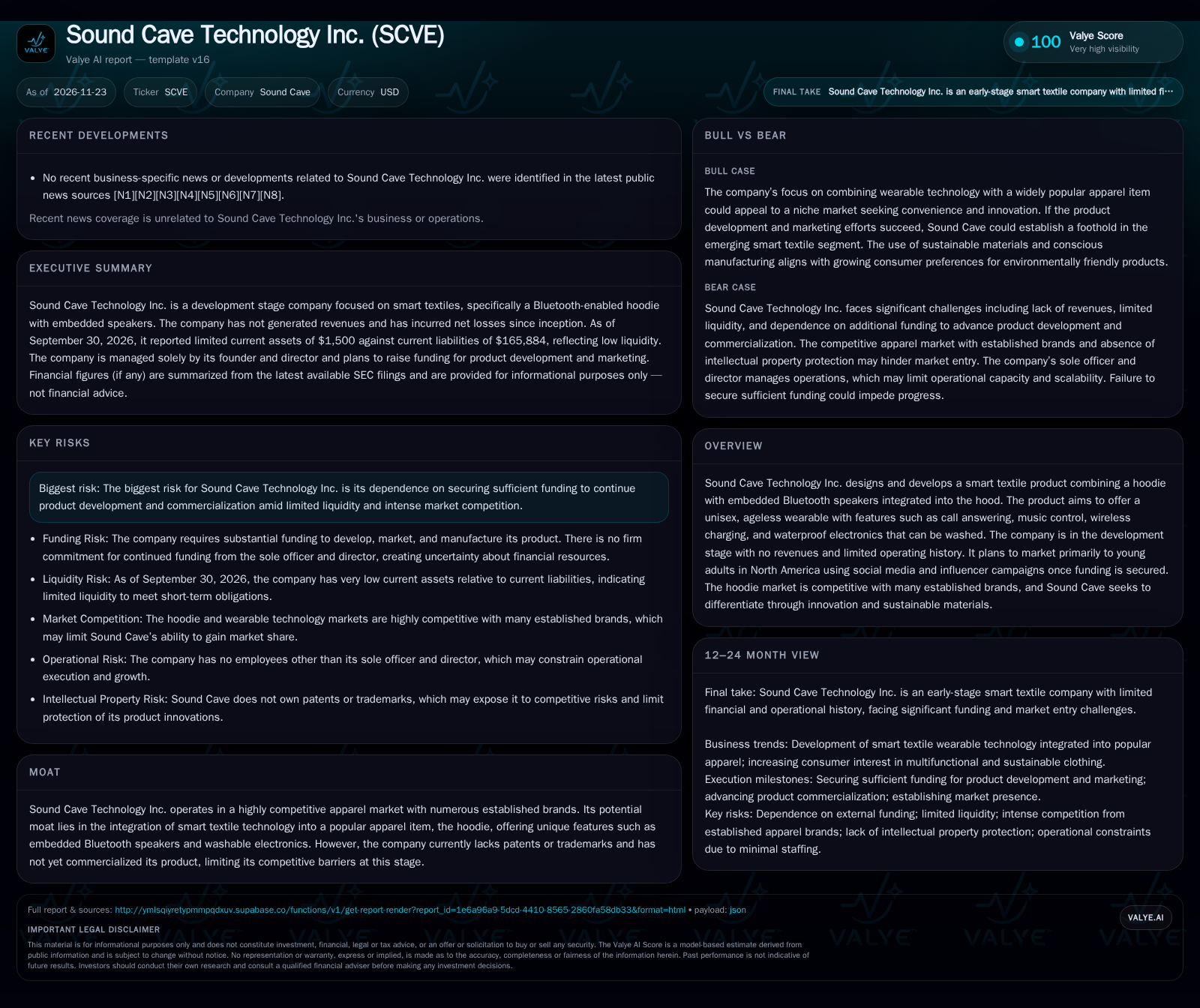
Sound Cave Technology is developing a smart hoodie with embedded Bluetooth speakers but remains pre-revenue, cash-strapped, and reliant on uncertain future funding. The company’s strategy hinges on successful product development and digital marketing, but faces daunting obstacles from liquidity shortfalls, lack of IP, and a crowded, brand-driven apparel market. Its future will depend on both capital access and its ability to carve out a unique value proposition.
Sound Cave Technology Inc. exemplifies the high-risk, high-uncertainty profile of early-stage smart textile ventures. The company’s ambition—to embed Bluetooth audio technology in a mass-market hoodie—capitalizes on the convergence of wearable tech and fashion. The challenge: validate both product-market fit and an operational model before resources run out.
Acute Funding Need and Pre-Revenue Status Define the Near-Term Reality
Sound Cave Technology Inc. is still in the development stage, having generated no operating revenues as of September 30, 2026 [S1] [S2]. The company reported a net loss of $9,083 for the most recent quarter and an accumulated deficit of $186,863, underscoring sustained negative cash flow [S2]. The company reported cash and liquidity metrics for the period; these figures do not by themselves establish operating runway, investment capacity, financial flexibility, or financing capacity. [S2] There are no patents or trademarks protecting the company’s product concept, and all operations are managed by the sole officer and director [S1]. Sound Cave requires a minimum of $380,000 in funding over the next twelve months to advance product development, marketing, and manufacturing, but has no firm external or internal funding commitments [S1].
Unit Economics and the Unproven Path to Margin in Smart Apparel
Sound Cave’s intended business model involves manufacturing and selling a Bluetooth-enabled hoodie targeting young adult consumers. The company plans to use a mid-quality cotton/polyester fleece blend and market the product as both innovative and sustainable [S1]. In the apparel sector, gross margins are typically squeezed by high variable costs, especially for new entrants lacking scale in sourcing and production. The addition of embedded electronics further complicates the cost structure, likely increasing bill-of-materials and requiring specialized assembly, quality control, and post-sale support. Without volume manufacturing or supply-chain leverage, per-unit costs may be high and working capital needs acute.
Price elasticity in the hoodie market is significant: established brands can command premiums based on brand equity, but new entrants typically face a tradeoff between pricing for adoption and covering costs. The integration of Bluetooth speakers could justify a higher price point, but only if perceived as genuinely useful, reliable, and differentiated from both conventional hoodies and standalone audio wearables. The company’s lack of IP protection and brand recognition suggests limited ability to command premium pricing or defend margins if competitors imitate the feature set.
Operating leverage is likely negative at this stage: fixed costs remain low (single staff, no manufacturing overhead), but any attempt to scale production or launch a meaningful marketing campaign would require significant upfront capital. The absence of recurring revenue streams (such as subscriptions or digital services) means that future cash flow would be highly dependent on unit sales volume and velocity, which are unproven.
Differentiation Without Defensibility: The Challenge of Standing Out in Apparel and Tech
Sound Cave operates in a highly competitive intersection of apparel and consumer electronics. The hoodie market is saturated with established brands that benefit from scale, distribution, and deep customer loyalty. Meanwhile, the wearable tech segment is dominated by large electronics firms with advanced R&D capabilities and robust IP portfolios. Sound Cave’s main differentiator is the integration of Bluetooth audio into everyday apparel, but with no patent or trademark protection, this feature could be rapidly replicated by larger, better-capitalized competitors.
Switching costs for consumers are negligible: most buyers choose apparel based on brand, style, price, and fit, while Bluetooth audio is widely available as a standalone accessory. For Sound Cave to capture share, it must convince a niche segment that the convenience and novelty of integrated audio justifies switching from both conventional hoodies and existing wearable devices. Its planned reliance on social media and influencer marketing is a common strategy in the apparel space, but without a unique brand story or viral appeal, customer acquisition costs could quickly outpace sales.
The lack of operational scale, distribution networks, and after-sale support infrastructure further limits Sound Cave’s ability to compete effectively. In the absence of IP, sustainable materials and design may offer some appeal, but are now table stakes for many younger consumers and do not constitute a durable moat.
If Product-Market Fit Emerges and Funding Arrives: A Path to Niche Adoption
The most favorable outcome for Sound Cave is predicated on two sequential breakthroughs. First, the company must secure the $380,000 minimum funding needed to complete product development and launch an effective marketing campaign [S1]. Second, the smart hoodie must resonate with a well-defined segment—likely young, tech-enthusiastic consumers seeking novelty and convenience in wearable tech. Early positive feedback, social media virality, and influencer endorsements could drive initial adoption and organic buzz, reducing the need for expensive paid advertising.
If the product proves reliable, comfortable, and genuinely useful (for example, offering better integration or convenience than existing Bluetooth headphones), Sound Cave could establish a niche foothold. The use of environmentally friendly fabrics may offer incremental appeal to sustainability-conscious buyers. Evidence confirming this scenario would include successful fundraising, rapid prototype-to-market execution, early sell-through at initial launch, and positive user reviews or influencer advocacy. Falsification would be signaled by inability to raise funds, delays in product development, or poor market reception even after launch.
Funding Delays and Competitive Pressure Stall Commercialization
The most likely trajectory for Sound Cave, given current facts, is protracted struggle to secure sufficient funding, resulting in delayed or piecemeal product development. Even if some capital is raised, execution challenges—such as difficulties in hardware prototyping, manufacturing logistics, and digital marketing—could slow progress and dissipate limited resources. The lack of brand equity, IP protection, and operational bandwidth (with only one officer) suggest a high probability that Sound Cave will encounter formidable barriers to both market entry and scale.
In this scenario, the company may attempt to launch a limited pilot or crowdfunding campaign, but faces the risk of being outmaneuvered by faster-moving or better-resourced competitors. Evidence confirming this base case would include prolonged fundraising efforts, incremental prototype updates without a full launch, ongoing net losses, and a lack of visible traction with consumers or retail partners. Falsification would require a sudden breakthrough in capital access or unexpected viral adoption.
Liquidity Exhaustion Triggers Insolvency or Strategic Retreat
The adverse scenario is defined by Sound Cave’s acute liquidity shortfall and lack of committed financing. If the company cannot secure the minimum $380,000 required for development and marketing, or if outflows outpace any modest inflows from prototype sales or pre-orders, it may be forced to suspend operations or seek a distressed sale of assets. With only $1,500 in current assets and mounting liabilities, the window for action is narrow [S2].
Further compounding risk is the absence of insurance and the dependence on a single individual for all key functions, which amplifies operational fragility. The lack of IP protection means there is little residual value for acquirers beyond any working prototypes or brand assets. Confirmation of this scenario would come from continued cash burn without fundraising progress, creditor actions, or the announcement of a strategic wind-down. Falsification would require a near-term capital infusion or a credible partnership with an established apparel or tech brand.
Milestones and External Shifts That Could Redefine Sound Cave’s Prospects
Announcement of successful fundraising, whether through equity, debt, or external investment, and the terms of any such financing.
Progress in hardware prototyping, pilot manufacturing, and initial product testing, including any third-party validation or influencer engagement.
Disclosure of pre-orders, early sales, or partnerships with retail distributors or e-commerce platforms (if disclosed).
Any moves toward securing intellectual property, such as patent or trademark filings, that could help defend product differentiation.
Updates on marketing execution, including the launch of social media or influencer campaigns and the resulting consumer engagement metrics (a useful metric would be conversion rates or cost-per-acquisition, if disclosed).
Operational expansion, such as hiring key personnel or formalizing relationships with manufacturing or logistics partners.
Evidence of brand awareness or consumer buzz, such as press coverage, social media trends, or third-party product reviews.
Changes in the competitive landscape—such as large apparel or electronics brands launching directly competing smart textile products—which could affect Sound Cave’s market opportunity.
Disclaimer: This is research-only, informational analysis and not investment advice. It may include AI-generated interpretation and general industry context. Always verify important details using primary sources.

Comments