
Tivic Health Systems: Financial Pressure, Strategic Uncertainty, and the Stakes of CDMO Asset Monetization
The company's future hinges on the outcome of asset monetization efforts and its ability to adapt its business model under duress.
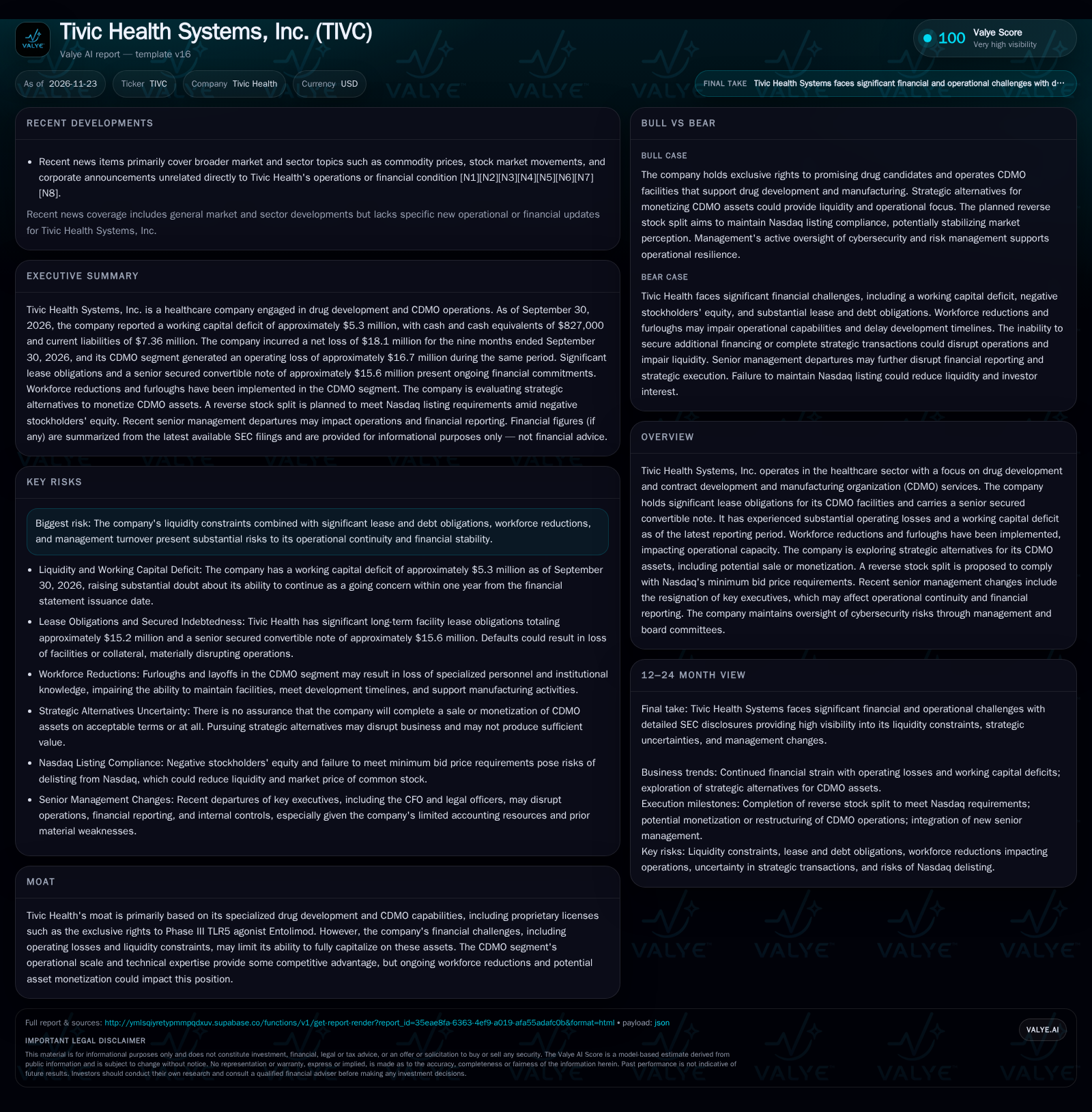
Tivic Health Systems, Inc. is in a precarious financial position, with a large working capital deficit, persistent operating losses, major lease and debt obligations, and negative equity. Workforce reductions and the resignation of key executives compound the operational risks. The company is seeking to monetize its CDMO assets and is planning a reverse split to avoid Nasdaq delisting, but the success and impact of these measures remain uncertain. The next phase depends on asset sales, strategic pivots, and whether Tivic can stabilize operations amid ongoing liquidity pressures. [S2]
Tivic Health Systems, Inc. stands at a critical juncture marked by deepening financial distress and organizational upheaval. Amid workforce cuts and the loss of key senior executives, Tivic is exploring asset monetization and a reverse stock split to preserve its Nasdaq listing. The company’s near-term viability and long-term prospects now depend on its ability to execute strategic transactions and stabilize its operations under considerable pressure. [S2]
Mounting Deficit, Asset Monetization, and Leadership Volatility Define Current State
Tivic Health Systems' most recent SEC filings paint a picture of acute financial distress: as of September 30, 2026, the company held just $827,000 in cash against $7.36 million in current liabilities, resulting in a working capital deficit of $5.3 million. Net losses totaled $18.1 million for the first nine months of 2026, with the CDMO segment alone incurring a $16.7 million operating loss. These figures underscore severe liquidity constraints and ongoing operational losses. [S2]
Lease obligations, totaling $15.2 million in future minimum payments, and a $15.6 million senior secured convertible note magnify the company’s fixed financial commitments. Meanwhile, Tivic has implemented substantial workforce reductions and furloughs in its CDMO operations, including 34 employees placed on unpaid furlough and nine layoffs in Q3 2026. The company is actively evaluating strategic alternatives to monetize its CDMO assets, but there is no assurance of a successful or timely outcome. [S2]
Recent senior management departures—including the resignation of the President, COO, and CFO, as well as termination of the General Counsel and Senior VP of Legal—raise additional concerns about operational continuity, execution risk, and the ability to navigate these challenges. The planned reverse stock split aims to maintain Nasdaq listing compliance amid negative equity, but this is a stopgap rather than a solution to underlying business issues. [S2]
Structural Cash Burn and Fixed Cost Overhang Dominate Tivic’s Model
Tivic Health’s business model combines drug development with contract development and manufacturing organization (CDMO) operations, both of which are capital- and labor-intensive. The CDMO segment, in particular, carries significant fixed costs due to facility leases and specialized workforce requirements. With $15.2 million in future lease obligations and a $15.6 million secured note, the company’s cost structure is highly inflexible. [S2]
Operating leverage in this context has turned negative: with reported revenue of only $86,000 in the June 2025 quarter, the scale of fixed costs is vastly disproportionate to current revenue generation. The sharp operating loss from the CDMO segment illustrates the risk of underutilized capacity, where high break-even volumes are not being met. The company’s recurring cash burn—net loss of $18.1 million for nine months—suggests that without a major change in revenue mix or substantial cost relief, Tivic’s current model is unsustainable. [S2]
Drug development activities typically require long lead times and substantial funding before any revenue realization, further compounding the cash flow challenge. The company’s ability to raise capital is constrained by negative equity and the risk of Nasdaq delisting, limiting traditional fundraising options. The urgent pursuit of strategic alternatives for its CDMO assets reflects a need to shrink fixed obligations, generate liquidity, or both.
Specialized Capabilities Undermined by Financial Instability and Execution Risk
Tivic Health’s potential competitive advantage lies in its specialized CDMO operations and exclusive rights to promising drug candidates such as the TLR5 agonist Entolimod. In theory, proprietary licenses and technical expertise could position the company as a differentiated player in contract manufacturing and drug development.
However, these advantages are severely compromised by the company’s financial instability. The workforce reductions and furloughs risk eroding institutional knowledge and technical capacity, while the threat of further attrition or loss of key personnel is heightened by management turnover and uncertainty. Competitors—including larger, better-capitalized CDMOs and drug developers—may be better positioned to absorb industry shocks, invest in technology, or win customer contracts that Tivic cannot credibly pursue in its current state.
Should Tivic succeed in monetizing its CDMO assets, it might lose a core source of differentiation, unless it can redeploy capital into higher-return opportunities. Conversely, failure to execute a strategic transaction could leave the company unable to fund ongoing operations, further eroding its position.
Asset Sale or Strategic Transaction Unlocks Liquidity and Refocuses the Business
The most favorable near-term scenario for Tivic Health is a successful monetization or sale of its CDMO assets at a price sufficient to cover pressing liabilities and provide a cash bridge for ongoing business activities. This could relieve the company of its largest fixed costs (lease payments, workforce obligations) and potentially allow a refocus on core drug development assets with a leaner cost structure.
If the company is able to close such a transaction, evidence would include a material reduction in lease obligations and debt, a meaningful cash infusion, and clarity on the go-forward business model (e.g., pivoting away from CDMO operations or investing in higher-potential drug candidates). Falsification would be the failure to announce a binding agreement or the sale of assets at a distressed price insufficient to address core liabilities.
A further upside would be the stabilization of Nasdaq listing through restored equity and improved financial optics, which could facilitate new capital raises or partnerships.
Protracted Restructuring and Operational Contraction Amid Ongoing Uncertainty
The most plausible scenario is a period of continued financial strain marked by workforce contraction, asset sales negotiations, and incremental efforts to maintain listing compliance. Operational capacity in the CDMO segment is likely to remain impaired, with furloughs and layoffs limiting the company’s ability to deliver on existing contracts or generate new revenue.
If negotiations for asset monetization drag on or fail to yield sufficient proceeds, Tivic may need to pursue additional cost cuts, seek bridge financing, or enter restructuring discussions with creditors. Evidence confirming this scenario would include further reductions in workforce or operations, ongoing negative cash flow, and continued disclosures of going concern risk.
Falsification of this scenario would be a rapid and successful transaction that fundamentally alters the balance sheet and operating model, or a new capital raise large enough to restore operational stability without major asset sales.
Failure to Secure Liquidity Triggers Default or Delisting
The adverse scenario is one in which Tivic Health is unable to monetize its CDMO assets, raise new capital, or reduce its fixed cost base in time to avert a cash crisis. In this event, the company could default on lease or debt obligations, potentially triggering loss of critical assets, creditor enforcement actions, or bankruptcy proceedings.
Delisting from Nasdaq due to negative equity or insufficient share price could further limit access to capital and reduce investor interest, creating a downward spiral. Additional evidence for this scenario would be missed lease or debt payments, formal default notices, bankruptcy filings, or announcements of delisting from Nasdaq.
Falsification would require clear, binding evidence of new funding, asset sales, or a material improvement in operating performance sufficient to avert liquidity-driven distress.
Milestones and Developments to Clarify Tivic Health’s Pivot and Survival Prospects
Announcement of a binding agreement to sell or monetize CDMO assets, including transaction size and terms.
Updates on lease and debt obligations—specifically, any notices of default, renegotiations, or reductions in minimum payment requirements.
Disclosure of new capital raised, either through equity, debt, or strategic partnership, and the resulting impact on working capital and liquidity.
Further workforce changes, including additional layoffs, furloughs, or rehiring, as indicators of operational capacity and restructuring progress.
Nasdaq compliance updates: confirmation of reverse stock split implementation, changes to stockholders’ equity, and listing status.
Appointment of new senior management or board members, as evidence of efforts to restore operational and financial leadership.
Material changes in revenue generation, particularly in the CDMO segment, which would signal either stabilization or further contraction.
Disclaimer: This is research-only, informational analysis and not investment advice. It may include AI-generated interpretation and general industry context. Always verify important details using primary sources.

Comments