
AppYea’s Blockchain Lottery Pivot: Early-Stage Promise Meets Immediate Liquidity Risks
AppYea has transitioned from digital health wearables to a blockchain-based lottery and gaming platform, now in early commercial rollout with one customer.
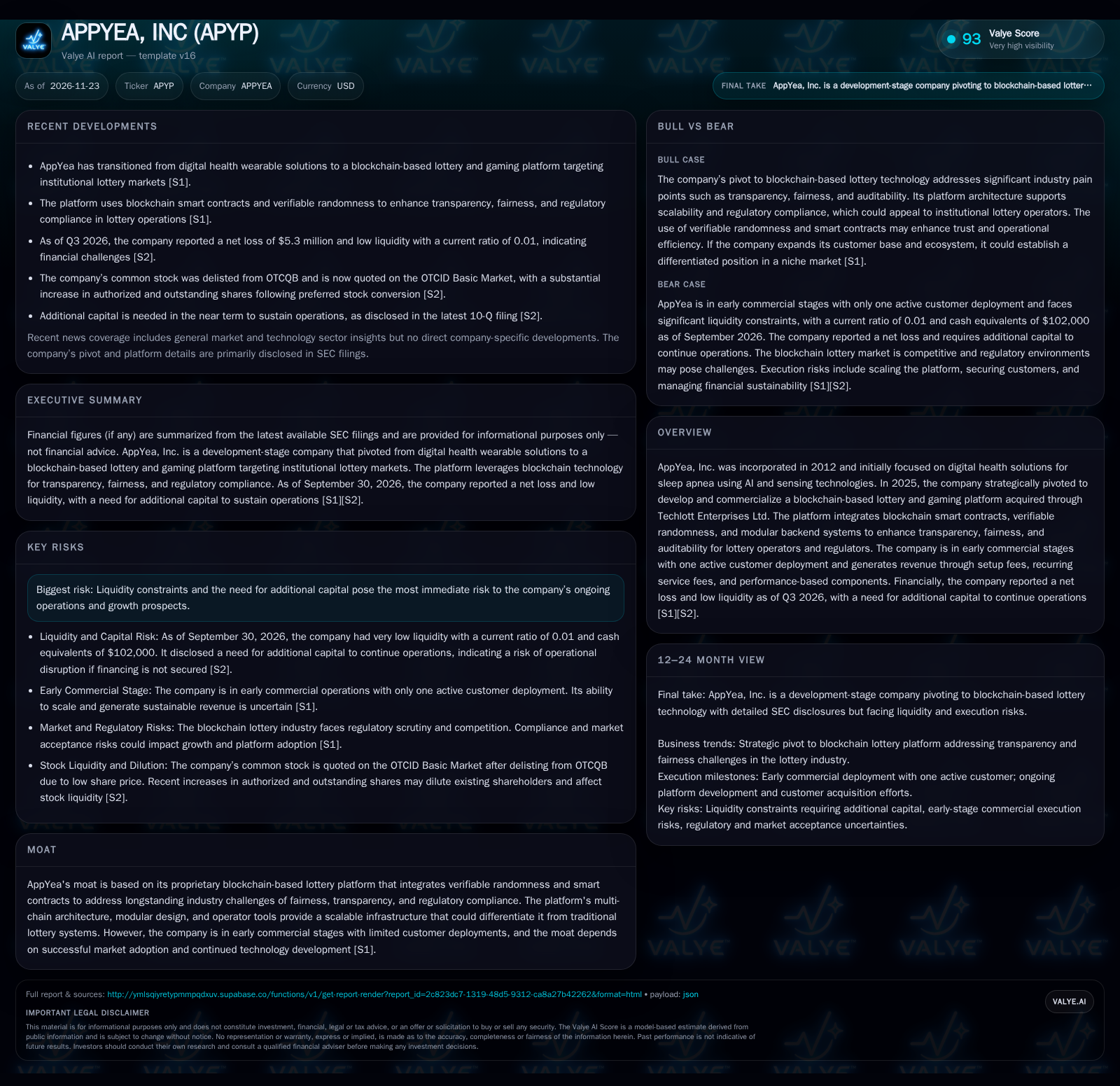
AppYea has transitioned from digital health wearables to a blockchain-based lottery and gaming platform, now in early commercial rollout with one customer. The platform’s architecture targets industry pain points around transparency and regulatory compliance, but as of September 2026, the company faces acute liquidity pressure and an urgent need for additional capital, raising questions about its ability to execute and grow [S1] [S2].
AppYea, Inc.’s transformation from a digital health company to a blockchain lottery platform provider reflects a bold attempt to capitalize on emerging technology trends in gaming. The company’s new platform—designed for institutional operators—promises enhanced transparency, fairness, and regulatory compliance through blockchain, smart contracts, and verifiable randomness. However, the transition comes at a critical financial juncture: AppYea’s liquidity is extremely limited, with ongoing operating losses and a clear disclosure of near-term capital requirements. The interplay between the platform’s potential and the company’s urgent need for funding will define whether this pivot can deliver sustainable value or result in continued operational and financial strain.
Liquidity Crunch and Early Commercialization Define AppYea’s 2026 Status
AppYea, Inc. stands at the intersection of strategic reinvention and acute financial pressure. After acquiring Techlott Enterprises Ltd. in August 2025, the company pivoted from digital health to focus on a proprietary blockchain-based lottery and gaming platform aimed at institutional operators [S1]. As of the latest reporting period (September 30, 2026), AppYea has only one active customer deployment and is in the very early stages of commercial operations [S1]. Financially, the company posted a net loss of $5.3 million for the third quarter and is operating with just $102,000 in cash against $10.5 million in current liabilities, translating to a current ratio of 0.01 [S2]. Critically, management has disclosed a need for additional capital in the near term to sustain operations, and the company’s stock has been relegated from OTCQB to the OTCID Basic Market following dilution events [S2]. These facts highlight a business with significant technical ambition but facing immediate existential financing challenges.
Platform Economics: Multi-Layered Revenue Streams but High Fixed Costs
AppYea’s new business model is built around a blockchain lottery platform that targets institutional operators, offering a mix of technological infrastructure, compliance tools, and player engagement features [S1]. The stated revenue model includes upfront setup fees, recurring service fees (likely tied to platform usage or licensing), and performance-based components, which could include transaction or gross gaming revenue shares [S1]. In theory, this approach can drive high-margin, recurring revenue if the platform achieves scale: setup fees help offset customer acquisition and onboarding costs, while service and performance fees provide ongoing cash flow.
However, the economics are currently unfavorable due to the company’s infancy in the market and the heavy fixed costs associated with R&D, compliance, security, and ongoing platform updates. Without a meaningful customer base, AppYea is likely operating below breakeven, with limited ability to leverage fixed costs or benefit from network effects. Capital needs are acute, as evidenced by the immediate requirement for new funding to continue operations [S2]. In the absence of rapid customer acquisition or a significant financing event, the company’s negative operating leverage will persist and may even worsen.
Blockchain Lottery Ambitions Meet a Crowded RegTech and Gaming Landscape
AppYea’s pivot places it in a competitive market defined by both legacy lottery system providers and a new wave of blockchain-based gaming and regtech platforms. The company’s technology—emphasizing smart contracts, verifiable randomness, and modular architecture—addresses industry pain points around fairness, transparency, and regulatory compliance [S1]. These features are increasingly demanded by regulators and operators in the global lottery sector and could, in principle, differentiate the platform from older, opaque systems.
However, the sector is seeing rapid innovation with multiple blockchain lottery projects, established gaming software vendors adding compliance and auditability features, and regulatory environments that remain fragmented and uncertain. Larger competitors typically have established relationships with lottery operators, deeper financial resources, and broader product suites. AppYea’s limited commercial track record—only one customer deployment—means it lacks proof points and reference customers, a significant disadvantage when selling to risk-averse institutional buyers. The question is whether its technology can deliver enough practical benefit and regulatory comfort to win customers before it exhausts its financial runway.
Accelerated Adoption Driven by Regulatory Tailwinds and Platform Validation
A favorable scenario would see AppYea’s platform gain traction as lottery operators and regulators increasingly demand transparency and fairness, especially in jurisdictions mandating blockchain or verifiable randomness for licensed games. Early customer success—demonstrated by expansion of the initial deployment or wins with additional institutional operators—could validate the platform’s value proposition and trigger network effects. If AppYea can secure bridge financing or a strategic investment, it could accelerate product development and expand its commercial team, improving its ability to compete for larger contracts.
Evidence that would confirm this scenario includes announcements of new customer contracts, meaningful increases in recurring or performance-based revenue, successful capital raises that reduce liquidity risk, and positive feedback from regulatory audits or third-party certifications. Conversely, if the company fails to convert pilots into multi-year contracts or cannot close a financing round, this upside would be called into question.
Survival Hinges on Financing While Platform Proves Commercial Appeal
The most probable path for AppYea centers on a period of financial stress and operational triage. The company is likely to focus its limited resources on supporting the current customer, refining the platform, and pursuing a handful of high-potential sales opportunities. The commercial ramp will be slow—given institutional lottery sales cycles and regulatory hurdles—so revenue growth may lag behind ongoing cash outflows.
The base scenario assumes that AppYea is able to secure at least short-term bridge financing, potentially through equity dilution or convertible debt, enabling operations to continue while management seeks further customer validation. Confirmation would come from disclosed financing events, stabilization of the company’s cash position, and incremental customer or pilot wins. Falsification would occur if the company fails to raise capital imminently, loses its only customer, or is forced to halt operations due to insolvency.
Liquidity Shortfall and Slow Adoption Threaten Continuity
The most acute risk to AppYea is a failure to secure new capital before cash resources are depleted, forcing the company into operational shutdown, asset sales, or a distressed transaction. The early commercial stage—just one customer—means that any delay in customer acquisition or platform validation could quickly translate to a loss of market credibility and bargaining power with potential investors or acquirers.
This scenario would be confirmed by continued operating losses without new funding, missed payroll or vendor payments, and a lack of material customer announcements. Further delisting or regulatory actions on the public stock could also signal deteriorating prospects. In this environment, existing shareholders could face severe dilution or even a total loss if the company is unable to execute a turnaround or find a buyer for its technology assets.
Milestones That Will Determine If AppYea’s Blockchain Lottery Pivot Succeeds
Evidence of new customer wins, platform expansions, or signed multi-year contracts would demonstrate commercial traction and test the scalability thesis.
Disclosure of completed financing events, whether through equity, debt, or strategic investment, is critical to address immediate liquidity needs.
Trends in recurring and performance-based revenue (if disclosed) would indicate whether the platform is moving from pilot to sustainable deployment.
Regulatory approvals or compliance certifications in key jurisdictions would signal that the platform meets evolving market standards.
Gross margin development and operating expense trends (if disclosed) would clarify whether the business can reach breakeven with scale.
Churn or expansion within the first active customer—such as contract renewal or increased usage—would provide an early read on product-market fit.
Any further changes in trading status, authorized shares, or shareholder dilution would reflect management’s approach to funding and capital structure.
Updates on technology development, such as new features, integrations, or third-party security audits, would indicate ongoing platform competitiveness.
Disclaimer: This is research-only, informational analysis and not investment advice. It may include AI-generated interpretation and general industry context. Always verify important details using primary sources.

Comments