
Lingerie Fighting Championships: Digital Audience Growth Confronts Structural Financial Strain
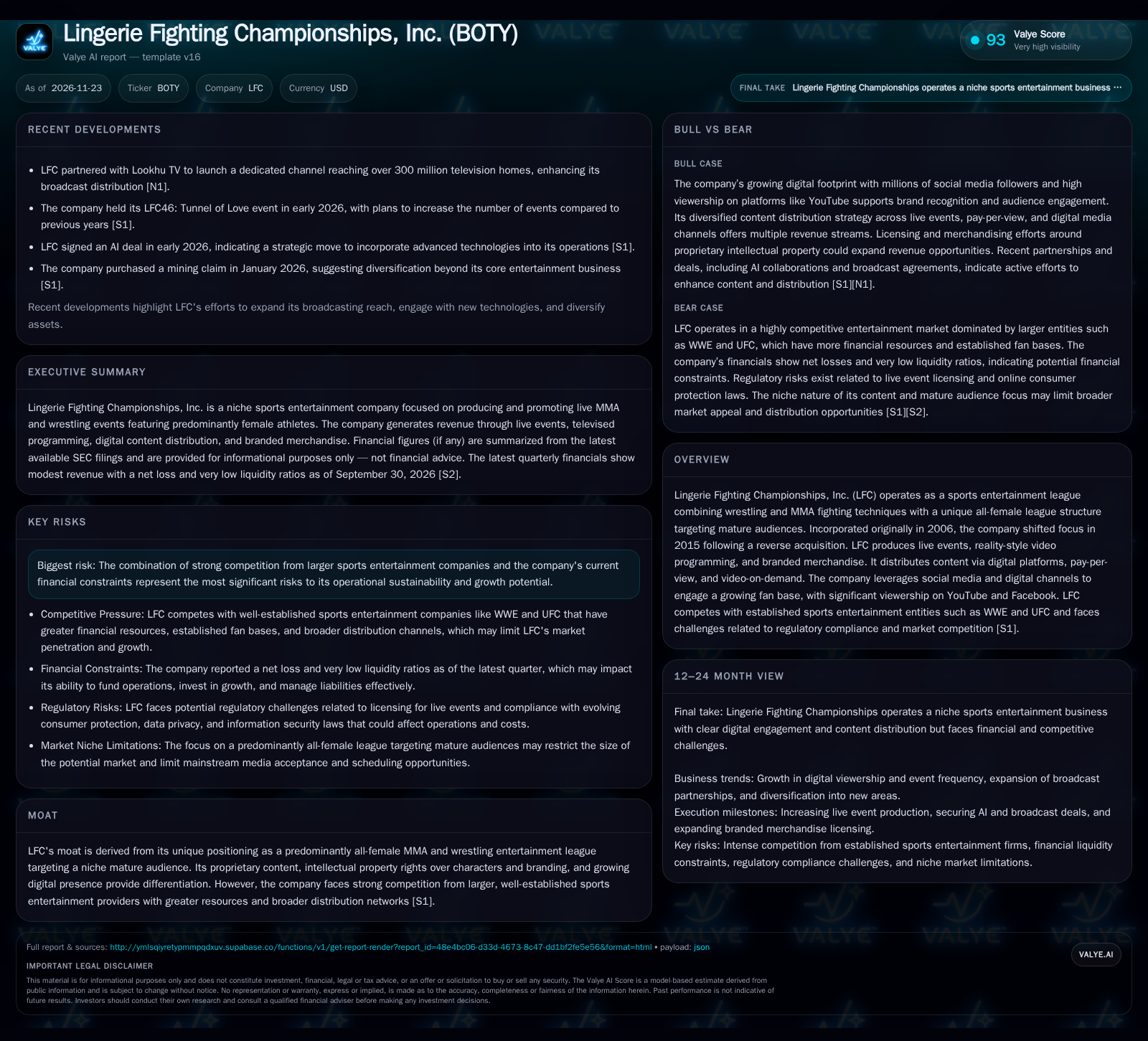
Lingerie Fighting Championships, Inc. (LFC) leverages a distinct niche in sports entertainment, boasting millions of digital viewers and a diversified content strategy.
Lingerie Fighting Championships, Inc. combines an all-female MMA/wrestling format targeting mature audiences with a growing digital presence and diversified content distribution. The viability of monetizing its digital audience and expanding revenue streams will be crucial to LFC’s future.
Lingerie Fighting Championships, Inc. (LFC) stands at a crossroads where digital popularity collides with financial fragility. The company’s unique all-female MMA and wrestling entertainment model, combined with significant social media traction and diversified content delivery, sets it apart in the crowded sports entertainment landscape. As LFC experiments with AI partnerships and even ventures outside its core sector, the fundamental question is whether digital engagement can be translated into sustainable revenue—before financial realities force a strategic reset.
Surge in Digital Engagement Meets Stark Financial Realities
Lingerie Fighting Championships, Inc. reported quarterly revenue of $42,006 and a net loss of $11,463 for the period ending September 30, 2026 [S2]. The company’s cash and equivalents stood at $10,009 against current liabilities of $5,911,857, resulting in a current ratio of 0.01 and a cash ratio of zero [S2].
Counterbalancing these financial constraints, LFC’s digital footprint is considerable: over 800,000 YouTube subscribers, nearly 4 million Facebook followers, and recent events averaging nearly 10 million views [S1]. The company produces live events, a reality series with over 120 episodes, and distributes content globally via pay-per-view and digital platforms [S1].
Recent business developments include a partnership for AI integration, broadcast deals, and a surprising acquisition of a mining claim, indicating efforts to diversify revenue streams and leverage digital technologies [S1].
Revenue Streams, Fixed Costs, and the Challenge of Scaling Monetization
LFC’s revenue model is a blend of live event ticket sales, pay-per-view and video-on-demand content, digital distribution (including platforms like Amazon and iTunes), and branded merchandise. Additional income could come from IP licensing around proprietary characters and league branding [S1].
The company’s one-employee structure and use of contract labor for cast and crew create a highly variable cost base, enabling operational flexibility but limiting capacity for in-house content production, marketing, and business development. This structure may help contain fixed costs but can also hinder the ability to scale and institutionalize core business functions.
Despite a large digital audience, the reported quarterly revenue remains modest. This suggests that either monetization rates per viewer are low, that digital engagement does not directly translate to substantial paid content consumption, or that merchandise/licensing uptake is limited. Without evidence of high-margin recurring revenue or a robust pipeline of new lucrative contracts, the company’s economics appear heavily dependent on the success of each individual event and the ability to convert digital engagement into spend.
Recent diversification—such as AI partnerships—may be intended to drive new monetization opportunities (e.g., enhanced fan engagement, digital collectibles, or automated content production). However, the acquisition of a mining claim signals a lack of strategic focus and could distract from core business execution [S1].
Niche Differentiation Versus the Weight of Established Rivals
LFC’s unique selling proposition is its predominantly all-female, mature-audience MMA/wrestling league, which differentiates it from mainstream sports entertainment offerings [S1]. This niche positioning allows for distinct branding and IP creation, but also inherently limits the addressable market compared to the broad, family-friendly appeal of giants like WWE and UFC.
Entrenched competitors have deeper financial reserves, established distribution partnerships, and extensive marketing machinery. These advantages enable them to outspend on talent, production, and promotion, while also weathering cyclical downturns or regulatory shocks more effectively.
LFC’s digital engagement is significant, but the challenge is twofold: converting free viewers into paying customers, and defending its niche against either imitation by larger players or shifts in audience taste. Additionally, regulatory compliance (around live events, online content, and consumer protection) introduces recurring risks and costs that scale more easily for larger peers [S1].
Intellectual property protection and licensing could, in theory, provide a defensible moat, but only if the brand achieves sustained cultural relevance and commercial demand beyond its existing fan base.
Unlocking Digital Value: How Monetization and Partnerships Could Reshape Outcomes
The most favorable scenario for LFC hinges on successfully converting its substantial digital reach into higher-margin, recurring revenue streams. If the company can implement effective pay-per-view upselling, premium memberships, or exclusive digital content offerings, even modest conversion rates could meaningfully lift revenue and gross profit.
Strategic partnerships with technology providers (such as recent AI deals) could unlock new fan engagement tools—ranging from interactive experiences to personalized merchandise or digital collectibles. Licensing the LFC brand to third-party entertainment, gaming, or international event partners could further diversify revenue.
Evidence that would confirm this upside includes sustained increases in average revenue per user (ARPU), new licensing contracts, expansion of recurring digital subscriptions, and renewed or expanded broadcast distribution deals.
A falsification would be continued stagnation in revenue despite audience growth, failed partnership rollouts, or inability to secure recurring contracts—indicating the digital audience is not monetizable at scale.
Audience Growth Outpaces Monetization, Sustaining Persistent Strain
The most plausible near-term path is one where LFC continues to grow its digital audience and social media engagement but struggles to materially improve monetization rates or diversify revenue. In this scenario, live events, pay-per-view, and limited merchandise sales remain the primary sources of cash flow, with periodic licensing or partnership revenue providing only episodic boosts.
The company’s reliance on contract labor keeps fixed costs low but also restricts scale and operational depth.
Confirmation of this scenario would be a steady or modestly rising digital following without a commensurate increase in reported revenue, continued net losses, and absence of transformative licensing or partnership announcements.
A falsifier would be a material, sustained increase in revenue per event, clear evidence of successful recurring digital monetization, or a major capital raise that alleviates balance sheet stress.
Liquidity Crunch Forces Retrenchment or Strategic Pivot
In a negative scenario, the company’s acute liquidity shortfall becomes untenable. The inability to cover liabilities or fund basic operations could force LFC to scale back live events, reduce content output, or seek emergency financing under unfavorable terms.
Diversification efforts such as the mining claim could distract limited management bandwidth and dilute focus from core revenue drivers, exacerbating losses and eroding brand equity.
If digital engagement plateaus or declines, and no effective monetization or partnership opportunities materialize, the company may be forced to consider asset sales, a distressed merger, or even bankruptcy protection.
Milestones and Metrics That Will Define the LFC Story
Quarterly and annual revenue growth, especially as it relates to digital monetization and new partnership contributions [S2].
Average revenue per digital viewer or user—if disclosed—to gauge success in converting audience scale into spend.
Updates on recurring digital subscription or premium content offerings, and their adoption rates.
Announcements of new licensing deals, broadcast partnerships, or international expansion agreements.
Event frequency and average attendance or viewership metrics, as a proxy for ongoing fan engagement.
Evidence of improved liquidity—such as capital raises, debt restructuring, or material reductions in current liabilities [S2].
Progress, if any, on AI partnership execution and any resulting technology-enabled revenue streams.
Clarification on the strategic intent and financial impact of non-core asset acquisitions, such as the mining claim.
Disclaimer: This is research-only, informational analysis and not investment advice. It may include AI-generated interpretation and general industry context. Always verify important details using primary sources.

Comments