
Cosmos Health: Vertically Integrated Ambitions Confront Margin Pressure and Execution Hurdles
Cosmos Health Inc. pursues a multi-pronged growth strategy in pharmaceuticals, nutraceuticals, and telehealth, leveraging vertical integration and recent manufacturing deals. Yet persistent net losses and thin liquidity ratios highlight the stakes of scaling branded products and innovation amid fierce industry competition.
Cosmos Health is expanding proprietary brands and manufacturing partnerships across pharmaceuticals and nutraceuticals, with recent deals targeting margin growth and broader distribution.
Cosmos Health Inc. operates with an ambitious scope: a vertically integrated model spanning generics, branded nutraceuticals, biocides, medical devices, and a telehealth platform. Recent manufacturing and distribution deals, along with targeted expansion of proprietary brands, reflect a drive to stabilize and grow revenue streams. However, persistent net losses and a slim liquidity buffer raise the stakes for execution, especially as the company seeks to differentiate in a fiercely competitive, capital-intensive healthcare landscape. The core tension is whether Cosmos Health can translate its strategic breadth and operational integration into durable margin gains and financial resilience.
Recent Deals and Financial Performance Set the Stage for Critical Execution
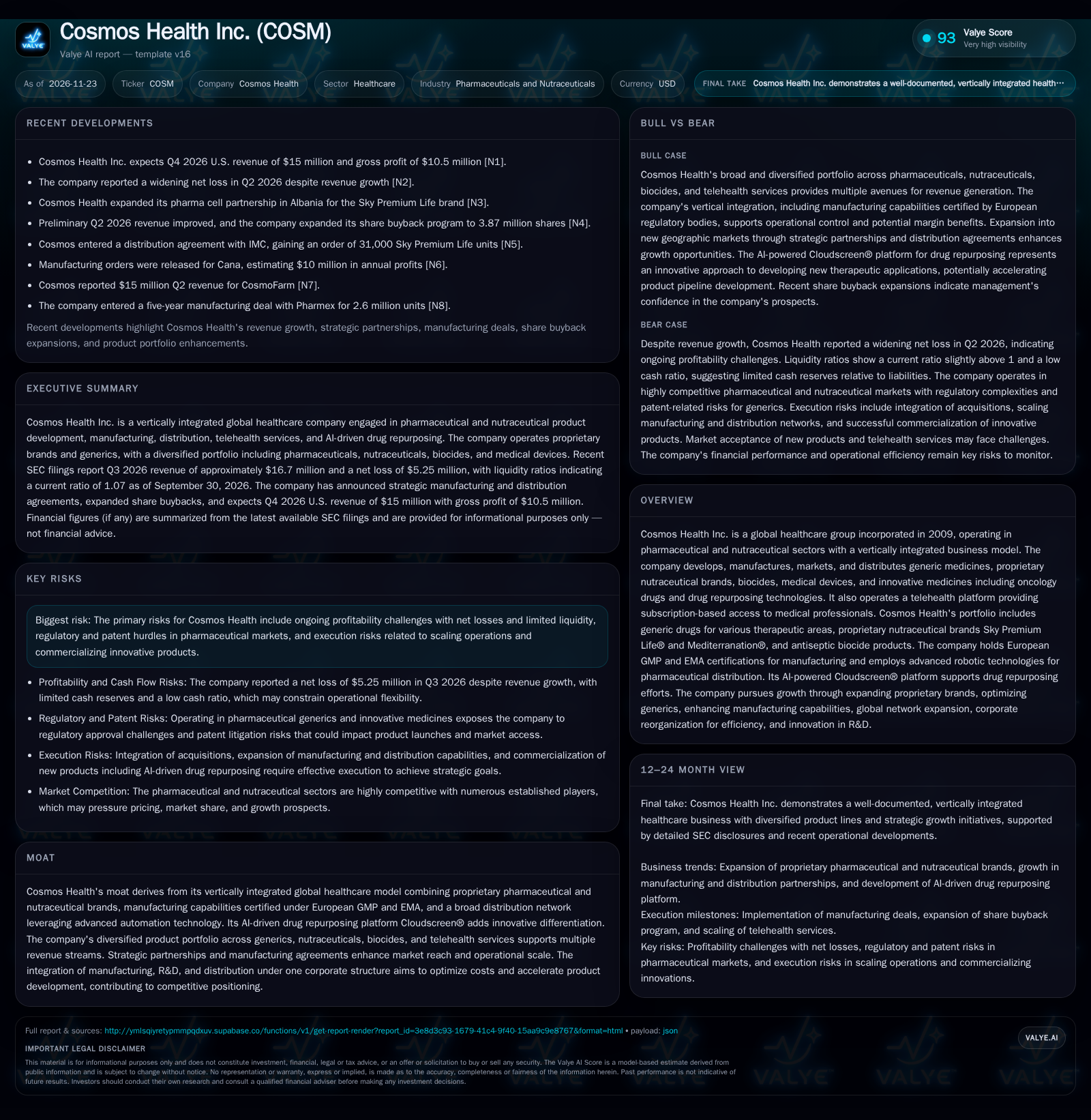
Cosmos Health’s latest results highlight a company at a strategic crossroads. Q2 2026 revenue for CosmoFarm reached $15 million and preliminary Q2 revenue improved year-on-year, yet the company reported a widening net loss for the quarter and an earnings per share of -$1.02 as of September 30, 2026 [N2] [S2] [N7]. Liquidity remains thin, with cash and equivalents of $1.09 million and a current ratio of 1.07 at quarter end [S2].
On the commercial front, Cosmos Health announced several notable agreements: a five-year manufacturing deal with Pharmex for 2.6 million units, manufacturing orders for Cana with an estimated $10 million in annual profits, and a distribution order for 31,000 Sky Premium Life units through IMC [N6] [N8] [N5]. The company also expanded its pharma cell partnership in Albania and continued to invest in share buybacks, signaling management’s intent to bolster both market presence and shareholder value [N3] [N4].
Looking ahead, Cosmos Health expects Q4 2026 U.S. revenue of $15 million and gross profit of $10.5 million [N1]. These developments matter because they test the thesis that operational scale and brand expansion can offset persistent margin pressures and liquidity constraints.
How Cosmos Health’s Integrated Model Could Unlock Margin Expansion—Or Expose Structural Strain
Cosmos Health’s economic engine is built on vertical integration across development, manufacturing, and distribution of pharmaceuticals, proprietary nutraceuticals, biocides, and medical devices [S1]. The company’s own manufacturing capabilities, certified under European GMP and EMA, theoretically allow for cost control, quality assurance, and improved gross margins—especially for higher-value branded products. Recent manufacturing deals and proprietary brands (Sky Premium Life®, Mediterranation®) are intended to drive a shift in mix toward higher-margin categories [N6] [N8] [N3].
However, the economics of this model are complex. Generic pharmaceuticals typically face intense price competition and low margins, while nutraceuticals and branded products can command premium pricing if brand equity and distribution scale are achieved. The telehealth segment (ZipDoctor) introduces a subscription-based recurring revenue stream, but success depends on user acquisition, retention, and payer acceptance—metrics not currently disclosed.
Fixed costs are significant due to ongoing R&D (including the Cloudscreen® AI platform), regulatory compliance, and the need to maintain manufacturing capacity. This creates operating leverage: incremental revenue from proprietary or high-margin products could drive meaningful margin expansion, but sluggish uptake or pricing pressure would quickly expose the business to further losses. The company reported cash and liquidity metrics for the period; these figures do not by themselves establish operating runway, investment capacity, financial flexibility, or financing capacity. [S2]
Competitive Landscape: Scale, Differentiation, and the Challenge of Standing Out
Cosmos Health operates in highly fragmented and competitive markets—generic pharmaceuticals, nutraceuticals, biocides, and telehealth—each with large, entrenched players and low barriers to entry in most categories. The company's broad product portfolio and vertical integration may provide some insulation from single-market shocks and allow for cross-selling across distribution relationships [S1].
However, the core challenge is differentiation. In generics, price and regulatory agility are paramount; in nutraceuticals, brand equity, distribution reach, and perceived efficacy drive consumer choice. The AI-driven Cloudscreen® platform for drug repurposing could become a source of future pipeline differentiation, but its commercial impact remains unproven. Similarly, the telehealth offering must compete against better-funded digital health platforms, with adoption dependent on network effects and payer partnerships.
Large pharmaceutical and consumer health companies benefit from scale, established brands, and robust R&D pipelines. Cosmos Health’s strategy of pursuing niche markets and leveraging proprietary brands may help avoid direct competition with industry giants, but the risk is that limited resources constrain both marketing reach and innovation speed.
If Brand Expansion and Manufacturing Scale Drive Margin Acceleration
A favorable scenario unfolds if Cosmos Health successfully executes on its manufacturing agreements and achieves traction with its proprietary nutraceutical and pharmaceutical brands. If the Cana manufacturing order delivers on its $10 million annual profit estimate, and the five-year Pharmex deal is fulfilled at target volumes and margins, the company could see a step-change in gross profit and operating leverage [N6] [N8].
Further, if distribution partnerships (such as the IMC deal for Sky Premium Life®) catalyze recurring, higher-margin sales, and if telehealth adoption grows meaningfully, Cosmos Health would be positioned to diversify its revenue streams and reduce reliance on low-margin generics. The AI-driven Cloudscreen® platform could also yield non-linear upside if it delivers successful drug repurposing candidates that move into commercialization.
Evidence confirming this scenario would include: sustained gross margin expansion above recent levels, recurring orders from new or expanded distribution channels, positive free cash flow, and clear progress in commercializing innovations from Cloudscreen® or telehealth platforms.
A Mixed Outcome: Incremental Growth Amid Persistent Margin Pressure
The most plausible near-term outcome is that Cosmos Health delivers incremental revenue growth from new manufacturing and distribution deals, but continues to struggle with profitability due to a heavy fixed cost base, competitive pricing pressures, and the slow ramp of proprietary brands. [S2]
The product mix may shift gradually toward higher-margin branded products, but gains are offset by ongoing losses in generics or tepid adoption of new offerings. Telehealth and the Cloudscreen® platform contribute modestly but do not yet become material profit drivers. Share buybacks may support the stock price but do not resolve underlying cash flow constraints.
Confirmation of this scenario would be continued revenue growth in line with recent quarters, stable but thin gross margins, and persistent net losses with little improvement in liquidity or cash flow. Falsification would require a material shift in profitability, such as a break-even or positive net income quarter driven by branded product success.
Margin Compression and Liquidity Stress Force Strategic Retrenchment
A negative scenario develops if competitive pressure in generics and nutraceuticals intensifies, squeezing margins and resulting in continued or deepening losses. Manufacturing deals or distribution partnerships may underdeliver if volumes or pricing fall short of expectations, or if integration and execution issues arise.
[S2] In this situation, the company might be forced to curtail R&D, delay or scale back new product launches, or even consider asset sales or dilutive capital raises to bridge funding gaps.
Evidence supporting this scenario would include: declining or stagnant revenue, further widening of net losses, negative operating cash flow, deteriorating liquidity ratios, and announcements of restructuring, asset divestitures, or emergency financings.
Signals That Will Clarify Cosmos Health’s Margin and Growth Trajectory
Gross margin trends by segment—especially for proprietary brands and new manufacturing deals—would help test whether the business model is shifting toward higher-margin categories.
Recurring revenue from distribution partnerships and branded product orders, if disclosed, would clarify the durability of recent commercial wins.
Telehealth user adoption, retention, and revenue metrics would illuminate the platform’s actual contribution to growth and margin.
Updates on the commercialization pipeline and out-licensing or partnership deals from the Cloudscreen® drug repurposing platform would signal innovation leverage.
Further liquidity developments—such as new credit facilities, capital raises, or asset sales—would show how Cosmos Health is managing potential financial flexibility.
Execution milestones for manufacturing agreements (order fulfillment rates, realized profits) would validate or challenge management’s revenue and margin projections.
Regulatory approvals or setbacks for new products, especially in international markets, could materially affect competitive position and growth prospects.
Disclaimer: This is research-only, informational analysis and not investment advice. It may include AI-generated interpretation and general industry context. Always verify important details using primary sources.

Comments