
International Stem Cell Corporation: Strategic Refocus, Technology Potential, and the Stakes of Concentration Risk
Following the divestiture of its biomedical subsidiary in 2026, ISCO is now a leaner, more concentrated clinical-stage biotech betting on proprietary parthenogenetic stem cell technology and a single commercial skin care line, with execution risk and capital requirements looming large.
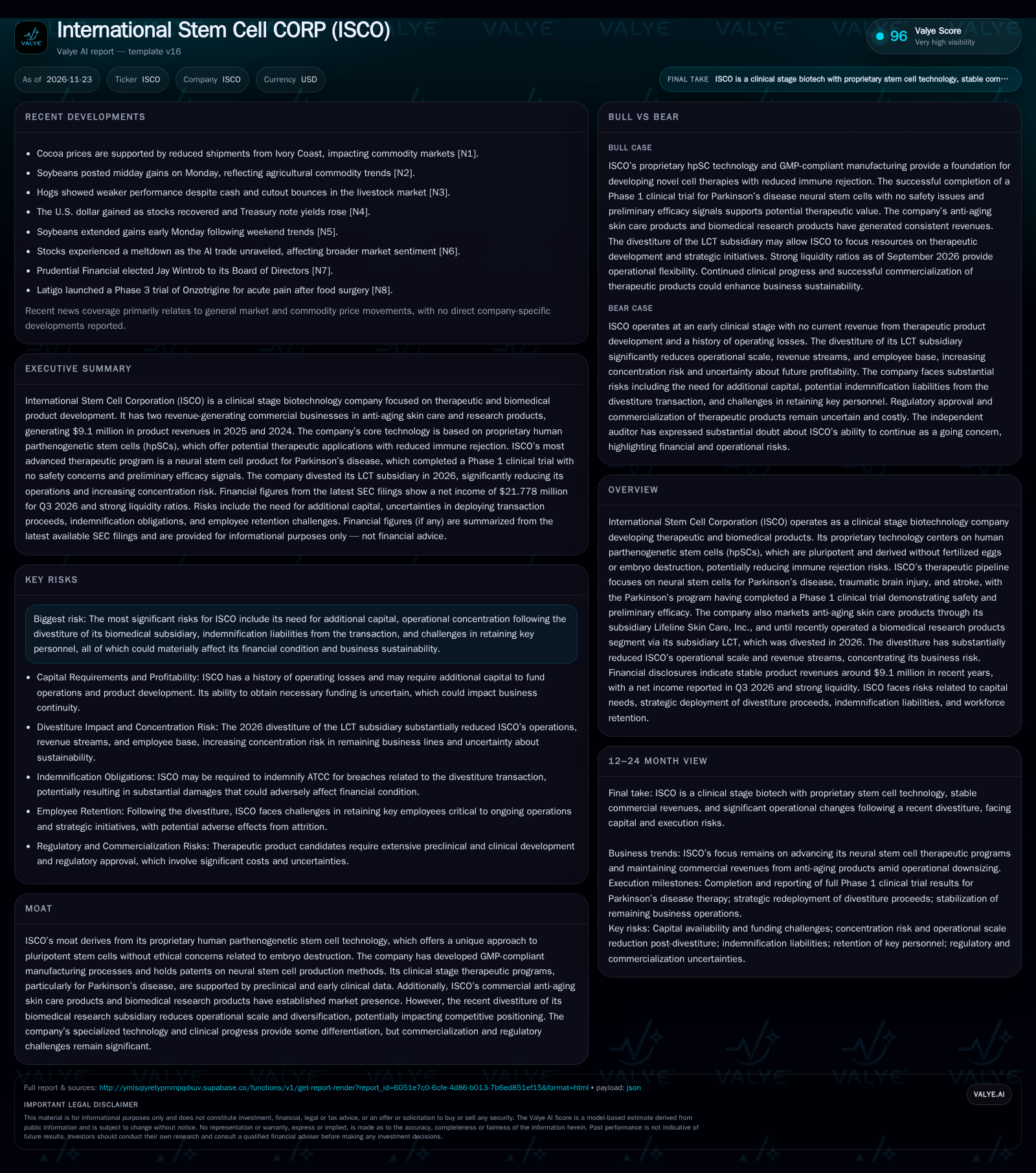
ISCO has transitioned from a diversified biotech with commercial research and skin care revenues to a highly concentrated clinical-stage company after divesting its LCT biomedical subsidiary in 2026. The transformation increases dependence on successful clinical development and commercialization of its proprietary stem cell therapies, with the Parkinson’s program as the most advanced asset. Ongoing risks include capital needs, indemnification from divestiture, and retention of key personnel [S2].
International Stem Cell Corporation (ISCO) stands at a pivotal juncture in late 2026, having divested its biomedical research products subsidiary and narrowed its operational focus to two business lines: a small but stable anti-aging skin care business and an ambitious, still-precommercial pipeline of stem cell therapies. The ultimate value proposition now rests on the successful clinical development and commercialization of proprietary parthenogenetic stem cell technologies, with little diversification to buffer execution setbacks or delay. The company’s ability to deploy transaction proceeds, manage capital needs, and retain critical talent will determine whether it can transition from clinical promise to commercial reality [S2].
After the LCT Divestiture: A Smaller, More Focused ISCO Faces New Risks
In 2026, International Stem Cell Corporation executed a major strategic shift by divesting its LCT subsidiary, which developed and sold human cell culture research products. This move dramatically reduced ISCO’s operational footprint, revenue streams, and employee base, leaving its anti-aging skin care segment and early-stage stem cell therapeutics as the primary remaining business lines [S2].
Despite the dramatic reduction in scale, ISCO reported a net income of $21.778 million and a current ratio of 15.11 as of Q3 2026, reflecting the impact of transaction proceeds and a temporarily reported liquidity position [S2]. However, the core therapeutic pipeline remains in early clinical stages, and the company currently generates no revenue from its main development programs [S2].
The most advanced asset, ISC-hpNSC® for Parkinson’s disease, completed a Phase 1 trial in 2021 with encouraging safety and potential efficacy signals, but commercialization remains distant and uncertain [S1] [S2]. The abrupt business concentration heightens exposure to capital needs, indemnification liabilities, and the challenge of retaining key personnel post-divestiture [S2].
Stem Cell Therapies and Skin Care: Two Divergent Models Under One Roof
ISCO’s business economics are now defined by two disparate lines: a modest, cash-generating skin care unit and a high-risk, high-reward therapeutic pipeline. The anti-aging skin care segment, operated by Lifeline Skin Care, Inc., delivered stable revenues of $9.1 million in both 2025 and 2024, marketed primarily through ecommerce channels [S2]. This business likely operates with relatively high gross margins typical of premium skin care, but faces growing competition and limited scalability.
In contrast, the therapeutic division is capital-intensive and pre-revenue. ISCO’s proprietary hpSC technology, if successful, could justify premium pricing in neurology indications with high unmet need (such as Parkinson’s), but the costs of late-stage clinical trials, regulatory submissions, and eventual commercial manufacturing are substantial. With the LCT divestiture, ISCO’s fixed cost base may have declined, but the loss of a diversified revenue stream also increases the volatility of future cash flows and magnifies the importance of external funding.
The company’s recent net income is largely attributable to non-recurring effects from the LCT transaction, not ongoing operations [S2]. Going forward, the economics will hinge on the ability to secure additional capital, achieve clinical milestones, and ultimately transition at least one therapeutic candidate to revenue-generating status.
Proprietary hpSC Platform: Differentiation Versus Entrenched Biotech Risks
ISCO’s competitive position rests on its proprietary human parthenogenetic stem cell (hpSC) platform, which offers pluripotency comparable to embryonic stem cells but avoids ethical controversies and, potentially, immune rejection. This technological differentiation could enable first-mover advantage in select neurodegenerative indications if clinical efficacy and safety are established.
However, the company operates in a highly competitive and capital-intensive field. It faces competition from established cell therapy developers, academic spinouts, and large pharmaceutical firms with deeper pipelines, greater resources, and broader distribution networks. The divestiture of the LCT subsidiary removes a source of operational and revenue diversification, making ISCO’s fortunes increasingly tied to a single asset class and technology approach.
Switching costs for customers in the skin care segment are typically low, and the market is crowded. In therapeutics, switching costs and barriers are higher—if and when products reach the market—but ISCO must first clear steep regulatory, clinical, and commercial hurdles. Its GMP-compliant manufacturing and patent portfolio offer some protection, but these advantages are only durable if the company can execute on clinical development and secure funding through to commercialization.
If Clinical Milestones Drive Investor Confidence and Capital Access
The most favorable scenario for ISCO involves a sequence of clinical and financial wins: successful completion of mid-stage clinical trials for ISC-hpNSC® in Parkinson’s disease (and potentially other indications), followed by positive regulatory interactions and access to non-dilutive funding or strategic partnerships. Continued safety and growing efficacy signals would validate the hpSC platform, attract investor and partner interest, and potentially enable the company to out-license its technology or secure milestone-based collaborations.
Evidence confirming this scenario would include: publication of robust Phase 2 trial results demonstrating clear efficacy; announcements of partnerships with established pharmaceutical firms; successful grant awards or non-dilutive financing; and visible progress on manufacturing scale-up or regulatory designations (e.g., fast track or orphan status). A meaningful uptick in recurring revenues or upfront payments from licensing deals would further support the upside case.
Navigating the Post-Divestiture Transition with Stable Skin Care and Slow Clinical Progress
The most plausible near-term path for ISCO is a period of operational stabilization as it adjusts to its smaller scale, with modest, steady revenues from the anti-aging skin care business and incremental progress in its therapeutic pipeline. The company may use divestiture proceeds to fund ongoing operations and early-stage clinical work, but is likely to face recurring capital raises to sustain development through later-stage trials.
Evidence supporting this scenario would include continued flat or slightly declining skin care sales, steady operating expenses, and incremental clinical updates (such as additional Phase 1/2 data or regulatory meetings). Signs of difficulty deploying divestiture proceeds effectively, delays in clinical milestones, or staff turnover could undermine operational momentum. The base case assumes neither a major breakthrough nor a catastrophic setback, but rather a prolonged period of execution risk and capital dependence.
When Concentration Risk and Funding Gaps Undermine Business Continuity
A negative scenario could play out if ISCO is unable to advance its therapeutic candidates due to insufficient capital, regulatory setbacks, or loss of key personnel following the LCT divestiture. The lack of diversification means that any adverse development—such as a failed clinical trial, unexpected indemnification liability, or a sharp drop in skin care sales—could quickly exhaust available resources.
Confirming evidence for this scenario would include: material delays or negative results in clinical trials; disclosures of indemnification payments or legal liabilities related to the LCT sale; significant declines in recurring product revenue; or explicit warnings regarding going-concern status and urgent capital needs. A sustained inability to attract new funding or strategic partners would likely force the company to curtail development programs or consider asset sales.
Milestones That Will Define ISCO’s Next Chapter
Clinical trial progress for ISC-hpNSC® in Parkinson’s disease—including any updates on Phase 2 initiation, patient enrollment, and interim efficacy/safety data—will directly affect the company’s value proposition.
Visibility into the deployment of proceeds from the LCT divestiture (e.g., funding pipeline development, shoring up the balance sheet, or strategic investments) would help clarify the company’s future trajectory.
Trends in anti-aging skin care product sales: any material growth, stability, or decline in this segment would impact baseline revenue and cash flow.
Disclosure of new strategic partnerships, licensing agreements, or non-dilutive funding (such as grants) would materially improve the funding outlook and reduce dilution risk.
Updates on indemnification obligations or any legal disputes arising from the LCT transaction could introduce new financial liabilities.
Retention of key scientific and operational personnel, particularly post-divestiture, will be critical to sustaining R&D momentum and execution.
Operating expense trends: increases or decreases in R&D and SG&A spending would indicate management’s risk appetite and operational discipline.
Any changes in auditor language regarding going-concern status or material weaknesses in controls would be a red flag for business continuity.
Disclaimer: This is research-only, informational analysis and not investment advice. It may include AI-generated interpretation and general industry context. Always verify important details using primary sources.

Comments