
Nutra Pharma Corp: Proprietary Pain Relief, Liquidity Strain, and the Stakes of Commercial Execution
The company reported Q3 2026 net income but remains at risk from limited funding, regulatory scrutiny, and uncertain commercial momentum.
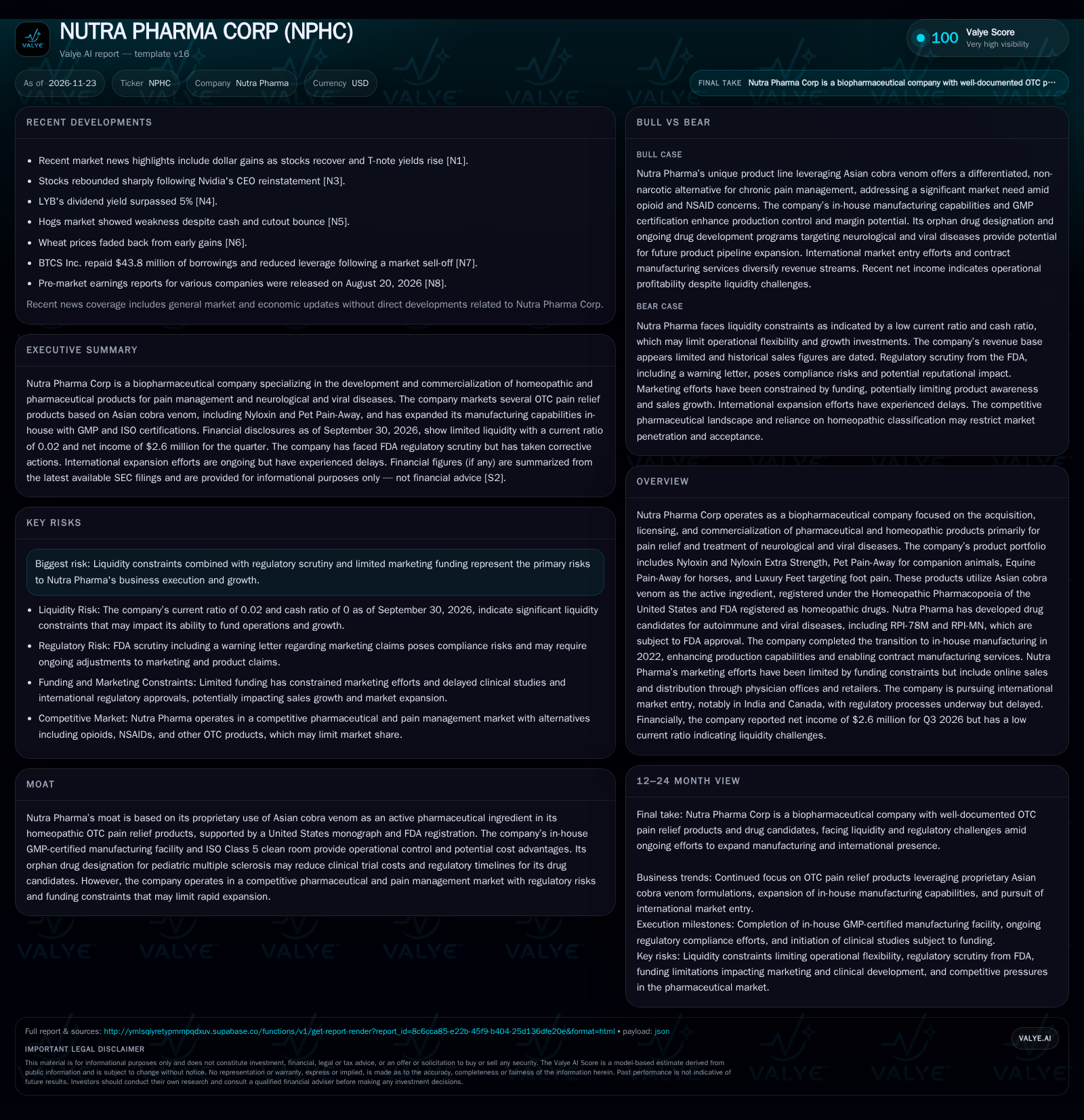
The company reported Q3 2026 net income but remains at risk from limited funding, regulatory scrutiny, and uncertain commercial momentum. Execution on marketing, international expansion, and product pipeline development are key to validating its differentiated positioning and overcoming structural barriers.
Nutra Pharma Corp occupies a distinct niche in pain management, leveraging proprietary cobra venom formulations to offer non-narcotic, homeopathic alternatives to opioids and NSAIDs. The company’s GMP-certified manufacturing and regulatory registrations provide a foundation for both branded and contract manufacturing opportunities. The company’s ability to convert unique science and operational assets into sustainable growth hinges on overcoming funding limitations, regulatory hurdles, and the challenge of scaling awareness in a crowded market.
Liquidity Pinch, Manufacturing Scale, and Unclear Revenue Traction: Where Nutra Pharma Stands
Three facts sharply define Nutra Pharma’s present state. First, the company reported net income of $2,623,828 for the quarter ending September 30, 2026 [S2]. [S2] Third, the most recent disclosed sales figure dates back to June 30, 2019, at only $10,215, leaving a six-year gap in revenue visibility [S1]. These facts together suggest a business with operational capabilities and some profitability but under acute liquidity stress and with uncertain recent commercial traction. The company’s ability to sustain operations and fund growth is in question absent clear evidence of sales recovery or external capital.
This divergence underscores the importance of analyzing cash flow statements and working capital trends to assess the true runway for ongoing activities. Additionally, the absence of recent revenue disclosures raises concerns about the transparency and consistency of financial reporting, which can affect investor confidence and the company’s ability to attract new capital. Understanding the timing and nature of cash inflows and outflows is critical to evaluating whether the company can bridge the gap between profitability on paper and practical liquidity needs.
How Proprietary OTC Pain Relief Could (or Could Not) Drive Profits
Nutra Pharma’s primary economic model is built around proprietary, homeopathic OTC pain relief products (such as Nyloxin and Pet Pain-Away) utilizing Asian cobra venom. The company’s in-house GMP-certified manufacturing facility allows for vertically integrated production, potentially supporting both higher gross margins and flexibility in scaling output. If contract manufacturing and private label deals can be expanded, this could diversify revenue and leverage fixed manufacturing costs.
However, the economics of OTC pain relief are challenging. Pricing power is limited by the crowded marketplace and the homeopathic classification, which can restrict premium positioning. Volume growth is dependent on both consumer awareness and distribution reach, both of which are constrained by Nutra Pharma’s limited marketing spend. Variable costs may be manageable given the company’s control of production, but the fixed costs of maintaining regulatory compliance and facility certification persist regardless of sales volume.
The company’s pipeline of therapeutic protein drugs (RPI-78M, RPI-MN) could, if advanced, open higher-margin, prescription-driven revenue streams. But these will require substantial capital for clinical trials, regulatory submissions, and commercialization.
The vertical integration of manufacturing offers potential cost advantages but also imposes fixed overhead that may dilute margins if volume growth does not materialize. Economies of scale in pharmaceutical manufacturing typically require substantial throughput to justify the capital investment and regulatory maintenance costs. Therefore, the company’s ability to ramp up production efficiently and secure consistent demand is pivotal. Moreover, the homeopathic nature of the products limits reimbursement opportunities and may confine sales largely to out-of-pocket consumers, which can constrain pricing elasticity and volume expansion. Strategic partnerships or licensing agreements could mitigate these risks by expanding distribution reach and sharing marketing costs, but such arrangements depend heavily on the company’s track record and market credibility.
Competitive Edge or Niche Constraint? Assessing Nutra Pharma’s Place in Pain Relief
Nutra Pharma’s differentiation comes from its proprietary use of cobra venom as an active ingredient, FDA registration under the homeopathic drug pathway, and operational control via a GMP/ISO-certified facility. This positions the company to market non-narcotic, non-addictive pain relief as an alternative to opioids, NSAIDs, and conventional OTC options.
However, the company faces formidable competitors across several dimensions: major pharmaceutical firms with deep marketing budgets, established OTC brands with broad distribution, and new entrants leveraging digital channels. The homeopathic classification could be a double-edged sword—enabling regulatory clearance for OTC sale but limiting mainstream medical adoption and reimbursement. Regulatory scrutiny, as evidenced by the 2019 FDA warning letter, adds ongoing compliance risk.
Contract manufacturing could provide a supplemental revenue stream, but the company must compete with larger, more established CDMOs (contract development and manufacturing organizations) that offer broader service portfolios and greater financial stability. The question is whether Nutra Pharma’s technical niche and certifications are enough to attract meaningful third-party business.
The regulatory environment for homeopathic products remains uncertain, with shifting policies potentially impacting market access and consumer perception. While FDA registration under the homeopathic pathway facilitates OTC availability, it does not equate to endorsement of efficacy, which can influence both prescriber recommendations and consumer trust. The company’s niche positioning may attract a dedicated segment of consumers seeking alternatives to conventional analgesics, but broader market penetration requires overcoming skepticism and educating healthcare providers. Additionally, the competitive landscape includes not only pharmaceutical incumbents but also emerging wellness and natural remedy brands leveraging digital marketing, which can rapidly capture consumer attention with lower cost structures. Nutra Pharma’s ability to articulate and substantiate its unique value proposition will be critical in differentiating itself amid these competing forces.
Unlocking Value: What a Commercial Turnaround Would Look Like
A favorable scenario would see Nutra Pharma translate its proprietary science and manufacturing capabilities into commercial momentum. This could occur if the company secures significant distribution partnerships—perhaps with pharmacy chains or online health platforms—that drive sales of Nyloxin and other OTC products. Increased marketing investment, potentially funded through external capital or a strategic partnership, would be necessary to build consumer awareness and educate prescribers.
Contract manufacturing could become a material revenue stream if Nutra Pharma leverages its GMP/ISO certifications to win third-party business, especially from smaller brands seeking specialized capabilities. Progress on international registrations (notably in India and Canada) would add incremental sales channels and validate the company’s global potential.
Evidence supporting this scenario would include a clear rebound in disclosed sales figures, new distribution agreements, expanded contract manufacturing relationships, and updates on regulatory milestones achieved in international markets.
Achieving a commercial turnaround would likely necessitate a multi-faceted strategy combining product innovation, expanded distribution, and enhanced brand credibility. The company could explore targeted marketing campaigns emphasizing the non-addictive nature and proprietary science behind its formulations to appeal to both consumers and healthcare professionals concerned about opioid alternatives. International expansion might provide access to less saturated markets with regulatory frameworks more favorable to homeopathic products, thereby diversifying revenue streams and reducing dependence on domestic sales. Furthermore, leveraging digital health platforms and telemedicine partnerships could accelerate consumer education and adoption, particularly if supported by real-world evidence or clinical data demonstrating efficacy and safety. Success in these areas would create a virtuous cycle, enabling reinvestment in marketing and product development to sustain growth.
Sustained Survival, Slow Growth: The Most Plausible Outcome Without Major Change
Absent dramatic new funding or a breakthrough in distribution, Nutra Pharma is likely to continue operating as a niche OTC player with limited market penetration. The company may maintain a small but stable presence through online sales, physician offices, and specialty retail, but constrained marketing resources and intense competition will limit the pace of growth.
Contract manufacturing and private label work could provide a buffer, but without scale, this is unlikely to offset broader funding constraints. International expansion may proceed gradually, subject to regulatory delays and the company’s ability to finance registration and launch activities.
Liquidity Crunch Meets Commercial Stagnation: What Could Go Wrong
The primary risk is that Nutra Pharma’s acute liquidity constraints force cutbacks in marketing, regulatory, or manufacturing activities, leading to a downward spiral of declining sales and operational viability. Failure to secure external funding or improve working capital could result in missed supplier payments, regulatory non-compliance, or inability to fulfill orders.
Competitively, the company risks being marginalized by larger OTC players and new entrants with superior resources. Regulatory action—such as renewed FDA scrutiny—could disrupt sales or damage reputation further, especially given the homeopathic classification’s vulnerability to shifting regulatory attitudes.
Evidence of this scenario would include further deterioration in liquidity metrics, lack of new sales disclosures, disclosure of going-concern warnings, or news of layoffs, facility closures, or loss of key distribution relationships.
Milestones and Metrics That Could Shift Nutra Pharma’s Trajectory
Updated and regular disclosure of revenue figures—particularly any rebound from the last disclosed sales in 2019—would help test whether commercial momentum is returning.
Announcements of new distribution agreements with major pharmacy chains, online platforms, or health networks would validate expanded reach.
Contract manufacturing wins, especially with third-party brands outside of related parties, would signal leverage of the company’s production assets.
Updates on international regulatory approvals or launches in India, Canada, or other target markets would support the global expansion thesis.
Progress on clinical development of RPI-78M and RPI-MN, such as trial initiations or milestone completions, would indicate pipeline advancement.
Any renewed FDA scrutiny, warning letters, or regulatory enforcement actions would increase execution risk and could impact sales.
Disclaimer: This is research-only, informational analysis and not investment advice. It may include AI-generated interpretation and general industry context. Always verify important details using primary sources.

Comments