
RemSleep Holdings: Zero Revenue, Liquidity Stress, and the Stakes of Commercial Validation
RemSleep Holdings Inc.
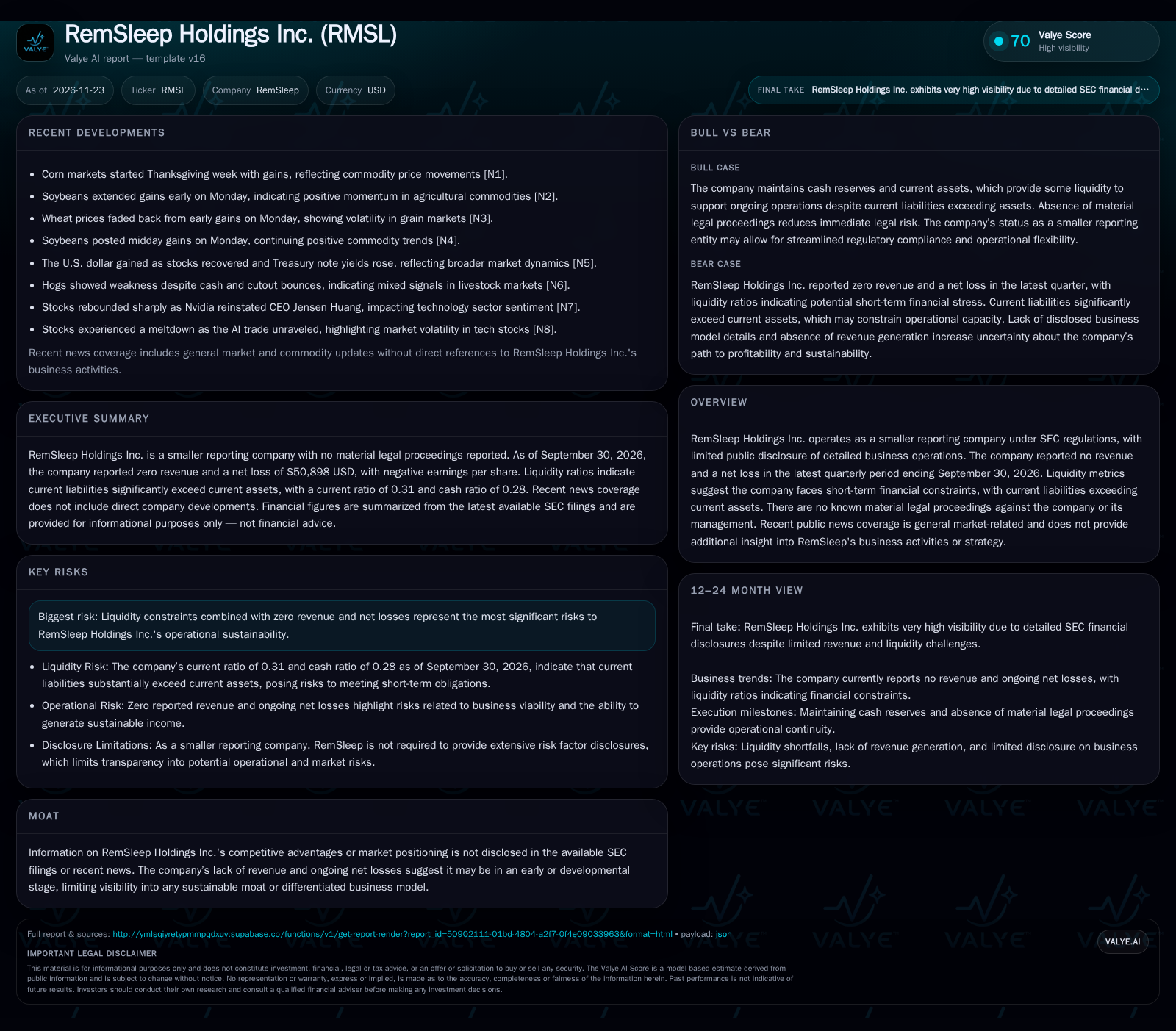
RemSleep Holdings Inc. reports zero revenue, ongoing net losses, and a current ratio of just 0.31 as of September 30, 2026, making liquidity a critical concern. The absence of disclosed business operations or commercial progress leaves the company’s path to sustainability highly uncertain. Near-term viability depends on either rapid commercialization, new funding, or cost containment to avoid deeper financial distress. [S2]
With current liabilities outpacing assets by more than 3:1 and no evidence of revenue generation or commercial traction, the firm’s near-term future depends on its ability to secure new funding or rapidly validate a commercial business model. The absence of legal or regulatory overhangs offers some relief, but operational viability now hinges on resolving existential business and funding challenges. [S2] [S1]
Acute Liquidity Stress and Absence of Revenue Define RemSleep’s Present
RemSleep Holdings Inc. reported zero revenue for the quarter ending September 30, 2026, while posting a net loss of $50,898 and negative basic and diluted earnings per share. The company’s balance sheet highlights immediate liquidity concerns: current assets of $96,803 are dwarfed by current liabilities of $315,411, resulting in a current ratio of 0.31 and cash ratio of 0.28. The company reported cash and liquidity metrics for the period; these figures do not by themselves establish operating runway, investment capacity, financial flexibility, or financing capacity. No lawsuits or regulatory proceedings are pending, so legal risk is not an immediate concern. However, the lack of any business update, new product, or revenue event in recent news or filings underscores the severity of the operational challenge. [S2] [S1]
How Business Model Uncertainty and Fixed Cost Drag Threaten Sustainability
With zero reported revenue and persistent net losses, RemSleep’s business economics remain opaque. In the absence of disclosed commercial activity, it is plausible the company either lacks a market-ready product or has failed to gain commercial traction in its target sector—possibly medical devices or sleep-related therapeutics, based on its name, though this cannot be confirmed from filings. If RemSleep is pre-revenue, its cost structure likely skews toward fixed expenses—such as regulatory compliance, management overhead, and product development—without the offset of gross profit from sales. This dynamic creates negative operating leverage: every incremental dollar spent increases losses, with no revenue to absorb overhead. [S2]
The absence of revenue also raises questions about capital needs. Pre-revenue or early-stage companies typically require periodic infusions of equity or convertible debt to sustain operations until commercialization. The current financial state suggests RemSleep is nearing the end of its existing cash runway, with little room for discretionary investment or growth initiatives.
The fixed cost structure, if significant, implies that RemSleep must achieve a minimum revenue threshold to reach operating breakeven. Without reaching this inflection point, incremental spending only accelerates cash depletion. This dynamic underscores the importance of scaling sales or licensing efforts rapidly once a product is market-ready. Moreover, the company’s capital allocation decisions—whether to prioritize product development, regulatory compliance, or market entry—will critically influence the timeline and magnitude of potential revenue generation. Efficient capital deployment becomes essential, as misallocated resources could exacerbate liquidity challenges without advancing commercialization.
Another consideration is the potential impact of development stage on financing terms. Early-stage companies with unproven technology or unclear market fit often face higher cost of capital, resulting in more dilutive or restrictive funding arrangements. If RemSleep’s technology or product concept remains unvalidated, investors may demand steeper discounts or protective provisions, further complicating future capital raises. Conversely, demonstration of technical feasibility or clinical validation could improve financing prospects.
Market Positioning Remains Unclear Amidst Severe Resource Constraints
There is no concrete evidence in filings or news of RemSleep’s market niche, customer base, or competitive differentiators. In sectors such as medical devices or health technology (if applicable), barriers to entry can include regulatory approvals, intellectual property, distribution relationships, and clinician adoption. However, RemSleep’s lack of revenue and commercial disclosure suggests any such advantages are either undeveloped or unproven. The company’s acute liquidity constraints likely further erode any potential to build or defend a moat: limited cash restricts product development, regulatory filings, customer engagement, and marketing.
Competitor categories—ranging from established medical device manufacturers to emerging healthtech startups—typically enjoy scale, distribution reach, and regulatory expertise. RemSleep’s only near-term advantage is the absence of legal or regulatory overhangs, but this is a defensive posture rather than a source of competitive strength. Without evidence of a differentiated product, pending partnership, or unique technology, RemSleep’s position in any value chain remains tenuous.
In markets characterized by rapid technological innovation and regulatory complexity, first-mover advantage or intellectual property protection can be decisive. If RemSleep lacks a defensible patent portfolio or proprietary technology, it risks commoditization or displacement by competitors with greater resources. Additionally, the absence of strategic partnerships or distribution channels limits market access, which is especially detrimental in healthcare sectors where established relationships with providers and payors are key. Without these strategic assets, the company’s ability to scale and defend market share is constrained, potentially relegating it to a marginal position or forcing reliance on licensing or acquisition as exit strategies.
A Commercial Breakthrough or Strategic Capital Could Reset the Trajectory
The most favorable scenario for RemSleep is a rapid transition from pre-revenue to revenue-generating status, whether through the launch of a validated product, a strategic partnership, or licensing agreement. Such a breakthrough would require evidence of customer adoption, regulatory clearance (if in a regulated sector), or non-dilutive funding that extends the company’s runway long enough to scale operations. Alternatively, a substantial equity raise from new or existing investors could stabilize the balance sheet and buy time to execute a go-to-market plan.
Confirmation of this scenario would include new SEC filings indicating product sales, customer contracts, or strategic investments; press releases announcing regulatory milestones or partnerships; and a measurable improvement in liquidity ratios. Falsification would occur if subsequent filings continue to report zero revenue, deepening net losses, or signal inability to raise capital.
Inaction or Incremental Progress Leaves Company Vulnerable to Dilution or Restructuring
Without evidence of business development, RemSleep may need to pursue dilutive financings, sharply cut operating expenses, or begin exploring strategic alternatives such as a merger, acquisition, or wind-down.
This scenario would be confirmed by continued zero revenue in future filings, further deterioration in liquidity metrics, or announcements of highly dilutive capital raises (e.g., deeply discounted equity or convertible offerings). Falsification would require evidence of either revenue traction or a non-dilutive capital infusion that materially improves the balance sheet.
Liquidity Exhaustion Forces Drastic Restructuring or Wind-Down
The adverse scenario is that RemSleep’s liquidity is exhausted before it can achieve commercial traction or secure new funding. In this case, the company may be forced to enter bankruptcy proceedings, liquidate assets, or pursue a distressed sale. Creditors could push for restructuring or asset sales if payables go unmet, and shareholders would likely be severely diluted or wiped out.
This scenario would be confirmed by SEC filings indicating going-concern warnings, missed payments or defaults, sharp reductions in staff or operations, or announcements of bankruptcy or asset sales. A reversal could only occur if emergency funding is secured or if a last-minute strategic transaction restores solvency.
Milestones That Would Challenge or Reinforce the RemSleep Thesis
Any announcement or SEC filing reporting initial product revenue, customer contracts, or purchase orders would materially alter the company’s outlook.
Disclosure of a new equity or debt financing, including terms and dilution impact, is critical to assessing near-term solvency.
Evidence of regulatory progress—such as FDA filings, approvals, or clinical trial milestones (if applicable)—would signal commercial readiness.
A useful metric would be quarterly cash burn and projected runway, if disclosed, to gauge the urgency of funding needs.
Board or management changes, especially involving turnaround specialists or new strategic investors, could indicate a shift in direction.
Updates on legal or regulatory risks, though currently absent, could impact operational flexibility if they emerge.
Any strategic partnership, acquisition, or licensing deal announced via press release or filing would challenge the base case of inaction.
A change in auditor opinion, particularly a going-concern warning, would reinforce the downside scenario.
Disclaimer: This is research-only, informational analysis and not investment advice. It may include AI-generated interpretation and general industry context. Always verify important details using primary sources.

Comments