
China Foods Holdings: s and Channel Expansion in a Shifting Chinese Health Market
Its multi-channel strategy and C2M product approach offer potential for differentiation, but regulatory risk and financial headwinds define the near-term landscape.
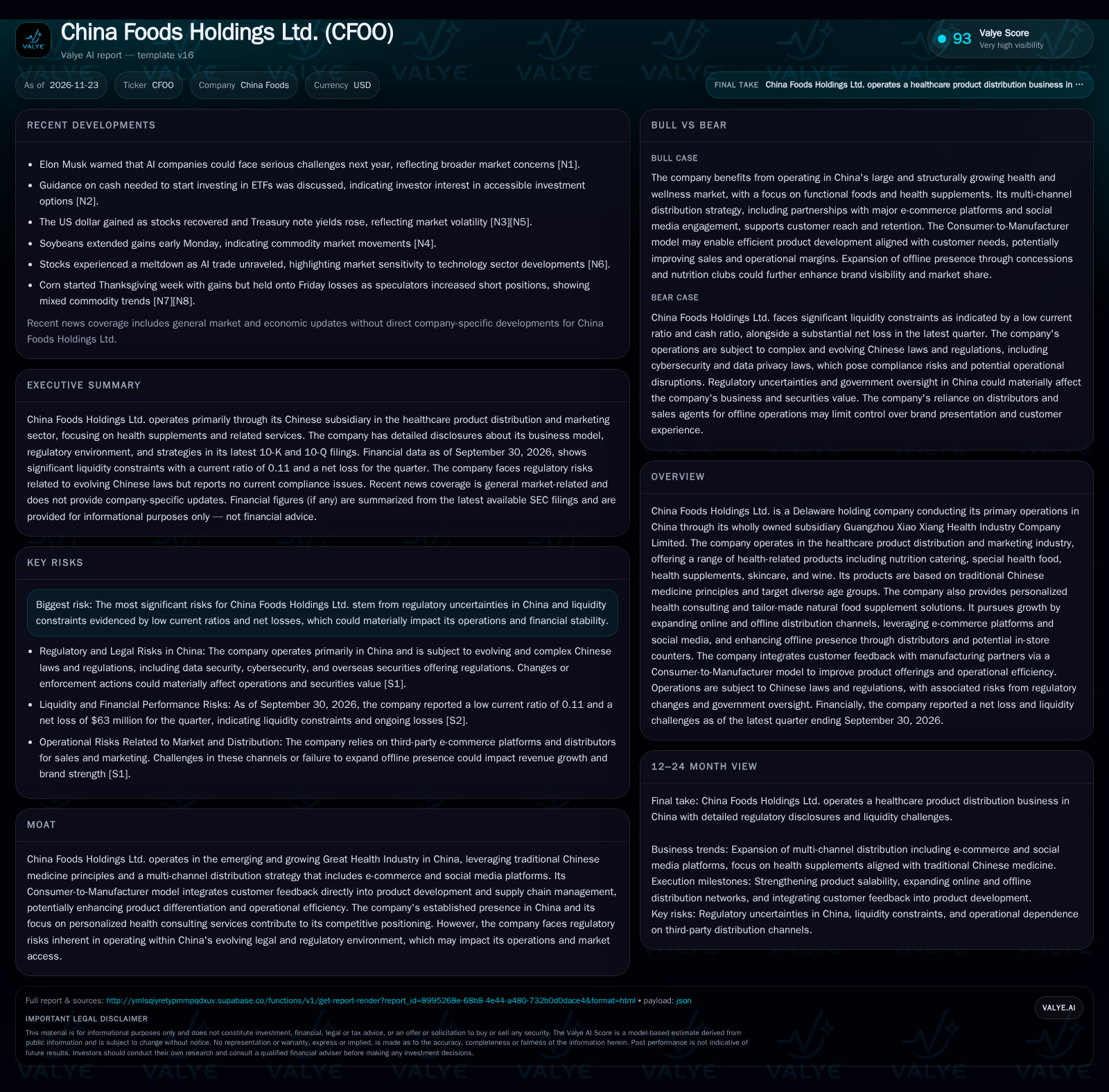
The company seeks growth through e-commerce and offline expansion, leveraging a consumer-to-manufacturer model to tailor products in the Chinese health market. Regulatory compliance remains a persistent risk, but no recent enforcement actions have been reported.
As of September 2026, the company’s current ratio of 0.11 and net quarterly loss underscore a pressing need for operational and financial stabilization. Yet, China Foods continues to invest in multi-channel distribution and a consumer-driven product model, seeking to carve out a differentiated position in the crowded supplement and health product industry. The question is whether these strategic bets can overcome the gravity of its financial and regulatory constraints.
Liquidity Pressures and Strategic Channel Expansion Define the Current Moment
The most immediately material facts are China Foods Holdings Ltd.’s severe liquidity constraints and ongoing operational losses. As of September 30, 2026, the company reported cash and equivalents of $20.6 million against current liabilities of $1.7 billion, resulting in a current ratio of 0.11 and a cash ratio of 0.01. Net income for the quarter was a loss of $63 million, with zero basic and diluted earnings per share reported [S2].
In parallel, China Foods is pursuing a multi-channel distribution strategy, aiming to expand both online (Tmall, JD.com, WeChat, TikTok, Xiaohongshu) and offline (distributors, sales agents, in-store counters, nutrition clubs) presence in China’s health and wellness market [S1].
Although the company acknowledges regulatory risks—particularly around data security and evolving Chinese compliance demands—it has not received any formal inquiry or sanction from PRC authorities as of its latest filings [S1].
Financial Model Under Strain: Margins, Mix, and the Cost of Growth
China Foods Holdings’ business model relies on distributing and marketing a portfolio of health products—supplements, nutrition catering, special health foods, skincare, and wine—primarily in China. Revenue is driven by product volume across a broad customer base, with pricing power typically constrained by the competitive nature of Chinese consumer health markets and the prevalence of similar offerings.
The company’s use of a Consumer-to-Manufacturer (C2M) model may, in theory, reduce product development cycle times and align offerings more closely with consumer preferences, potentially supporting higher volumes or better margins if successful. The company reported cash and liquidity metrics for the period; these figures do not by themselves establish operating runway, investment capacity, financial flexibility, or financing capacity.
Gross margins in this sector can be highly sensitive to product mix (e.g., supplements versus skincare or wine), channel costs (e.g., e-commerce platform fees, distributor commissions), and logistics. The strategy to reduce logistics costs and strengthen product salability suggests an attempt to offset margin pressures, but execution may be hampered by capital constraints.
Operating leverage could be positive if channel expansion and product innovation drive significant revenue growth, but current losses and a high fixed-cost base raise the risk that scale benefits may not materialize before additional funding is required.
Competing for Mindshare and Shelf Space in a Fragmented Market
China Foods operates in a crowded and fast-evolving health product market in China, facing competition from both domestic and multinational supplement brands, traditional Chinese medicine (TCM) enterprises, and a growing number of direct-to-consumer startups.
The multi-channel distribution model—leveraging both major e-commerce platforms and physical outlets—offers potential breadth, but also exposes the company to intense competition for online traffic, high platform fees, and limited bargaining power. Offline, reliance on third-party distributors and sales agents could dilute brand control and customer experience, especially as larger competitors invest in direct channels or proprietary stores.
Product differentiation based on traditional Chinese medicine principles and personalized health consulting services may provide some moat, particularly if these offerings can be credibly marketed and tailored to consumer needs. However, the absence of established recurring revenue mechanics or disclosed customer retention metrics limits visibility into the sustainability of these advantages.
Regulatory compliance and brand credibility are critical differentiators in this sector. Any future compliance issues or negative publicity could quickly erode competitive standing.
If Channel Expansion and C2M Product Innovation Gain Traction
The upside scenario rests on China Foods successfully leveraging its C2M model to develop high-demand products that resonate with evolving Chinese consumer preferences, while its multi-channel strategy drives accelerated top-line growth. If the company can rapidly scale sales via e-commerce platforms and expand offline through nutrition clubs or in-store counters, it may achieve sufficient volume to improve operational leverage and negotiate better terms with suppliers and distributors.
Evidence that would confirm this trajectory includes: sustained double-digit revenue growth quarter-over-quarter, a demonstrable improvement in gross margins (driven by mix or cost efficiencies), and a narrowing of net losses or a return to operating profitability. Additional validating indicators would be successful launches of new flagship products, improved brand recognition, and positive customer engagement metrics—if disclosed.
Likely Course: Incremental Channel Gains Offset by Persistent Financial Strain
The most plausible near-term scenario is one in which China Foods achieves moderate expansion in online and offline channels but continues to struggle with cash flow and profitability due to margin pressures and the high cost of customer acquisition in a competitive market. The C2M model may produce some incremental product wins, but broad-based differentiation and scale benefits likely remain elusive without substantial new investment.
Under this scenario, the company could experience modest revenue growth and some operational improvements, but ongoing net losses and working capital deficits persist. Confirmation would come from sequentially stable or slightly improving revenue, continued negative net income, and little change in current ratio or cash position.
Falsification would occur if the company either sharply reverses its losses (suggesting a breakthrough in cost control or sales productivity) or if financial distress accelerates, leading to missed payments, loss of key distributor relationships, or regulatory intervention.
Liquidity Crunch and Regulatory Setbacks Threaten Continuity
In the adverse scenario, China Foods’ liquidity constraints worsen before channel or product initiatives can deliver meaningful results. The company may be forced to curtail marketing, delay supplier payments, or scale back expansion plans, leading to further erosion of brand presence and customer trust.
Potential triggers include a sharp drop in sales (due to intensified competition or regulatory changes), loss of key distribution partners, or new compliance requirements that increase costs or restrict product offerings. If the company fails to secure additional financing or asset sales, insolvency risk becomes acute.
Confirmation of this scenario would be visible in deteriorating sales, widening net losses, further declines in current and cash ratios, or the disclosure of default events, regulatory actions, or management turnover.
Milestones That Will Test the Resilience of China Foods’ Growth Ambitions
Quarterly revenue growth and margin trends: Sustained top-line growth or margin improvement would support the case for successful channel and product strategies.
Gross profit by product category (if disclosed): Shifts in mix toward higher-margin offerings or away from commoditized products would indicate progress.
Customer acquisition and retention metrics: Data on repeat purchase rates, customer lifetime value, or loyalty program uptake would help test the stickiness of the model.
Regulatory disclosures: Any mention of new investigations, compliance warnings, or legal proceedings in China could materially alter the risk profile.
Expansion of offline footprint: Evidence of new nutrition clubs, in-store counters, or exclusive distributor arrangements would signal execution on the offline growth plan.
C2M model effectiveness: Qualitative or quantitative disclosures about how customer feedback is impacting product development and sales outcomes would clarify the practical value of the approach.
Management or board changes: Significant personnel shifts could signal distress or a strategic pivot.
Disclaimer: This is research-only, informational analysis and not investment advice. It may include AI-generated interpretation and general industry context. Always verify important details using primary sources.

Comments