
Spark I Acquisition Corp: Extension, Merger Agreement, and the Stakes of SPAC Execution
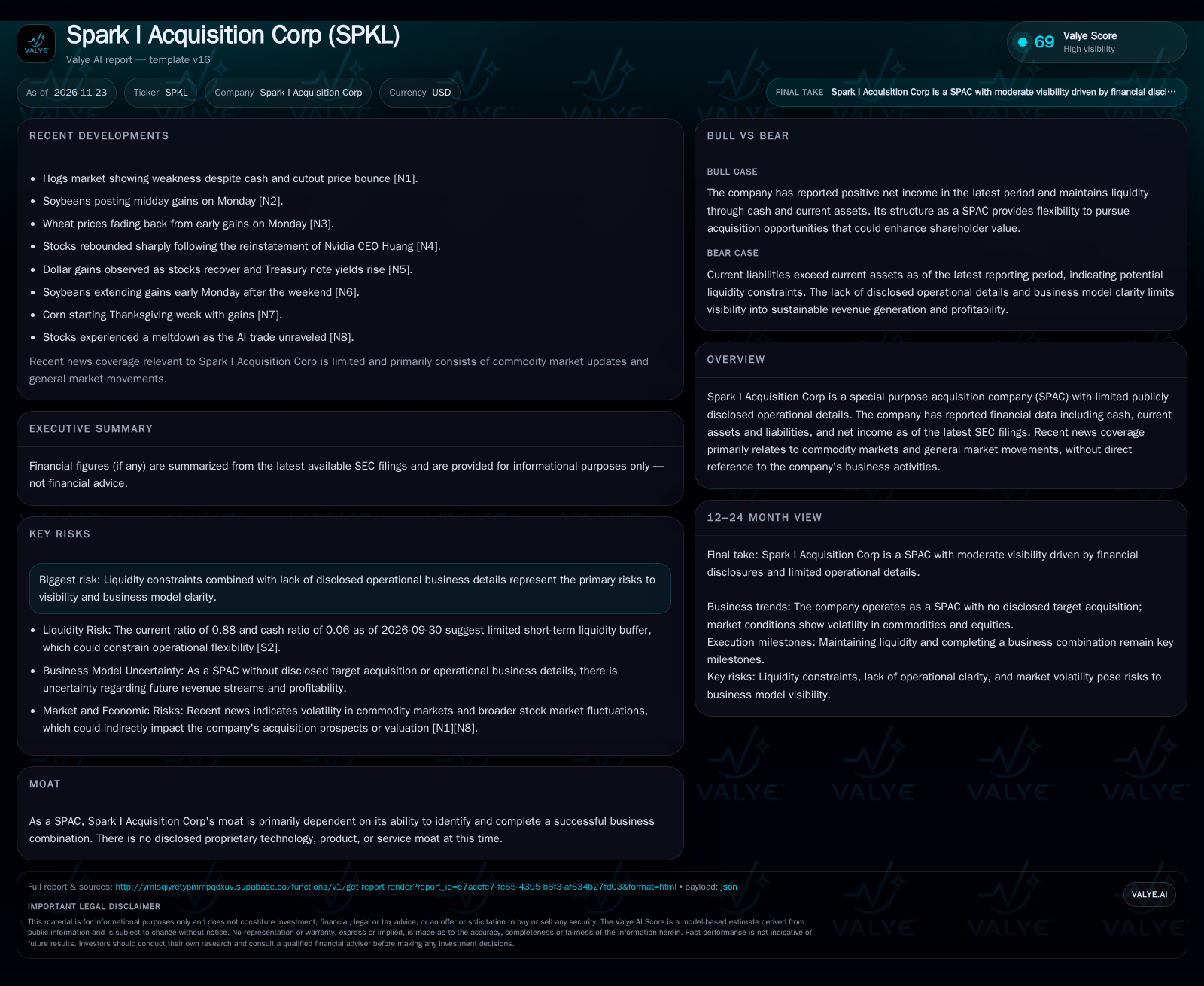
Spark I Acquisition Corp, a blank-check company pursuing its first business combination, has extended its merger deadline to March 2027 and entered into a merger agreement with ZincFive, Inc. While net income is reported for the period, the company’s current liabilities now exceed current assets, leaving execution and liquidity management as critical hurdles.
Spark I Acquisition Corp is a SPAC that recently extended its deadline for a business combination to March 2027 and entered into a merger agreement with ZincFive, Inc. The company’s future hinges on successfully closing the merger and managing short-term liquidity.
Spark I Acquisition Corp is at a pivotal juncture typical of late-stage SPACs: it has extended its deadline to complete a business combination and reached a merger agreement with ZincFive, Inc. The successful completion of the merger—and the terms under which it is executed—will determine whether Spark I can transition from a capital pool into an operating business with real value creation potential.
Merger Agreement and Deadline Extension Define the Present
As of September 2026, Spark I Acquisition Corp has taken two major steps: it entered into a merger agreement with ZincFive, Inc., and secured shareholder approval to extend its business combination deadline from September 29, 2026, to March 29, 2027 [S2]. This extension gives Spark I additional time to close its initial business combination, a critical milestone for any SPAC. Financially, the company reported $7.5 million in current assets and $8.5 million in current liabilities, yielding a current ratio of 0.88 and a cash ratio of just 0.06 as of September 30, 2026 [S2]. Net income for the period was $5.36 million, but negative earnings per share indicate dilution or non-operating income effects [S2]. The combination of a merger agreement and a ticking extension clock now frames the company's near-term trajectory.
How SPAC Economics and Capital Structure Shape the Outcome
As a SPAC, Spark I’s fundamental economics are determined by its ability to identify, negotiate, and close a value-accretive merger. Until a business combination is consummated, the company generates no operating revenue. The primary sources of cash are IPO proceeds and sponsor-backed loans, with any interest income typically modest and non-recurring. The company’s current asset and liability structure, including a convertible unsecured promissory note from its sponsor, reflects the common SPAC model of bridging operating expenses and deal costs with sponsor funding until a merger event [S2].
Should the merger with ZincFive close, Spark I’s economics will hinge on the acquired company's financial profile: revenue scale, margin structure, capital intensity, and growth prospects. For now, the reported net income may reflect accounting effects such as changes in warrant valuations or other non-cash items, which are typical in SPAC financials prior to business combinations. The negative earnings per share despite positive net income signals that dilution, possibly from warrants or sponsor shares, is already affecting per-share economics [S2]. After the merger, the capital needs and operating leverage will shift to the target business’s fundamentals, potentially requiring additional capital if ZincFive is growth-stage or capital-intensive.
The capital structure of SPACs like Spark I inherently creates a bifurcated risk profile before and after the business combination. Prior to closing, the SPAC operates largely as a holding entity with limited operational risk but significant liquidity risk, especially as the deadline approaches and operating expenses persist. The sponsor’s convertible promissory note and potential bridge financing provide necessary runway but also introduce leverage and potential dilution that can affect shareholder value. Post-merger, the capital structure complexity often increases as the acquired company’s existing debt, equity, and capital needs integrate with the SPAC’s structure, potentially requiring recapitalization or new equity raises to support growth or debt servicing. This transition phase is critical because misalignment between capital structure and operating cash flow can constrain strategic flexibility and investor confidence.
Moreover, the timing and terms of the merger directly influence the SPAC’s economics. Delays in closing can exacerbate liquidity pressures, forcing additional sponsor funding or asset sales, which may dilute existing shareholders or complicate governance. Conversely, an expedited close without thorough due diligence or favorable terms risks overpaying for the target or inheriting unforeseen liabilities. The interplay between deal timing, financing arrangements, and market conditions ultimately shapes the merged entity’s valuation trajectory. A well-executed merger aligns incentives to preserve trust cash, minimize dilution, and position the combined company for sustainable growth, whereas execution missteps can erode value before operational synergies materialize.
SPACs Compete for Targets, Not Markets—But Post-Merger Dynamics Matter
Spark I’s competitive environment is defined by its ability to source, negotiate, and close a compelling business combination ahead of SPAC peers also seeking targets. The recent merger agreement with ZincFive positions Spark I ahead of SPACs still searching for targets, but execution risk remains high until the deal closes. The lack of proprietary technology, recurring revenue, or operational moat means Spark I’s value proposition is entirely contingent on the quality of the acquired business [S2].
Post-merger, the competitive landscape will shift to ZincFive’s industry segment, where value creation will depend on market share gains, differentiation, and the ability to scale. The transition from a SPAC to an operating public company can be challenging, as many de-SPAC transactions face post-close execution risk, integration complexity, and market skepticism regarding projections. The ability to retain investor interest and attract institutional capital after the merger will be critical for long-term value.
Value Creation if the ZincFive Merger Closes Smoothly
The most favorable outcome for Spark I shareholders is a timely and successful closing of the merger with ZincFive under terms that allow for accretive value realization. If ZincFive is a high-growth, capital-efficient company with an attractive market opportunity, Spark I could transition into a differentiated operating business with strong revenue potential and public-market access to additional capital.
Confirmation of this scenario would include: (1) the public release of detailed pro forma financials showing robust revenue growth, positive margins, and a clear path to profitability for ZincFive; (2) shareholder approval of the merger; (3) minimal redemptions of SPAC shares prior to closing, preserving cash in trust; and (4) positive initial trading performance and institutional investor support post-close.
Falsification would occur if the merger is delayed, terminated, or if extensive redemptions drain the SPAC’s cash, leaving the combined entity undercapitalized or unable to execute its business plan.
Most Likely: Execution Challenges and a Narrow Window for Success
The most plausible outcome is that Spark I faces significant execution risk over the next several months as it works to close the ZincFive merger. [S2]
In this scenario, the merger eventually closes—but possibly with significant redemptions, resulting in less cash available for the combined company. Post-close, the new entity may face challenges proving its business model and meeting public market expectations, especially if ZincFive is not yet profitable or requires further capital. Evidence supporting this base case would include routine SEC filings without major surprises, ongoing sponsor support, and the absence of major regulatory or shareholder obstacles.
Falsification would be rapid deal termination, failure to secure shareholder approval, or material adverse developments in ZincFive’s fundamentals prior to closing.
Failure to Close: Liquidation and Share Redemption Risks
In the adverse scenario, Spark I fails to close the ZincFive merger within the extended deadline—either due to regulatory, financial, or shareholder hurdles. If the business combination is not consummated by March 29, 2027, the company is obligated to redeem all public shares and liquidate [S2].
This would likely return only the cash held in trust to shareholders, with minimal or no premium, and potentially leave warrant holders and sponsors with out-of-the-money securities. The risk of sponsor loans becoming unrecoverable and the loss of sunk offering and operating costs would crystallize. Confirmation would come from missed merger milestones, regulatory rejections, or a spike in redemption requests ahead of the merger vote.
Falsification would be a timely close with preserved cash and a viable path to post-merger operations.
Milestones That Will Determine Whether Spark I Delivers Shareholder Value
Progress toward finalizing and closing the merger agreement with ZincFive, including any SEC or shareholder approvals required.
Disclosure of pro forma financials for ZincFive, including revenue, EBITDA, and capital requirements—if disclosed, these would clarify the quality of the business combination.
Any additional sponsor loans or bridge financing required to maintain operations prior to the merger.
Changes in current assets and liabilities in subsequent quarterly filings, which would signal improving or deteriorating liquidity.
Post-merger trading performance and analyst/investor commentary, which would reflect market confidence in the de-SPACed entity.
Material regulatory, legal, or due diligence issues that could threaten or delay the deal.
Disclaimer: This is research-only, informational analysis and not investment advice. It may include AI-generated interpretation and general industry context. Always verify important details using primary sources.

Comments