
AMASS BRANDS: Brand Leadership Confronts Liquidity Strain and Nasdaq Compliance Pressures
AMASS BRANDS leads the U.S. organic non-alcoholic wine market with its Good Twin brand, but persistent liquidity shortfalls, continued net losses, and Nasdaq listing threats now overshadow its commercial momentum. The company's ability to address near-term financing and compliance risks will likely determine whether its market position translates into enduring value.
AMASS BRANDS' Good Twin brand has achieved U.S. segment leadership in organic non-alcoholic wine, driving a preliminary $5.3 million in Q3 2026 net revenue. Near-term resolution of funding and compliance issues is critical to sustaining the company's competitive position amid rising risk of delisting and financial distress. [N1] [S1]
AMASS BRANDS stands at a critical juncture: its Good Twin brand has captured the top spot in the U.S. organic non-alcoholic wine market, fueling a notable revenue surge and a brief stock price rally. The company’s ability to resolve these financial and compliance pressures—before potential delisting or dilution events—will likely determine whether its market leadership can be sustained or if external risks will erode its competitive gains. [N1] [N2] [S1]
Leadership in Organic Non-Alcoholic Wine Meets Financial and Regulatory Pressure
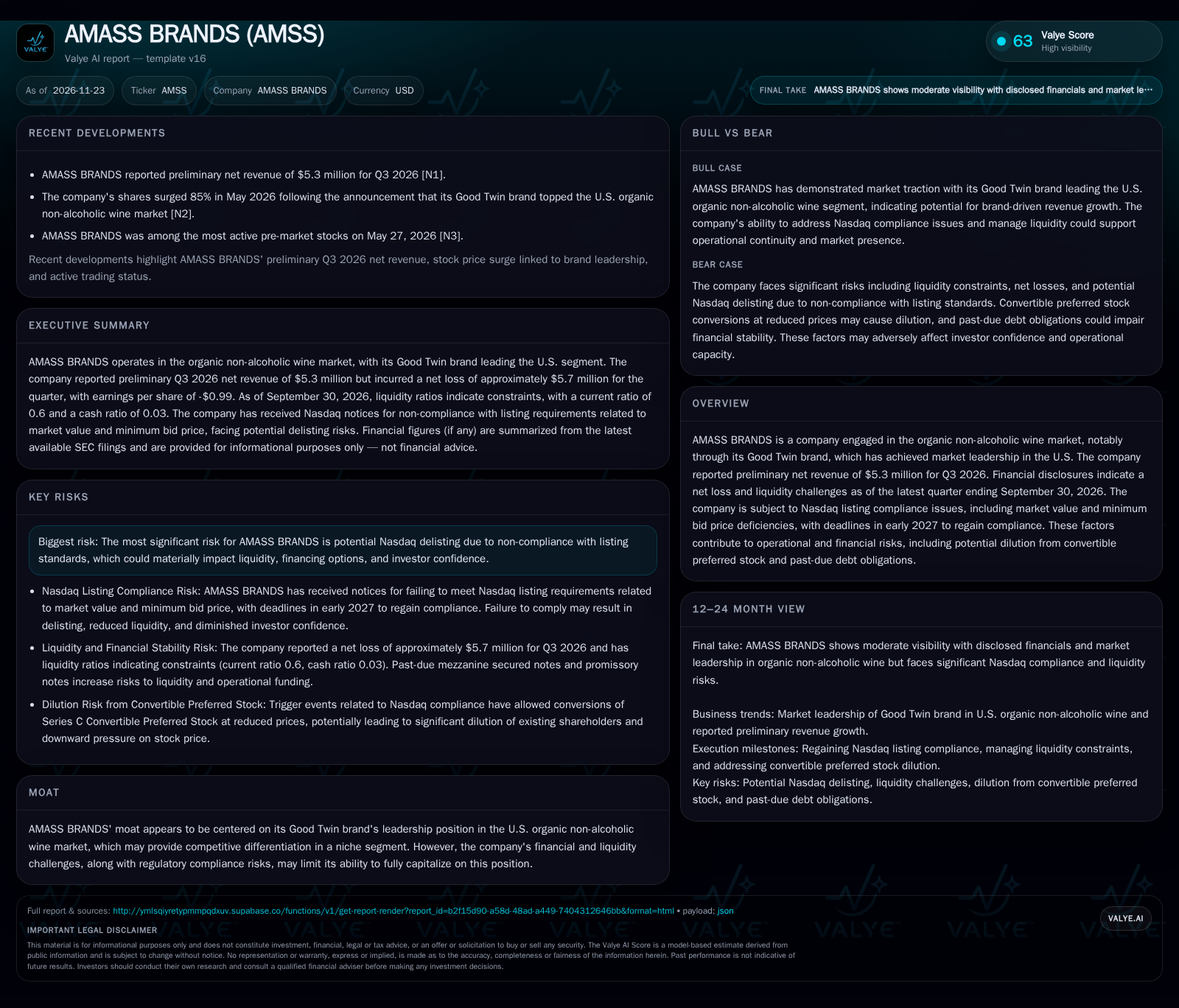
AMASS BRANDS reported preliminary net revenue of $5.3 million for Q3 2026, reflecting commercial momentum tied to its Good Twin brand, which has achieved market leadership in the U.S. organic non-alcoholic wine segment. This commercial win was followed by an 85% share price surge in May 2026 after the leadership announcement, signaling market enthusiasm for the brand’s positioning. However, the company’s financial health remains fragile: as of September 30, 2026, AMASS BRANDS reported a net loss of approximately $5.7 million for the quarter and held just $818,937 in cash and cash equivalents. Simultaneously, AMASS BRANDS has received Nasdaq notices of non-compliance with listing requirements, with early 2027 deadlines to regain compliance. The risk of delisting, combined with the potential for significant dilution from convertible preferred stock conversions triggered by compliance failures, now threatens to overshadow the company’s commercial achievements. [N1] [N2] [S1]
Revenue Growth Offsets by Losses: The Underlying Economics of AMASS BRANDS
AMASS BRANDS generates revenue by selling organic non-alcoholic wine, with its Good Twin brand at the forefront. The reported $5.3 million in Q3 2026 preliminary net revenue likely reflects both volume expansion and premium positioning within a fast-growing beverage niche. However, the economics of non-alcoholic wine are challenging: margins tend to be thinner than alcoholic counterparts due to higher production costs (organic sourcing, de-alcoholization processes), marketing spend to educate and convert consumers, and premium packaging. Given the company’s net loss of $5.7 million in the same quarter, it is clear that fixed costs—such as production facilities, distribution logistics, and brand marketing—are not yet being leveraged efficiently enough to offset relatively modest revenue scale. The persistent cash shortfall and negative operating leverage suggest that AMASS BRANDS requires either substantial revenue growth or a significant restructuring of cost structure to approach break-even. The capital-intensive nature of beverage distribution, especially for new brands, means that funding needs are ongoing, and constrained liquidity may limit the ability to invest in further growth or defend market share.
Brand Leadership as Differentiator—But Is It Durable?
The Good Twin brand’s ascendance to U.S. market leadership in organic non-alcoholic wine provides AMASS BRANDS with a valuable, if potentially fragile, competitive edge. In a category characterized by low brand loyalty and rapidly evolving consumer preferences, first-mover or early-mover status can confer temporary pricing power and distribution advantages. However, barriers to entry in non-alcoholic beverages are relatively low: established wine, beverage, and CPG companies can quickly introduce competing products, leveraging existing distribution networks and marketing muscle. The durability of AMASS BRANDS’ position will depend on its ability to deepen consumer loyalty (through taste, story, or health positioning), secure retail and e-commerce shelf space, and maintain cost discipline. Without sustained investment in brand and distribution, the current leadership could prove transient, especially as larger or better-capitalized rivals target the same growth segment. Additionally, the risk of dilution and operational distraction from financial distress could weaken AMASS BRANDS’ ability to defend its position against both new entrants and established beverage conglomerates.
From Market Leader to Profitable Scale: What Would Need to Happen
The most favorable outcome would see AMASS BRANDS successfully addressing its liquidity and compliance challenges—potentially through new equity or strategic investment—while leveraging its Good Twin brand leadership to drive rapid revenue growth. If the company can regain Nasdaq compliance without excessive dilution, secure working capital to support production and marketing, and improve operating leverage as revenues scale, it could establish a defensible niche in the premium non-alcoholic wine market. Confirmation of this scenario would require evidence of sustained or accelerating revenue growth (quarterly increases above industry norms), narrowing operating losses, new capital raised on non-punitive terms, and improvements in liquidity ratios. Additional positive signals would include expanded retail distribution, international expansion, or the signing of strategic partnerships with major beverage distributors. Falsification would come from continued cash burn without new funding, persistent non-compliance with Nasdaq, or erosion of brand leadership metrics.
Navigating Tightrope: Commercial Progress Versus Financial Constraints
The most plausible near-term scenario for AMASS BRANDS is a continued struggle to balance the promise of its Good Twin brand with the realities of constrained liquidity and looming regulatory deadlines. The company may seek a reverse stock split and/or additional capital raises to regain Nasdaq compliance, but these actions could be dilutive and may not fully resolve funding needs if operational losses persist. While revenue could continue to grow modestly due to category momentum, cost pressures and potential loss of investor confidence may restrict the ability to invest in marketing and distribution, slowing the pace of market share gains. The risk of delisting remains elevated, and even if avoided, the company may face a structurally higher cost of capital. Confirmation of this scenario would include stable but unspectacular revenue performance, ongoing net losses, incremental financing events with dilution, and repeated warnings or extensions from Nasdaq. Evidence contradicting this scenario would be a sudden, material improvement in profitability or a strategic transaction that fundamentally alters the capital base.
Liquidity Exhaustion and Delisting: The Spiral of Financial Distress
In the adverse scenario, AMASS BRANDS fails to secure new funding or strategic partnerships in time to meet its operational and regulatory obligations. Continued net losses and a shrinking cash balance could force the company to delay payments, scale back production, or lose key distribution relationships. If Nasdaq delisting occurs, secondary trading liquidity would deteriorate, making it harder to attract new capital and further depressing the share price. Triggered conversions of Series C Convertible Preferred Stock at reduced prices would accelerate dilution, potentially leading to a downward spiral in equity value and eroding any remaining investor confidence. Falsification would require a rapid, material capital infusion or an acquisition by a larger beverage company.
Milestones That Will Determine Whether AMASS BRANDS Converts Brand Momentum Into Lasting Value
Quarterly net revenue growth for the Good Twin brand and the broader portfolio—look for sustained acceleration or signs of plateauing, if disclosed.
Liquidity ratios (current ratio, cash ratio) and cash balance updates—especially any improvement from fresh capital or worsening due to ongoing cash burn.
Nasdaq compliance updates, including progress toward regaining market value and minimum bid price thresholds or any extension/forbearance notices.
Announcements of new equity raises, strategic investments, or partnerships—and the terms (dilutive or otherwise) attached to such financings.
Disclosure of conversions of Series C Convertible Preferred Stock and their impact on the share count and existing shareholder dilution.
Updates on past-due debt obligations and restructuring/repayment plans, if disclosed.
Expansion of distribution channels or entry into new geographic markets, which could signal scaling potential or, if absent, competitive stalling.
Disclaimer: This is research-only, informational analysis and not investment advice. It may include AI-generated interpretation and general industry context. Always verify important details using primary sources.

Comments