
GIVBUX’s Super App Gamble: Platform Integration, Competitive Pressures, and the Stakes of Scaling Amid Liquidity Strain
GIVBUX, INC. seeks to carve a niche in the crowded Fin-Tech landscape with its feature-rich Super App, blending payments, rewards, social networking, and charitable giving.
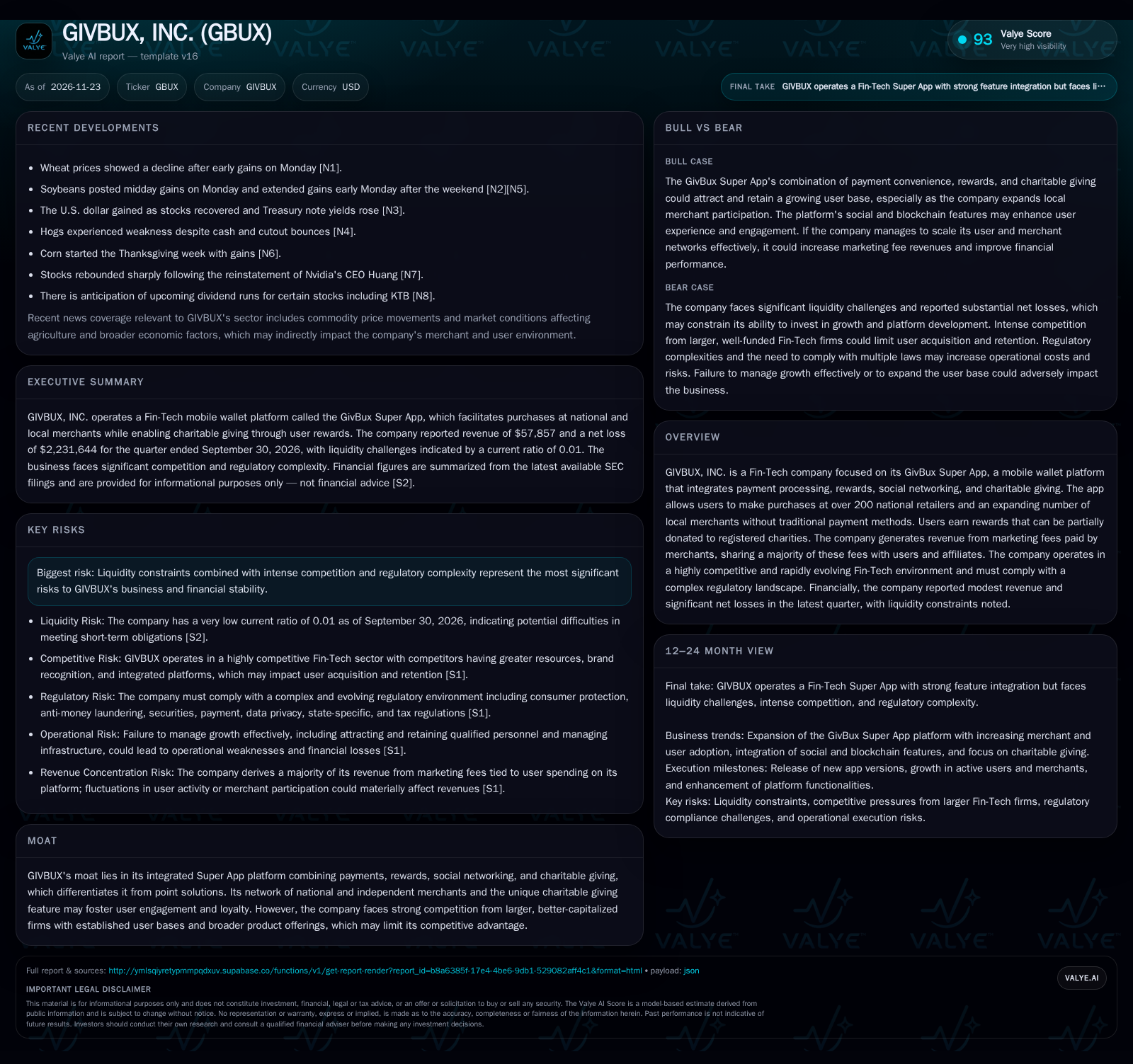
GIVBUX’s Super App aspires to differentiate through integrated payments, rewards, and charitable giving, targeting both national and local merchants. The path to viability likely hinges on accelerating user and merchant growth while navigating regulatory and competitive headwinds. [S1] [S2]
GIVBUX, INC. is betting on the power of integration with its GivBux Super App, aiming to provide a seamless payment and rewards experience that also channels consumer spending into charitable giving. The company’s model—linking mobile wallet transactions at hundreds of retailers to both consumer rewards and direct donations—positions it at the intersection of commerce, fintech, and social impact.
Recent Financials and Platform Expansion Define GIVBUX’s Inflection Point
GIVBUX, INC. reported revenue of $57,857 and a net loss of $2,231,644 for the quarter ended September 30, 2026. The company reported cash and liquidity metrics for the period; these figures do not by themselves establish operating runway, investment capacity, financial flexibility, or financing capacity. Operationally, the GivBux Super App has been downloaded over 20,000 times, supporting transactions at more than 200 national retailers and a growing contingent of local merchants. These facts set the stage for a company with feature breadth and some early adoption, but facing severe financial constraints that could limit its ability to invest, compete, or even sustain operations without external support. [S1] [S2]
How the GivBux Super App Could Turn User Spend into Revenue
The GivBux Super App’s economics hinge on a merchant-funded model: retailers pay marketing fees based on user spend through the app, with GIVBUX returning approximately 70% of these fees to users and affiliates and retaining 30%. This structure borrows from affiliate marketing, but with the added complexity of reward redistribution and charitable giving. For GIVBUX, this means that gross revenue potential is tightly linked to platform transaction volume, user engagement, and merchant willingness to pay for access and exposure.
The business is inherently high-volume, low-margin—requiring rapid scaling of both user and merchant bases to drive meaningful profitability. Fixed costs likely include platform development, compliance, and marketing, while variable costs scale with transaction volume and reward payouts. Without a material boost in transaction throughput or a shift in fee/reward splits, the company’s path to operating leverage is uncertain. Capital requirements will remain high as long as the company is forced to subsidize growth and absorb losses, especially with thin per-transaction margins and the need to continually enhance platform features.
Additionally, the integration of charitable giving into the rewards ecosystem adds complexity to the unit economics. Allocating a portion of rewards toward donations may enhance user goodwill and differentiation but could reduce the share of fees available for direct user incentives, potentially impacting the app’s attractiveness to high-frequency spenders. The company must carefully calibrate this balance to maintain user engagement without eroding merchant fee tolerance. Moreover, as the platform scales, operational costs related to compliance, fraud prevention, and payment settlement may increase disproportionately, further pressuring margins unless offset by significant volume growth or operational efficiencies.
Competitive Dynamics: Can Integration and Social Impact Offset Scale Disadvantages?
GIVBUX faces competition from established digital wallets, payment networks, and emerging Super Apps—most of which enjoy far greater brand recognition, user bases, and financial resources. These entrenched players can subsidize user acquisition, negotiate lower merchant fees, and invest in advanced features like AI-driven personalization or embedded financial services.
GIVBUX’s potential differentiation rests on its unique blend of rewards, charitable giving, and integrated social features. This could appeal to a niche of socially conscious consumers and charities, especially if the platform can deliver a seamless experience and compelling incentives. However, larger competitors can quickly replicate reward and charity features if they prove sticky. The absence of payment processing fees and chargebacks for merchants is attractive, but may not be enough to drive mass adoption without significant user scale. For GIVBUX to defend its position, it must not only grow its network but also continually innovate on user experience and merchant value—while managing the risk of being outspent or outmaneuvered by better-capitalized rivals.
Network Effects and Social Engagement Drive Accelerated Adoption
The most favorable scenario for GIVBUX involves rapid growth in both user and merchant adoption, creating a self-reinforcing network effect. If the Super App’s rewards, social, and charitable features prove uniquely engaging, user retention could rise, leading to increased transaction volumes and higher merchant willingness to pay marketing fees. As more local merchants join, the platform could become a go-to payment and engagement channel, deepening its value proposition.
Evidence that would confirm this trajectory includes a sharp increase in monthly active users, a growing roster of active merchants (especially in new geographies or categories), and a rising percentage of repeat transactions per user. Merchant testimonials, third-party integrations, or increased inbound interest from charities would further validate traction. Ultimately, if GIVBUX can demonstrate operating leverage—where revenue growth begins to outpace cost escalation—its business model could shift from cash burn to profitability.
Incremental Expansion Amid Persistent Financial Strain
The most likely near-term outcome is a continuation of incremental user and merchant growth, limited by GIVBUX’s current liquidity constraints and the need to manage compliance and operational complexity. The platform may continue to add features and refine its value proposition, but lacking substantial new capital or a viral adoption catalyst, growth will probably remain modest relative to sector leaders.
Confirmation of this scenario would include steady but not exponential increases in app downloads, transaction volume, and merchant sign-ups, without a corresponding improvement in profitability or liquidity. Any external fundraising or partnership announcements would indicate attempts to shore up the balance sheet or accelerate growth, but unless these are transformative, the company’s competitive position and financial health will likely remain fragile.
Liquidity Crisis or Competitive Squeeze Forces Retrenchment
The most adverse scenario is that GIVBUX’s liquidity position deteriorates further before user and merchant momentum can meaningfully improve. Under this scenario, the company may be forced to curtail platform investment, delay or halt feature rollouts, or even seek restructuring or asset sales. Intense competition could erode user and merchant interest, especially if larger platforms launch similar features or target the same merchant base.
Confirmation would come from declining user activity, merchant attrition, delays in app updates, or explicit disclosures about going-concern risks. Missed payroll, defaulted obligations, or regulatory enforcement actions could accelerate a downward spiral. In the worst case, the company’s platform could be marginalized before it achieves meaningful scale, resulting in a wind-down or distressed acquisition.
Milestones and Metrics to Test GIVBUX’s Platform Viability
Sustained growth in monthly active users and transaction frequency, if disclosed, would help gauge the stickiness and appeal of the Super App.
Net additions of local and national merchants on the platform, especially in new categories or geographies, would signal network expansion.
Changes in the ratio of marketing fees paid to and retained by GIVBUX (versus shared with users/affiliates) would indicate evolving unit economics.
Evidence of successful external fundraising or strategic partnerships would test the company’s ability to address liquidity constraints.
Updates on regulatory compliance, including any enforcement actions or remediation costs, would clarify operational risk.
App feature rollouts, such as enhanced social, AR, or blockchain capabilities, and user adoption of these features, would show platform innovation.
Charitable donation volumes and feedback from participating charities, if disclosed, would help validate the social impact thesis.
Disclosures on cost control, cash burn rate, and any changes to short-term obligations or working capital management would directly test solvency risk.
Disclaimer: This is research-only, informational analysis and not investment advice. It may include AI-generated interpretation and general industry context. Always verify important details using primary sources.

Comments