
Rapid Micro Biosystems: Merger Uncertainty, Platform Adoption, and the Stakes of Automated Microbial QC
Rapid Micro Biosystems faces a pivotal juncture as it navigates persistent losses, the operational and strategic disruptions of a pending Merck acquisition, and the challenge of driving widespread adoption of its Growth Direct platform in a conservative, high-stakes pharmaceutical manufacturing landscape.
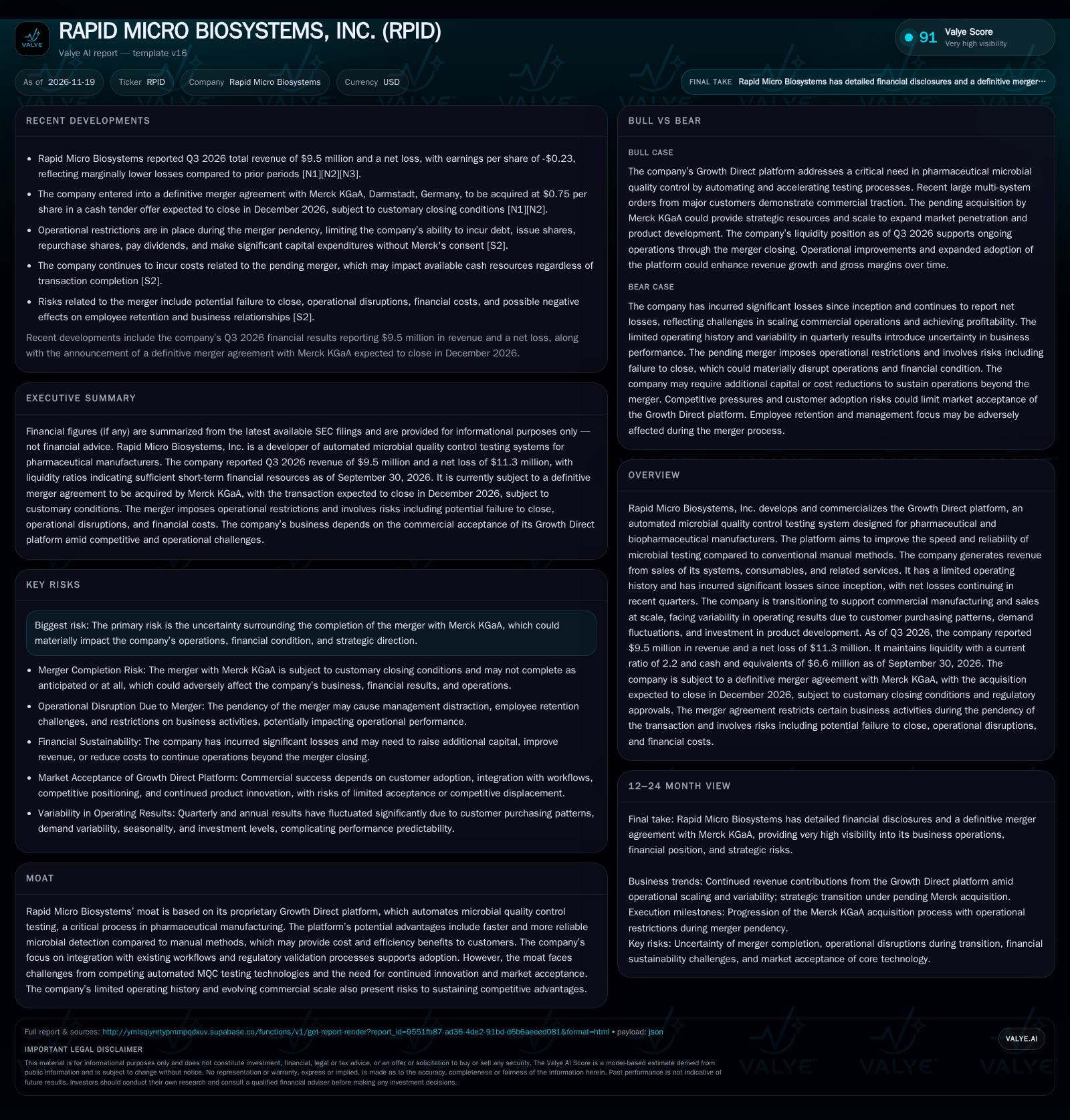
Rapid Micro Biosystems is contending with ongoing losses, a limited operating history, and significant operational disruptions stemming from its pending acquisition by Merck. The company's future hinges on the commercial acceptance and scaling of its Growth Direct automated microbial quality control platform, but near-term results remain volatile due to customer order patterns and merger-related distractions. Liquidity is currently stable, but sustained cash burn and the outcome of the Merck transaction will determine the longer-term trajectory. [S2] [N2]
Rapid Micro Biosystems (RPID) stands at a strategic crossroads, shaped by the dual forces of a pending acquisition by Merck and the ongoing challenge of scaling its Growth Direct automated microbial quality control platform. Despite promising technology that targets process efficiency and regulatory compliance for pharmaceutical manufacturers, Rapid Micro remains loss-making, with a net loss of $11.3 million in Q3 2026 and a persistent accumulated deficit. reported liquidity position in the short term, but operational restrictions and uncertainties tied to the merger, coupled with inconsistent revenue from large but sporadic customer orders, raise critical questions about execution, platform adoption, and long-term financial sustainability. [S2] [N2]
Merger Distractions and Financial Strain Define the Current State
Rapid Micro Biosystems is currently navigating several material developments. The company reported a net loss of $11.3 million for Q3 2026, with an accumulated deficit of $560.9 million as of September 30, 2026. The company reported cash and liquidity metrics for the period; these figures do not by themselves establish operating runway, investment capacity, financial flexibility, or financing capacity. The company's pending acquisition by Merck (expected to close in December 2026) has imposed operational restrictions: Rapid Micro cannot incur new debt, issue or repurchase shares, pay dividends, or make major capital expenditures without Merck's consent. These constraints, alongside ongoing merger costs, limit financial and strategic flexibility at a critical phase. Furthermore, management and employee attention is diverted by the deal process, with retention and day-to-day execution both under pressure. Finally, the company’s revenue remains volatile, recently boosted by large multi-system orders but still highly sensitive to customer purchasing patterns and order timing. [S2] [N2] [N1]
How Growth Direct Could Reshape Microbial QC Economics—If Adoption Accelerates
Rapid Micro Biosystems generates revenue from the sale of its Growth Direct systems, proprietary consumables, and related services. The platform is designed to automate and accelerate microbial quality control (MQC) testing, a bottleneck in pharmaceutical manufacturing. Traditional microbial testing is highly manual, labor-intensive, and slow—often requiring several days for results. Automation can reduce time-to-result by 50% or more and eliminate up to 85% of manual steps, promising cost savings, reduced error rates, and improved compliance for customers. [S2]
The business model likely relies on a mix of high upfront capital sales (for the Growth Direct systems), followed by recurring revenue streams from consumables and service contracts. As with many automation platforms in regulated industries, the initial sale is often lengthy and complex: customer validation, regulatory acceptance, and workflow integration can take months or even years. Once embedded, switching costs may rise due to the need to revalidate new systems, supporting recurring revenues from consumables and ongoing support.
Fixed costs are significant, including R&D, regulatory compliance, manufacturing infrastructure, and a global sales/service footprint. Variable costs center on consumables and field services. Achieving operating leverage requires sustainable, growing installed base and high consumables pull-through. However, with continued net losses and an accumulated deficit exceeding $560 million, the company’s unit economics and scale benefits remain to be proven. [S2]
Automation Advantage Meets Regulatory Inertia and Entrenched Alternatives
Rapid Micro's competitive proposition is anchored in the Growth Direct platform’s ability to automate, digitize, and accelerate MQC for pharmaceutical manufacturers. Theoretically, the platform offers customers measurable improvements in time-to-release, labor efficiency, and data integrity—critical in a sector where regulatory compliance and supply chain reliability are paramount. The platform’s integration with laboratory information management systems (LIMS) and compliance with regulatory requirements are key adoption drivers. [S2]
Competition is multifaceted: established manual and semi-automated testing methods have decades of regulatory acceptance and are deeply embedded in customer workflows. Competing automated MQC platforms—often from larger, better-capitalized diagnostics and life sciences companies—offer alternatives with their own integration and validation pathways. Customer incentives to switch are tied to demonstrable cost savings, regulatory acceptance, and the risk/benefit calculus around process change. Because pharmaceutical manufacturing is highly conservative, even superior technology faces long sales cycles, slow adoption, and the need for extensive customer validation.
Rapid Micro’s moat depends on sustained product innovation, robust service and support, and demonstrable regulatory and operational advantages. However, the company's limited operating history, evolving commercial scale, and the operational distraction of the pending merger all threaten to erode emerging competitive advantages.
Widespread Pharma Adoption Unlocks Recurring Revenue and Margin Expansion
In a favorable scenario, the pending Merck acquisition closes smoothly, providing Rapid Micro with both financial stability and global commercial reach. This would allow the company to invest in expanded sales, marketing, and product development, accelerating the adoption of Growth Direct across major pharmaceutical manufacturing sites. As more customers validate and embed the platform, recurring consumables and service revenue grows, driving operating leverage and improved gross margins.
Evidence confirming this scenario would include accelerated customer wins—particularly multi-system orders from top-tier pharmaceutical manufacturers—reduced sales cycle times, and improved retention of key technical and commercial staff through the merger integration. Clear upward trends in consumables revenue as a share of total revenue, and margin improvement, would also support the case. Conversely, delays in closing the merger, persistent customer hesitancy, or failure to scale recurring revenue would undermine this outcome.
Operational Turbulence and Slow Adoption Keep Growth and Margins in Check
The most plausible near-term outcome is continued operational volatility as the company works through the merger process and the challenges of scaling commercial operations. Revenue remains lumpy, driven by irregular large orders rather than steady adoption. Customer validation cycles are protracted, with new deployments slowed by regulatory and integration hurdles.
Confirmation of this scenario would come from continued quarterly variability in revenue, persistent net losses, and ongoing references to operational and retention challenges. If the Merck acquisition closes but fails to immediately translate into accelerated commercial momentum or improved cost discipline, the base case would be further validated.
Merger Failure or Prolonged Disruption Exposes Liquidity and Execution Risk
In the adverse case, the Merck acquisition is delayed, renegotiated, or fails to close, leaving Rapid Micro with limited cash and constrained flexibility. Operational distractions intensify, with employee attrition, loss of key commercial talent, and customer hesitancy undermining pipeline development. Without new capital or a strategic buyer, the company may be forced to curtail product development, delay customer deployments, or pursue cost-cutting measures that further erode competitive positioning.
Evidence for this scenario would include missed merger milestones, increased employee turnover (if disclosed), customer cancellations or delayed orders, and warnings regarding going concern status or the need for external capital.
Milestones That Will Determine Rapid Micro's Post-Merger Trajectory
Progress and closure of the Merck acquisition, including any regulatory or shareholder hurdles that could delay or derail the transaction.
Quarterly trends in system sales and, critically, growth in consumables and service revenue as a proxy for installed base utilization and recurring revenue strength.
Gross margin progression, particularly as the mix shifts from capital equipment to higher-margin recurring revenue streams.
Retention of key technical, sales, and operational personnel through the merger and integration period (if disclosed).
Customer win rate—especially multi-system or multi-site deals with major pharmaceutical manufacturers, and evidence of shortened sales cycles (if disclosed).
Ongoing cash burn rate andreported liquidity position, factoring in merger-related costs and any new capital requirements.
Potential changes in competitive positioning, such as new product launches, regulatory approvals, or loss of exclusivity for the Growth Direct platform.
Disclaimer: This is research-only, informational analysis and not investment advice. It may include AI-generated interpretation and general industry context. Always verify important details using primary sources.

Comments