
Plexus Corp: Manufacturing Scale, Sector Breadth, and Sustaining Margin Growth
Plexus Corp’s recent outperformance in earnings and revenue highlights the company’s diversified exposure and operational resilience, but the path to durable value creation depends on margin discipline, customer mix, and the ability to navigate sectoral volatility across its global footprint.
Plexus Corp delivered better-than-expected earnings and revenue for Q4 and FY 2026, driven by its multi-sector customer base and geographic reach. While liquidity and profit growth are evident, long-term economics hinge on managing margin pressures, sector cyclicality, and capital intensity. Sustained outperformance will require continued execution in supply chain management, customer retention, and the ability to shift mix toward higher-value contracts.
Plexus Corp’s latest financial disclosures underscore a period of strong performance, with both quarterly and annual results exceeding expectations and demonstrating the company’s ability to execute across multiple industrial and technology markets. With a global footprint and a diversified customer base spanning aerospace, defense, healthcare, and industrial sectors, Plexus has managed to grow revenues and profits despite sectoral headwinds.
Recent Results Demonstrate Revenue Expansion and Operational Scale
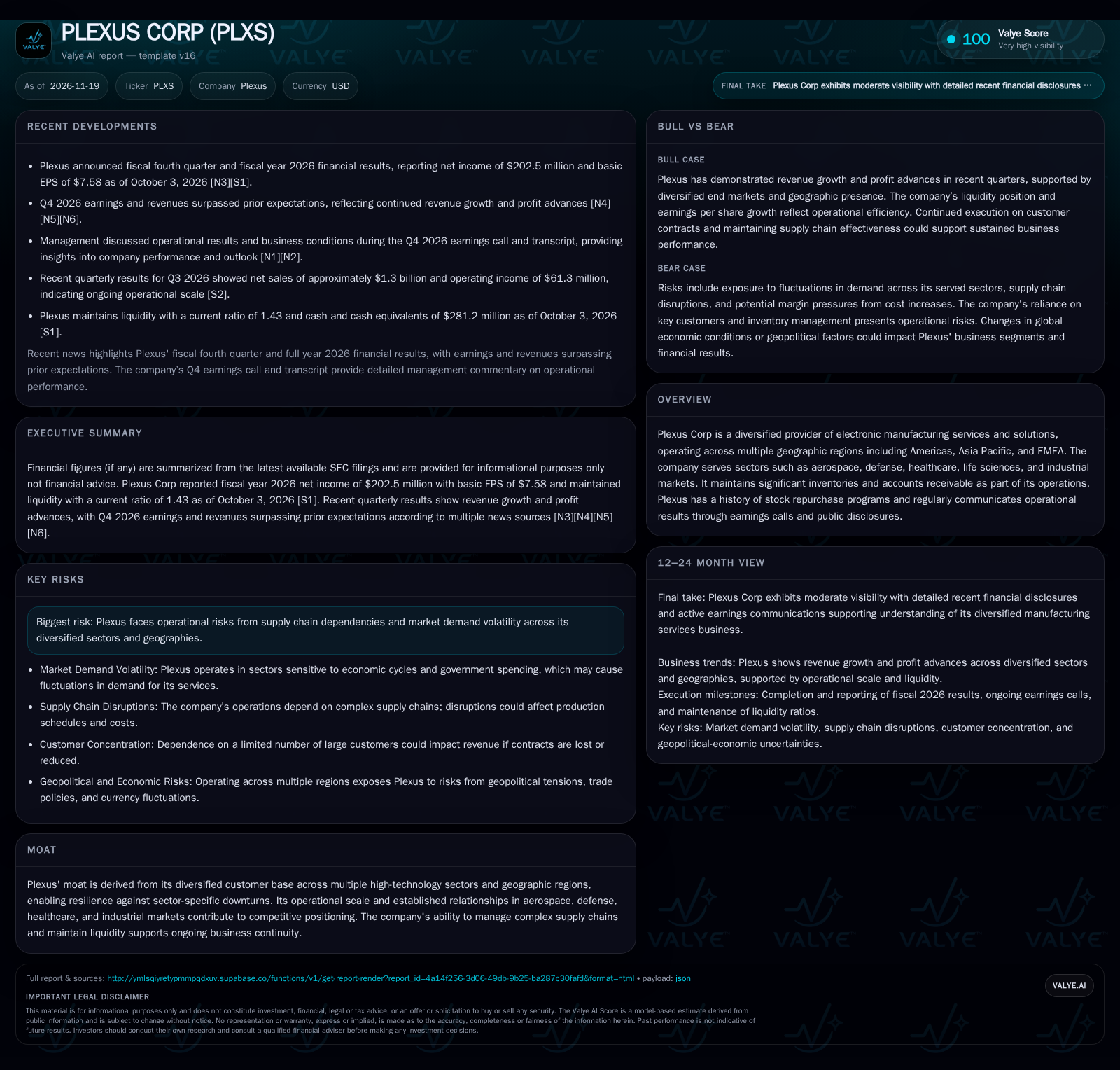
As of October 3, 2026, Plexus reported net income of $202.5 million and basic earnings per share of $7.58, with quarterly and fiscal year results surpassing prior expectations [S1] [N3] [N4] [N5] [N6]. The company’s Q3 2026 net sales reached approximately $1.3 billion, and operating income was $61.3 million [S2]. Liquidity remains steady, with $281.2 million in cash and a current ratio of 1.43 [S1]. Plexus’s operations span the Americas, Asia Pacific, and EMEA, and its customer base is diversified across aerospace, defense, healthcare, life sciences, and industrial markets [S1]. The company reported cash and liquidity metrics for the period; these figures do not by themselves establish operating runway, investment capacity, financial flexibility, or financing capacity.
Understanding Plexus’s Value Creation: Volume, Mix, and Margin Interplay
Plexus’s business model hinges on providing electronic manufacturing services (EMS) and solutions to a wide range of high-reliability sectors. Revenue is driven by a mix of high-volume, lower-margin production contracts and lower-volume, higher-complexity programs, particularly in regulated or mission-critical end markets such as aerospace, defense, and healthcare. The company’s significant inventories and accounts receivable reflect the working capital intensity typical of EMS businesses, where customer programs often require upfront procurement and substantial supply chain coordination [S2].
Gross margins in EMS are structurally thin, given intense competition, customer bargaining power, and the need to absorb volatility in component costs and supply chain disruptions. Operating leverage can be achieved if Plexus grows revenue faster than fixed costs, but variable costs—especially labor, logistics, and materials—remain a constant pressure. The company’s ability to selectively win higher-value, engineering-intensive contracts could improve mix and expand margins, but this depends on customer retention, the ability to move up the value chain, and effective risk management in inventory and receivables.
Capital requirements are moderate to high: investments in manufacturing capacity, automation, and working capital are ongoing necessities.
Sector Breadth Offers Both Opportunity and Complexity in the EMS Market
Plexus’s competitive position is shaped by its broad sector exposure and geographic reach. Serving aerospace, defense, healthcare, life sciences, and industrial markets allows the company to mitigate downturns in any single sector, but it also exposes Plexus to a patchwork of supply chain, regulatory, and customer concentration risks. The company competes with both global EMS giants and regional specialists, many of whom are equally capable in high-mix, low-volume production and have deep relationships with key customers.
Switching costs for customers can be moderate in regulated industries due to qualification and certification requirements, but price remains a critical lever. Plexus’s moat is based on operational scale, engineering expertise, and the ability to manage complex, global supply chains. However, the company’s bargaining power is constrained by the procurement-driven nature of EMS contracts and the risk that major customers could insource or rebid production. Technological substitution is less of a threat in the short term, but the long-term risk is that value migrates to design/IP-rich segments or to geographies with structurally lower costs.
To the extent that Plexus can leverage its diversified base to win more design-in or lifecycle management business, it could improve retention and pricing power. However, this is a dynamic competitive arena, and leadership in one sector does not always translate to others.
Mix Shift and Supply Chain Efficiencies Could Drive Margin Improvement
The most favorable scenario for Plexus would see continued revenue growth combined with a successful shift toward higher-margin, engineering-intensive contracts—particularly in aerospace, defense, and healthcare, where product complexity and regulatory barriers can entrench supplier relationships. If Plexus can maintain operational discipline, keep inventory turns high, and minimize cost overruns, operating leverage could drive incremental margin expansion even if headline revenue growth slows.
Confirmation of this scenario would require evidence of rising gross and operating margins, increasing contract wins in high-value sectors, and stable or improving working capital efficiency. Additional proof points would include customer announcements for multi-year programs, greater disclosure of design and after-market services revenue, and a declining share of revenue from lower-margin, commoditized accounts.
Falsification would come from margin stagnation, rising days sales outstanding or inventory days, or loss of key contracts to competitors or insourcing.
Growth Prospects Confront Cyclical Trends and Cost Fluctuations
The most plausible near-term path for Plexus is steady revenue growth with some quarterly variability due to sector demand cycles, supply chain constraints, and customer program timing. The diversified customer base and global footprint should buffer the company from severe shocks in any one market, but gross margins are likely to remain under pressure due to cost pass-through limitations and the ongoing need for competitive pricing.
This scenario would be confirmed by continued top-line growth, stable operating margins (even if not expanding), and evidence of prudent working capital management. The company may continue share repurchases, but capital returns would remain balanced with reinvestment needs. Investors should expect periodic volatility tied to macroeconomic swings, especially in industrial and healthcare demand, and keep an eye on customer concentration metrics.
Falsification would be signaled by sustained margin erosion, significant inventory write-downs, or a sharp uptick in customer churn or program delays.
Value Creation Threatened by Margin Pressure and Customer Instability
In an adverse scenario, Plexus faces simultaneous margin compression and demand volatility—triggered by supply chain shocks, cost inflation, or the loss of major customer programs. If the company is forced to absorb higher input costs or is unable to pass them through, gross and operating margins could deteriorate. Large inventory balances could become a liability if sector demand slows, leading to write-downs or cash flow strain.
A further risk is a shift in procurement strategies by large customers: if key accounts insource production or turn to lower-cost rivals, Plexus’s revenue base could contract rapidly, especially given the working capital intensity of the business. Sector-specific downturns, particularly in cyclical industrial or discretionary healthcare segments, could exacerbate these pressures.
This scenario would be confirmed by declining revenues and profits, a marked drop in gross or operating margins, increased days inventory outstanding, and any announcement of customer contract losses or restructuring charges. Falsification would require evidence of margin stability and successful customer retention despite external shocks.
Evaluating Plexus’s Margin and Mix Performance in Upcoming Quarters
Gross margin and operating margin trends by segment—if disclosed—are needed to evaluate progress on mix and cost discipline.
Customer concentration ratios and changes in top account revenue contribution would help assess exposure to key program risks.
Inventory turns and days sales outstanding: rising levels may indicate demand softness or supply chain issues.
New contract wins, particularly in aerospace, defense, and healthcare, would signal success in targeting higher-value business.
Disclosure or commentary on engineering/design-in revenues versus pure manufacturing would clarify value chain positioning.
Evidence of margin pass-through on input cost increases would test pricing power and customer relationships.
Major program delays, cancellations, or insourcing by large customers would be red flags for revenue visibility and working capital risk.
Disclaimer: This is research-only, informational analysis and not investment advice. It may include AI-generated interpretation and general industry context. Always verify important details using primary sources.

Comments