
IT Tech Packaging: VIE Structure, Regulatory Headwinds, and the Challenges of Value Creation in China’s Paper Sector
IT Tech Packaging’s complex VIE structure enables access to China’s paper manufacturing market, but exposes investors to ongoing regulatory, operational, and listing risks. Recent net losses, capital raises, and compliance deadlines underscore the fragility of the business model and the importance of legal clarity for future value.
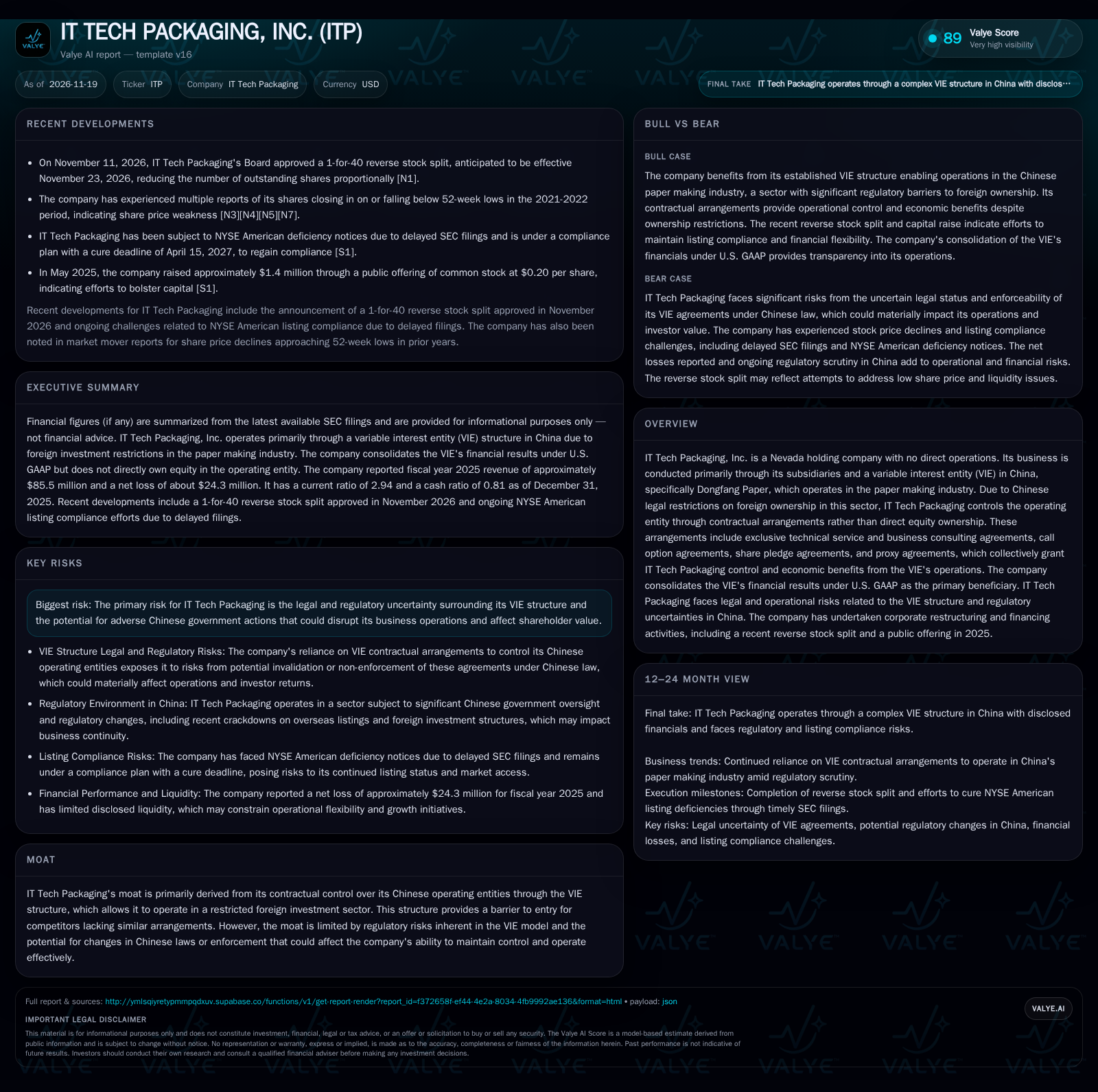
IT Tech Packaging operates through a variable interest entity in China, consolidating Dongfang Paper for financial reporting while lacking direct ownership due to foreign investment restrictions. The company reported $85.5 million in 2025 revenue but a $24.3 million net loss, faces regulatory risk around its VIE structure, and must address NYSE American listing compliance by April 2027. Its future hinges on stabilizing cash flows, navigating Chinese legal uncertainty, and retaining access to U.S. capital markets. [S1]
IT Tech Packaging, Inc. offers a window into the tensions facing foreign investors in China’s restricted industries. Without direct ownership of its main operating entity, the company depends on a web of contractual arrangements—its VIE structure—to extract value from Dongfang Paper in China’s paper sector. While this approach allows for accounting consolidation and operational control, it exposes IT Tech Packaging to profound legal and regulatory uncertainties. Recent net losses, efforts to bolster capital through equity offerings, and looming listing compliance deadlines paint a picture of a business model that is fragile and highly dependent on external factors, especially the evolving stance of Chinese regulators and U.S. capital market rules. [S1] [N1]
Recent Financial and Regulatory Pressures Define the Operating Landscape
IT Tech Packaging reported $85.5 million in revenue for the 2025 fiscal year but posted a net loss of $24.3 million, translating to -$1.68 per share. This ongoing unprofitability has required the company to pursue capital raises, most notably a $1.4 million public offering at $0.20 per share in May 2025. Meanwhile, IT Tech Packaging faces a critical compliance deadline: it must resolve NYSE American listing deficiencies by April 15, 2027, after previous delays in SEC filings triggered deficiency notices. These facts collectively underscore the company’s exposure to both financial headwinds and external regulatory pressures that could threaten its ability to operate as a U.S.-listed entity. [S1] [N1]
How the VIE Model Shapes Cash Flow and Profit Potential
IT Tech Packaging’s economics are defined by its variable interest entity structure. The main Chinese operating company, Dongfang Paper, is not directly owned but is controlled through contractual agreements. These contracts stipulate that 80% of the VIE’s annual net profits are paid as service fees to a wholly owned subsidiary, Baoding Shengde, allowing for economic benefit transfer. However, as the company operates in a low-margin, capital-intensive industry, persistent net losses suggest that the current scale and cost structure are not sufficient to generate positive net income. Fixed costs in the form of plant operations, labor, and regulatory compliance are likely high relative to variable input costs. The company’s need to periodically raise capital via equity offerings, coupled with reported cash balance ($8.2 million at year-end 2025), points to a business model with thin operating leverage and ongoing liquidity needs. If the VIE structure were invalidated or service fee flows disrupted, the U.S. holding company would lose access to operating cash flows entirely. [S1]
The VIE structure's reliance on contractual agreements rather than direct equity ownership inherently introduces counterparty risk and legal ambiguity, which can materially affect cash flow predictability. If the underlying contracts are challenged or renegotiated under adverse regulatory conditions, the flow of service fees could be delayed, reduced, or entirely halted. This would not only impact the holding company's revenue recognition but also its ability to service debt or fund capital expenditures. The company reported cash and liquidity metrics for the period; these figures do not by themselves establish operating runway, investment capacity, financial flexibility, or financing capacity.
Barriers and Vulnerabilities: Competing in China’s Paper Market Under a VIE
IT Tech Packaging’s main competitive advantage is its ability to operate in a sector closed to direct foreign ownership, thanks to its VIE structure. This creates a barrier to entry for international competitors lacking similar contractual arrangements. However, this advantage is precarious: Chinese regulators periodically review the legality and enforceability of such structures. Domestically, the paper industry is highly fragmented, with competition from state-owned and private Chinese manufacturers who do not face the same legal complexities or capital market constraints. Major competitive threats include price competition from larger, better-capitalized local players, potential regulatory crackdowns on VIEs, and input cost volatility. On the other hand, if IT Tech Packaging can maintain its contractual control and demonstrate cost discipline, it may retain a niche position, but the risk of regulatory intervention remains ever-present.
The competitive landscape in China’s paper sector is influenced by both structural and regulatory dynamics. While the VIE model grants IT Tech Packaging access to restricted markets, it also complicates strategic partnerships and supply chain negotiations, as counterparties may be wary of the legal uncertainties surrounding VIE entities. Additionally, domestic competitors benefit from government support mechanisms, such as subsidies or preferential financing, which a VIE-structured foreign entity may not access. This asymmetry can place IT Tech Packaging at a disadvantage when competing on pricing or capital investment. Moreover, fluctuations in raw material costs, energy prices, and environmental compliance costs add layers of operational risk that can compress margins further, especially given the thin profitability typical of the sector.
Pathways to Value: What Could Unlock a Turnaround?
A positive scenario for IT Tech Packaging would involve several reinforcing developments. First, stabilization or improvement in Chinese regulatory attitudes toward VIEs would reduce existential risk and reassure both management and investors about the continuity of profit flows. Second, operational initiatives that either reduce costs or expand higher-margin product lines could move the company toward breakeven or positive net income, increasing the size of service fees remitted to the U.S. entity. Third, successful execution of listing compliance plans would sustain access to U.S. capital markets, enabling further investment or balance sheet strengthening. Evidence confirming this scenario would include improved year-over-year gross and net margins, regulatory statements or legal precedents favoring VIE structures, and timely, compliant financial reporting restoring listing status.
Operational improvements that enhance manufacturing efficiency or product differentiation could incrementally improve profitability, but such gains are contingent on stable regulatory conditions that allow reinvestment and strategic planning. For instance, adopting advanced production technologies or shifting toward higher-value specialty paper products could increase margins if market demand supports price premiums. However, these initiatives require upfront capital and managerial focus, which may be difficult to sustain without assured access to capital markets. Additionally, any relaxation or formal recognition of VIE contracts by Chinese regulators would reduce legal risk premiums, potentially lowering the company’s cost of capital and enabling more aggressive growth strategies.
Sustained Uncertainty: Probable Outcomes Absent Major Change
The most plausible outcome is a continuation of current trends: IT Tech Packaging remains dependent on the VIE structure, faces recurring net losses, and is forced to periodically dilute shareholders to fund operations. Regulatory ambiguity in China persists, with neither a full crackdown nor a liberalization of foreign ownership rules. Confirmation of this scenario would come from continued financial losses, ongoing capital raises at dilutive terms, and a lack of clarity from Chinese authorities on the VIE’s legal standing.
In the absence of regulatory clarity or operational turnaround, the company may face a protracted period of financial strain, characterized by recurring capital raises and shareholder dilution. This cycle can erode investor confidence and depress equity valuations, limiting the company’s ability to attract long-term strategic investors. Moreover, persistent losses could constrain the company’s ability to invest in innovation or capacity expansion, leaving it vulnerable to competitive displacement. The ongoing uncertainty around VIE enforceability also means that any adverse regulatory announcement could trigger abrupt market reactions, complicating financial planning and potentially forcing reactive rather than proactive management decisions.
Fragility Exposed: Legal or Regulatory Shifts Could Sever Value Chain
The most adverse scenario materializes if Chinese authorities invalidate or strictly enforce limitations on VIE structures in the paper sector, rendering the contractual agreements non-enforceable. In this case, IT Tech Packaging would lose operational control and access to Dongfang Paper’s cash flows, potentially resulting in the loss of all consolidated revenue and assets tied to the VIE. Additional downside could come from a failure to cure NYSE American listing deficiencies, leading to delisting and severely restricted access to U.S. capital markets. Evidence supporting this scenario would include adverse regulatory rulings, new Chinese laws targeting VIEs, abrupt service fee disruptions, or an inability to file timely SEC reports.
Milestones That Could Reshape the Investment Thesis for IT Tech Packaging
Progress toward NYSE American listing compliance by or before the April 2027 deadline, as evidenced by timely SEC filings and updated deficiency notices.
Year-over-year changes in gross and net margins for the consolidated group, which would indicate underlying operational improvement or further deterioration, if disclosed.
Public statements or legal developments in China regarding the treatment or enforceability of VIE structures within the industrial sector.
Volume and pricing trends in Dongfang Paper’s main product categories, which would clarify whether revenue growth is driven by market share, price increases, or other factors, if disclosed.
Any changes to the terms or execution of the service fee agreements that govern profit transfer from the VIE to the U.S. parent.
Evidence of new product launches, capacity expansions, or strategic partnerships that could alter the company’s revenue mix or margin profile, if disclosed.
Shareholder dilution trends and reverse split activity, which may foreshadow future capital structure stress.
Disclaimer: This is research-only, informational analysis and not investment advice. It may include AI-generated interpretation and general industry context. Always verify important details using primary sources.

Comments