
New Jersey Resources: Diversification, Credit Leverage, and the Challenge of Inflationary Pressure
With regulated and unregulated energy operations, New Jersey Resources faces a pivotal period as inflation, rising gas costs, and credit market dynamics test its model. Recent credit facility expansion and below-expectation Q4 earnings put the focus on subsidiary cash flows, regulatory lag, and the company’s ability to balance growth, compliance, and capital needs.
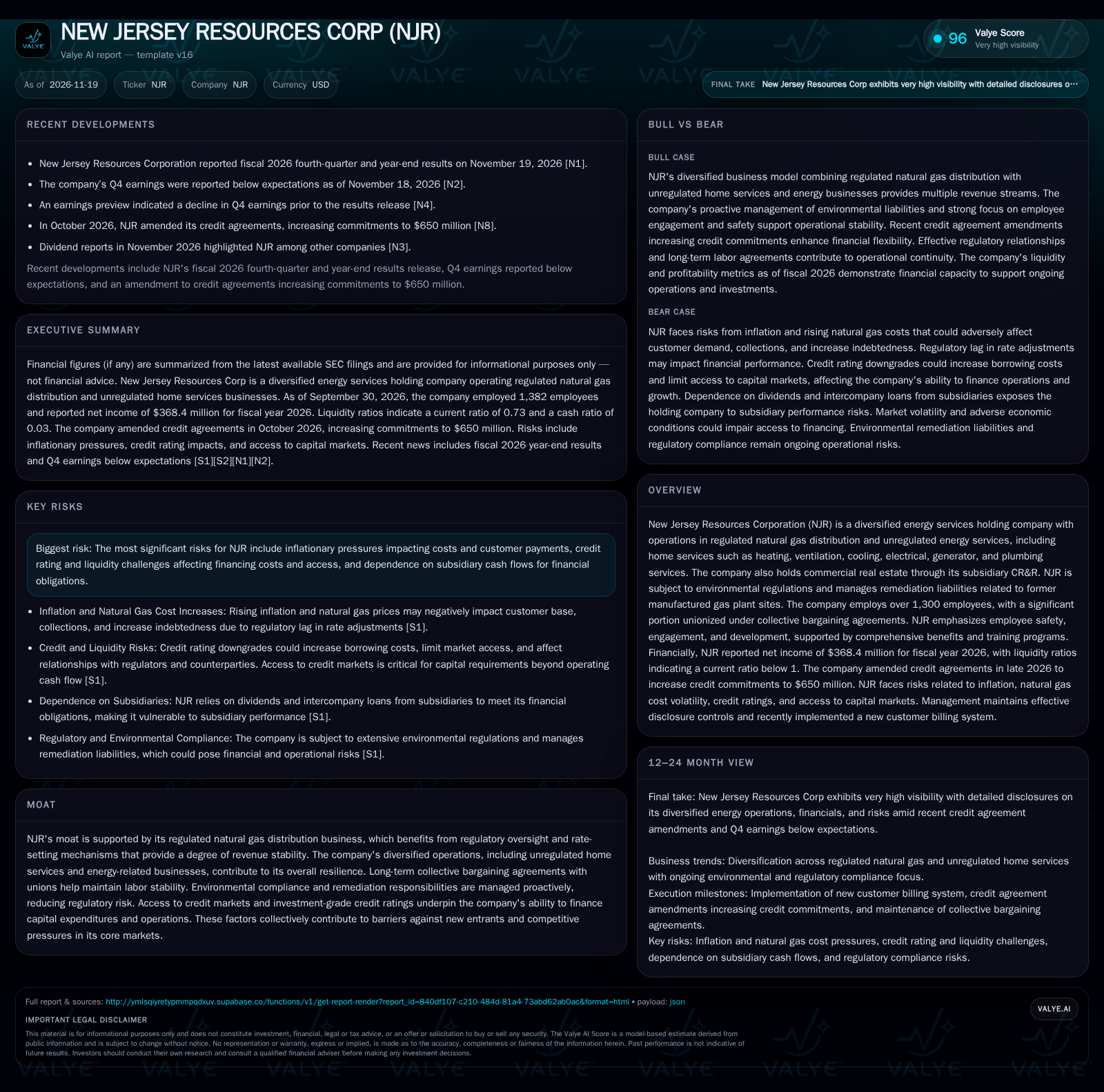
New Jersey Resources Corp (NJR) operates a blend of regulated natural gas distribution and unregulated home services, generating $368.4M net income in fiscal 2026. However, a current ratio of 0.73 and Q4 earnings below expectations highlight liquidity and margin pressures. The company increased credit commitments to $650M in October 2026, but inflation and gas cost volatility, regulatory lag, and reliance on subsidiary dividends all create substantial risk and opportunity for the business [S1] [N1] [N2] [N8].
New Jersey Resources Corp stands at a crossroads where the stability of its regulated gas utility is tempered by the volatility of its unregulated operations and the external pressures of inflation and energy price swings. The recent expansion of its credit facility suggests a proactive approach to capital needs, but also highlights ongoing reliance on financial markets and subsidiary performance. As regulatory lag and inflation test the limits of cost recovery, NJR’s next moves will be critical in determining whether its diversified model remains a source of resilience or vulnerability.
Recent Earnings Miss and Credit Facility Expansion: What’s at Stake
In fiscal 2026, New Jersey Resources reported net income of $368.4 million, but its Q4 earnings fell short of market expectations, signaling pressure on margins or cost control [S1] [N2]. The company reported cash and liquidity metrics for the period; these figures do not by themselves establish operating runway, investment capacity, financial flexibility, or financing capacity. [S1] To address funding needs, NJR amended its credit agreements in October 2026, increasing commitments to $650 million [N8]. This move reflects both the company’s proactive approach to ensuring access to capital and the ongoing importance of external financing amid a challenging cost environment. These developments are material because they put a spotlight on the company’s ability to balance growth investments, regulatory compliance, and financial resilience in the face of inflation and volatile natural gas prices.
How NJR’s Revenue Mix and Capital Needs Shape Its Financial Model
NJR’s core cash generation comes from regulated natural gas distribution—an industry where rates are set by public utility commissions, offering a degree of revenue predictability, but typically with a lag in cost recovery. This lag is particularly impactful during periods of rapid inflation or commodity price spikes, as cost increases may not be passed through to customers immediately. The company’s unregulated businesses, such as home services (HVAC, electrical, plumbing), provide higher potential margins but are subject to more competitive pricing and demand variability.
Fixed costs are substantial in the utility segment, given network infrastructure, labor, and environmental compliance, which creates potential for operating leverage when volumes or rates rise. However, the need for ongoing capital expenditures and environmental remediation means NJR frequently relies on both internally generated cash and external credit. The low current and cash ratios reported suggest a working capital structure that is either optimized for regulated cash cycles or under pressure from rising costs and delayed collections.
The cited source reports dividend-related activity; that disclosure alone does not establish dividend-policy continuity, management confidence, or a material constraint on capital flexibility. [S1]
Regulated Moat Meets Unregulated Competition: Where NJR Stands
NJR’s regulated utility operations benefit from high barriers to entry, given the capital intensity, regulatory oversight, and established infrastructure required to serve the New Jersey gas market. This creates a defensible base of earnings and customer relationships, especially when compared to potential new entrants. However, the unregulated home services and commercial real estate segments are exposed to far more direct competition from regional contractors, national chains, and, increasingly, digital platforms offering home maintenance services.
A key source of resilience is the company’s long-term collective bargaining agreements, which help stabilize labor costs and reduce the risk of operational disruption. Yet, the need to manage environmental remediation liabilities and comply with evolving regulations adds ongoing cost and complexity. The company’s ability to maintain investment-grade credit ratings and access affordable capital is another differentiator, but this advantage could erode quickly if performance slips or credit conditions tighten.
Substitution risk is low for core gas distribution in the short term, but longer-term trends—such as electrification, distributed energy resources, and policy-driven decarbonization—could gradually erode the utility’s customer base or rate base growth trajectory.
Unlocking Value Through Rate Recovery and Home Services Growth
A favorable outcome for NJR hinges on successful navigation of regulatory processes to achieve timely rate adjustments that fully compensate for higher fuel and inflation-driven costs. If the company demonstrates an ability to recover costs with minimal regulatory lag, core utility margins could stabilize or expand. Meanwhile, if the unregulated home services segment capitalizes on cross-selling to the utility customer base and executes well on service quality, it could deliver incremental growth and margin expansion.
Upside would be confirmed by evidence of effective rate case outcomes, sustained or rising net income despite inflationary pressures, and visible growth in nonregulated revenue streams. Evidence that would falsify this scenario includes persistent margin compression, further earnings misses, or regulatory setbacks delaying cost recovery.
Steady Utility Earnings Offset by Cost Pressures and Capital Constraints
The most plausible outlook is one in which NJR’s regulated gas utility continues to provide a stable, if modestly pressured, earnings base, while unregulated businesses contribute incremental but volatile growth. Inflation and volatile gas costs are likely to create ongoing headwinds, partially offset by periodic rate relief. Liquidity remains tight, with continued reliance on revolving credit facilities and a cautious approach to capital expenditures.
Under this scenario, the company maintains investment-grade ratings but faces elevated borrowing costs and limited potential financial flexibility. Evidence supporting this scenario includes stable or gradually improving net income, ongoing regulatory engagement, and maintenance of current credit levels. It would be challenged by a sharp increase in bad debts, further deterioration in liquidity, or an inability to access affordable capital markets funding.
When Regulatory Lag and Cost Inflation Converge: A Stress Test for NJR
The adverse scenario materializes if inflation and natural gas prices rise faster than NJR can recover costs through regulated rates, leading to margin erosion and increased customer payment delinquencies.
If the company is forced to curtail capital expenditures, defer environmental remediation, or seek asset sales to bolster liquidity, the long-term franchise value could be impaired. This scenario is also more likely if economic conditions in New Jersey deteriorate, further straining both residential and commercial customer bases.
Milestones That Will Define NJR’s Ability to Withstand Inflation and Capital Market Volatility
Evidence of successful rate case outcomes and the timing/extent of regulatory-approved cost recovery relative to inflation and commodity price increases.
Performance of unregulated home services: revenue growth, margin trends, and customer retention rates, if disclosed.
Changes in credit ratings or outlooks from major agencies, and management commentary on access to capital markets.
Subsidiary dividend and intercompany loan flows: their sufficiency and timing in supporting parent-level obligations.
Trends in bad debt expense and customer payment delinquencies, particularly in the context of rising gas costs.
Progress on environmental remediation liabilities, including any regulatory or legal developments that could affect cost estimates or required expenditures.
Implementation effectiveness of the new customer billing system and any reported impacts on collections, customer satisfaction, or operational efficiency.
Disclaimer: This is research-only, informational analysis and not investment advice. It may include AI-generated interpretation and general industry context. Always verify important details using primary sources.

Comments