
Azenta, Inc.: Core Focus, Divestiture Uncertainty, and the Stakes of Leadership Transition
Azenta, Inc. is sharpening its focus on sample management and multiomics solutions, but its substantial fiscal 2026 net loss, ongoing leadership changes, and the contingent sale of B Medical Systems underscore a company in operational and strategic flux.
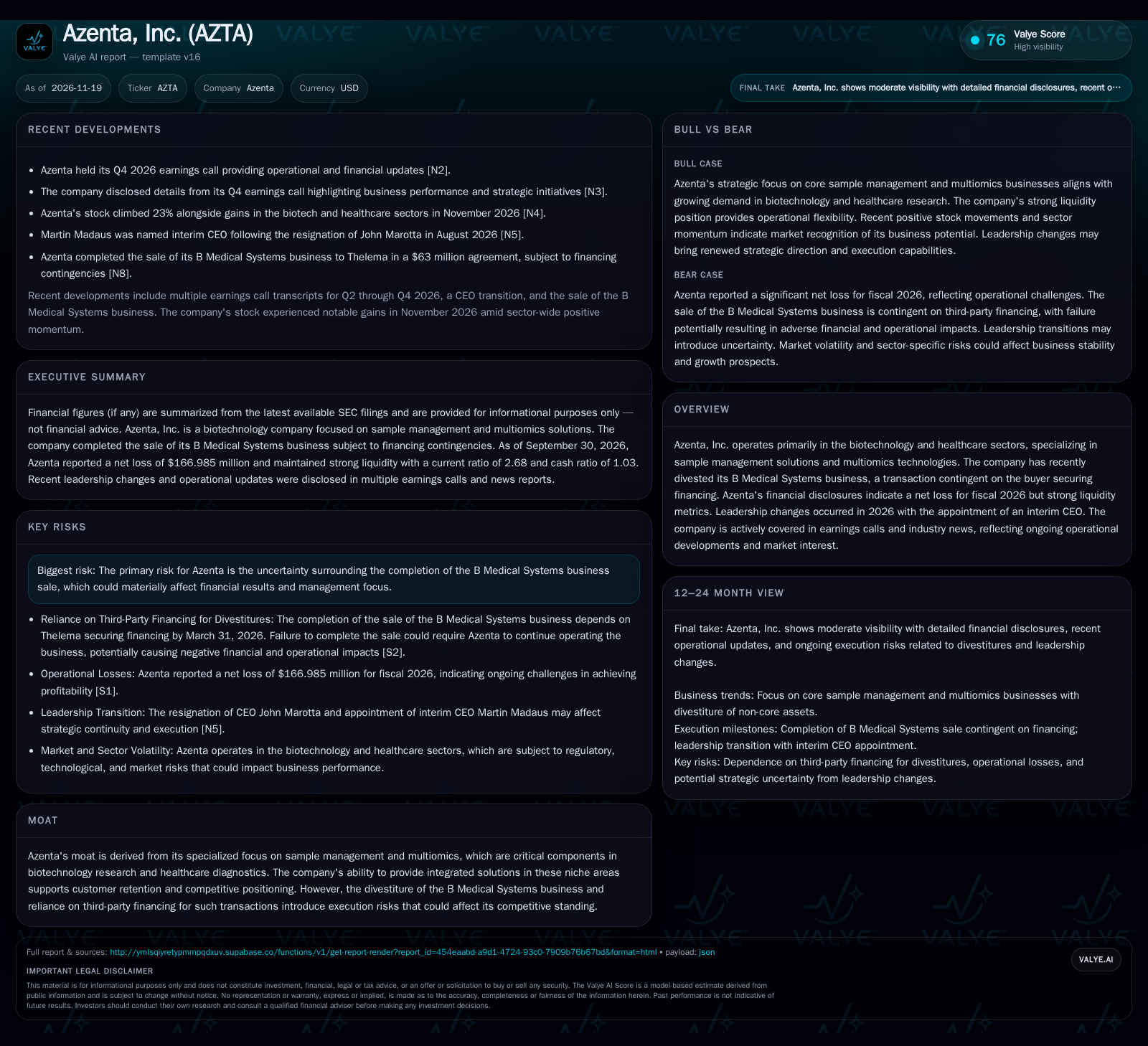
Azenta, Inc. reported a $167 million net loss for fiscal 2026, despite maintaining over $190 million in cash and a reported current ratio. The company is divesting its B Medical Systems unit for $63 million, but the deal depends on buyer financing. Meanwhile, an interim CEO navigates strategic realignment as Azenta doubles down on its sample management and multiomics core. The interplay of liquidity, divestiture, and leadership execution will shape the company's near-term trajectory. [S1] [S2] [N5] [N8]
Azenta, Inc. stands at a strategic crossroads as it seeks to sharpen its focus on core sample management and multiomics solutions while navigating significant operational and leadership turbulence. The successful completion of the B Medical Systems sale—and the ability of interim leadership to steer a tighter, more focused organization—will be pivotal in determining whether Azenta can transition from a period of disruption to one of sustainable growth.
Azenta’s Latest Realignment: Divestiture, Losses, and Leadership Flux
Azenta, Inc. reported a net loss of $166.985 million for fiscal year 2026, underscoring persistent operational and profitability challenges in its core biotechnology and healthcare markets. The company reported cash and liquidity metrics for the period; these figures do not by themselves establish operating runway, investment capacity, financial flexibility, or financing capacity. [S1]
A major strategic move is the announced sale of the B Medical Systems business to Thelema for $63 million, a transaction that remains contingent on the buyer securing financing by March 31, 2026. The deal’s completion is crucial, as a failed sale would require Azenta to retain and operate the business, potentially distracting management and impacting financial results. [S2] [N8]
Further complicating the landscape is leadership turnover: Martin Madaus was appointed interim CEO in August 2026 following the resignation of John Marotta, creating potential for both renewed strategy and short-term uncertainty. [N5]
Azenta’s shares rose 23% in late 2026, largely in tandem with broader sector gains, suggesting investor optimism but also highlighting the company’s sensitivity to market sentiment. [N4]
How Azenta’s Core Businesses Could Rebuild Profitability
Azenta’s revenue engine is built around sample management solutions and multiomics technologies—critical, high-value areas in biotechnology research and healthcare diagnostics. These businesses generally benefit from recurring demand, as biopharma and research customers require secure, compliant sample storage, logistics, and increasingly, integrated data analytics. The company’s economics likely depend on a mix of transactional volumes (for storage, retrieval, logistics) and potentially higher-margin, value-added services (such as informatics, automation, and multiomics analysis), though the specific contract structures are not disclosed.
The capital intensity of sample management is moderate: significant up-front investment is required for physical infrastructure (storage facilities, automation), but once operational, these assets offer operating leverage as utilization rises. Multiomics solutions may command premium pricing, especially if bundled with proprietary data analytics or workflow integration. However, the net loss for 2026 suggests that either scale efficiencies have yet to be realized, or that pricing and cost discipline are under pressure—possibly exacerbated by non-core business drag before divestiture. [S1] [S2]
The divestiture of B Medical Systems, if completed, could further improve the capital base and sharpen management focus, but delays or failure to close would prolong financial and operational overhead. [S2] [N8]
Sample Management and Multiomics: Where Azenta Stands in the Sector
Azenta operates in specialized niches—sample management and multiomics—where technical requirements and regulatory compliance create moderate barriers to entry. The company’s ability to provide integrated, end-to-end solutions (from physical storage to digital analytics) may offer some customer stickiness, especially for large research and pharma clients seeking scale and reliability.
However, these markets are increasingly competitive. Large contract research organizations, biorepository specialists, and data-centric life sciences players are all vying for share. Price competition for basic storage and logistics is intense, and technology-driven entrants are pushing innovation in automation and data analytics. The ability to cross-sell multiomics solutions to existing sample management customers could be a lever for Azenta, but only if the company can demonstrate differentiated value and maintain service quality during its current transition.
Switching costs for customers can be meaningful—especially for long-term storage contracts and integrated informatics—but not insurmountable if a competitor offers superior technology, compliance, or pricing. Azenta’s competitive position will hinge on its ability to execute on its core focus, maintain service reliability, and innovate at the pace of sector leaders.
Path to Reacceleration: Sharper Focus and Successful Divestiture
A favorable scenario for Azenta unfolds if the B Medical Systems divestiture closes smoothly, unlocking $63 million and freeing management to concentrate on higher-margin, growth-oriented core businesses. This capital influx could be used to invest in automation, digital solutions, or tuck-in acquisitions that strengthen the sample management and multiomics platforms.
If interim leadership is able to articulate and execute a clear strategic vision—streamlining operations, cutting non-core costs, and reinvigorating commercial efforts—Azenta could return to profitability as operating leverage improves and sector demand persists.
Evidence supporting this scenario would include confirmation of the B Medical Systems sale, improving gross and operating margins, stabilization or growth in core business revenue, and positive commentary from management on pipeline wins or customer retention in earnings calls. [S2] [N2] [N3] [N6] [N7]
Strategic Refocus Delivers Stability, but Margin Recovery Is Gradual
The most plausible outcome is that Azenta completes the B Medical Systems divestiture after some delay, incrementally improves its cost structure, and gradually stabilizes core operations under interim leadership. Revenue growth in sample management and multiomics could be steady but not explosive, as the company contends with strong competitors and lingering integration challenges.
Leadership transition could limit bold strategic moves, resulting in a cautious approach to capital allocation and innovation until a permanent CEO is named.
Confirmation of this scenario would come from sequential reductions in operating losses, steady core revenue, and absence of major negative surprises in divestiture or leadership continuity. Persistent, though narrowing, net losses and modest improvement in cash flow would be expected. [S1] [S2] [N5]
Divestiture Failure and Leadership Uncertainty Derail Recovery
A more adverse scenario would see the B Medical Systems sale fail to close—either due to Thelema’s inability to secure financing or regulatory holdups. In this case, Azenta would be forced to continue operating a non-core business, consuming management bandwidth and potentially incurring additional costs or losses. This would also leave the company’s capital structure less flexible, limiting its ability to invest in its core focus areas.
Ongoing leadership uncertainty—if the interim CEO period is prolonged or strategic vision remains muddled—could drive employee turnover, customer attrition, or missed opportunities in a fast-moving sector.
Evidence for this scenario would include public disclosure of the divestiture’s collapse, continued or worsening operating losses, negative cash flow trends, and further leadership instability. [S2] [N5] [N8]
What Could Prove or Disprove Azenta’s Strategic Reset in 2027
Final confirmation (or failure) of the B Medical Systems sale to Thelema, including the actual receipt of proceeds and any required regulatory approvals.
Quarterly trends in core sample management and multiomics revenue—growth, customer wins, or loss of major accounts would be especially telling.
Gross and operating margin trajectories, especially following the divestiture and any announced cost-reduction measures.
Cash burn rate and free cash flow generation: a useful metric would be the pace at which Azenta’s liquidity buffer changes post-divestiture, if disclosed.
Updates on permanent CEO search and transition, with any changes in senior leadership or organizational strategy.
Customer retention and contract renewal rates in core businesses, if disclosed, to test for switching cost strength and satisfaction.
Competitive developments—such as new product launches or pricing shifts by leading biorepository or multiomics firms—that could pressure Azenta’s positioning.
Any announced investments, partnerships, or acquisitions that signal a willingness to deploy capital for strategic growth rather than continued retrenchment.
Disclaimer: This is research-only, informational analysis and not investment advice. It may include AI-generated interpretation and general industry context. Always verify important details using primary sources.

Comments