
Intuit’s AI-Driven Transformation: Fintech Expansion, Profitability, and the Stakes of Competitive Disruption
Intuit’s latest results highlight strong profitability and ongoing investment in AI and fintech platforms, but the company faces intensifying competition and operational challenges as it pushes deeper into assisted tax and financial management services. The next phase will test whether its technology and ecosystem advantages can sustain growth and defend margins amid sector volatility.
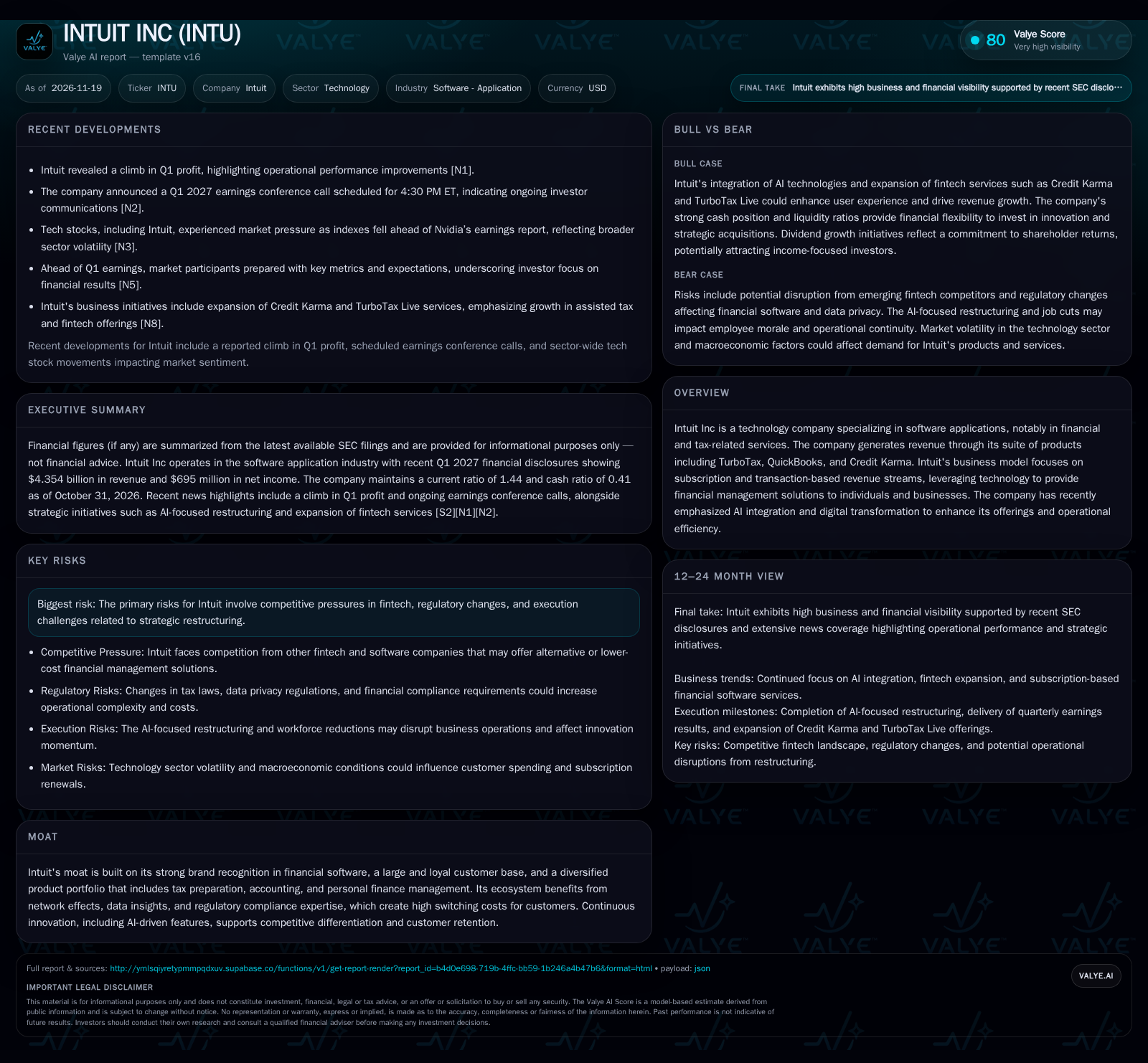
Intuit reported Q1 2027 revenue of $4.354 billion and net income of $695 million, underscoring robust profitability and operational momentum. The company is investing in AI integration and expanding fintech offerings like Credit Karma and TurboTax Live, aiming to drive growth through enhanced user experiences and new revenue streams. However, risks from fintech competitors, regulatory changes, and execution challenges related to restructuring remain material to the long-term thesis. Watch for evidence that Intuit’s ecosystem and technology investments are translating into durable customer retention and margin resilience. [S2] [N1] [N8]
Intuit’s most recent quarter underscores its status as a leading force in financial software, combining robust profitability with a strategic push into AI-powered fintech services. With $4.354 billion in quarterly revenue and $695 million in net income, the company is capitalizing on both legacy strengths and new growth vectors, particularly through its Credit Karma and TurboTax Live offerings. Yet, as Intuit deepens its bets on AI and digital transformation, it must contend with escalating competition, evolving regulations, and the operational complexities of restructuring. The coming quarters will be pivotal in determining whether its investments can translate into sustained customer loyalty, operating leverage, and defensible market share. [S2] [N1] [N8]
Recent Financial Strength and Strategic Shifts Define the Landscape
Intuit reported Q1 2027 revenue of $4.354 billion and net income of $695 million, demonstrating continued profitability and scale in its core software businesses [S2] [N1]. The company reported cash and liquidity metrics for the period; these figures do not by themselves establish operating runway, investment capacity, financial flexibility, or financing capacity. [S2] Recent initiatives have focused on expanding Credit Karma and TurboTax Live, indicating a strategic emphasis on assisted tax and fintech services to drive future growth [N8]. These facts matter because they show Intuit is not only maintaining profitability but also actively reallocating resources to higher-growth, technology-driven segments—moves that could reshape its long-term revenue mix and competitive posture.
How Intuit’s Revenue Model and Cost Structure Could Evolve
Intuit’s business model blends subscription and transaction-based revenues across flagship products like TurboTax, QuickBooks, and Credit Karma. Subscription pricing, particularly in QuickBooks and TurboTax Live, supports recurring revenue and predictability, while transaction fees from Credit Karma’s marketplace and ancillary services can provide incremental upside. The company’s cost structure is characterized by substantial fixed costs in software development, compliance, and customer support, creating the potential for meaningful operating leverage as volumes grow.
AI integration offers dual economic effects: it could lower marginal support and processing costs through automation, while also enabling premium pricing or new service tiers for enhanced features. However, these benefits depend on adoption rates and customer willingness to pay for AI-driven enhancements. If Intuit can scale its fintech and AI solutions efficiently, it may achieve higher margins and improved lifetime value per customer; conversely, execution missteps or pricing pressure from competitors could compress profitability.
Defending Share in a Crowded, Fast-Evolving Fintech Arena
Intuit’s competitive position is anchored by brand recognition, a large installed base, and regulatory expertise in financial software. Its ecosystem—spanning tax, accounting, and personal finance—could increase switching costs through data continuity, integrations, and compliance features. These dynamics historically deterred churn, particularly among small businesses and consumers with multi-year software relationships.
Yet, the fintech landscape is rapidly evolving. Intuit faces threats from both legacy software vendors and new digital-first entrants offering lower-cost or specialized solutions. AI-driven automation could level the playing field, reducing the value of legacy data moats as alternative platforms become smarter and more interoperable. Regulatory shifts—especially around data privacy and tax compliance—could also raise costs or open doors for niche competitors. The key question is whether Intuit’s scale and ecosystem depth can continue to outweigh the appeal of agile, lower-cost rivals in a market increasingly defined by rapid innovation and user experience.
Unlocking Value Through AI-Driven Personalization and Fintech Cross-Sell
If Intuit’s investments in AI and fintech integration translate into demonstrable improvements in user experience and financial outcomes, the company could capture greater share of wallet from both consumers and SMBs. AI-powered personalization may can support customer engagement; company-specific conversion rates are not disclosed for premium features, while expanded Credit Karma and TurboTax Live offerings could open new cross-sell and upsell opportunities.
Upside would be confirmed by accelerating paid user growth in assisted and premium tiers, increased average revenue per user (ARPU), and expanding operating margins as automation reduces support and compliance costs. Forward signals would include product adoption metrics for new AI-driven features, evidence of customer migration from free/basic to paid offerings, and successful monetization of Credit Karma’s marketplace. A positive scenario would also see Intuit leveraging its balance sheet to acquire complementary fintech assets, further entrenching its ecosystem advantage.
Sustained Core Performance with Incremental Fintech Gains
The most plausible trajectory is that Intuit maintains steady growth and margin discipline in its core tax and accounting franchises, while fintech and AI-driven initiatives contribute incremental, but not transformative, gains over the next 12–24 months. Subscription renewals and modest pricing power in QuickBooks and TurboTax are likely to underpin revenue stability, while Credit Karma and TurboTax Live expand total addressable market without immediately reshaping the company’s overall growth curve.
Confirmation would come from stable or slightly rising renewal rates, moderate expansion of ARPU, and consistent margin performance despite ongoing investment in AI and product development. A base scenario would also see Intuit absorbing restructuring costs without major operational disruption, and maintaining its current liquidity cushion. Falsification would involve unexpected churn in core products, margin compression, or a failure to scale new fintech offerings.
Competitive and Execution Risks Could Trigger Margin Erosion
Adverse outcomes could materialize if Intuit’s restructuring disrupts product innovation or customer support, causing elevated churn or stalled adoption in key segments. Intensifying competition—from both established fintechs and nimble startups—could force price reductions or increased marketing spend, undermining operating leverage.
Downside would be signaled by declining renewal rates, shrinking ARPU, or margin contraction exceeding restructuring cost impacts. Regulatory changes around tax or data privacy could further increase compliance costs or limit data-driven monetization. If AI investments fail to deliver clear user benefits or are quickly commoditized by competitors, Intuit’s differentiation and pricing power could erode, leading to slower growth and profitability headwinds.
Signals That Will Clarify Intuit’s AI and Fintech Trajectory
Adoption rates for AI-driven features across TurboTax, QuickBooks, and Credit Karma—if disclosed—would provide direct evidence of user engagement and willingness to pay.
Subscription renewal rates in core tax and accounting products remain a crucial indicator of customer stickiness and competitive pressure.
ARPU trends, especially within TurboTax Live and Credit Karma, would test the thesis that fintech and AI enhancements can drive monetization.
Gross and operating margin movements, net of restructuring costs, will reveal whether operating leverage is improving or under threat.
Customer acquisition costs and payback periods for new fintech users—if disclosed—would illuminate marketing efficiency and competitive intensity.
Regulatory or legal developments impacting tax, financial data, or privacy could materially alter Intuit’s compliance burden and business model.
Evidence of successful cross-sell between Credit Karma and other Intuit offerings would support the ecosystem advantage thesis.
Progress on AI-focused restructuring milestones, including talent retention and product delivery timelines, will indicate execution quality and risk.
Disclaimer: This is research-only, informational analysis and not investment advice. It may include AI-generated interpretation and general industry context. Always verify important details using primary sources.

Comments