
Jewett-Cameron Refocuses on Fencing: Divestitures, Cost Discipline, and the Challenge of Restoring Profitability
Jewett-Cameron is executing a strategic realignment by divesting non-core assets, prioritizing its patented fencing portfolio, and expanding its sourcing network to counter tariff-driven cost pressures.
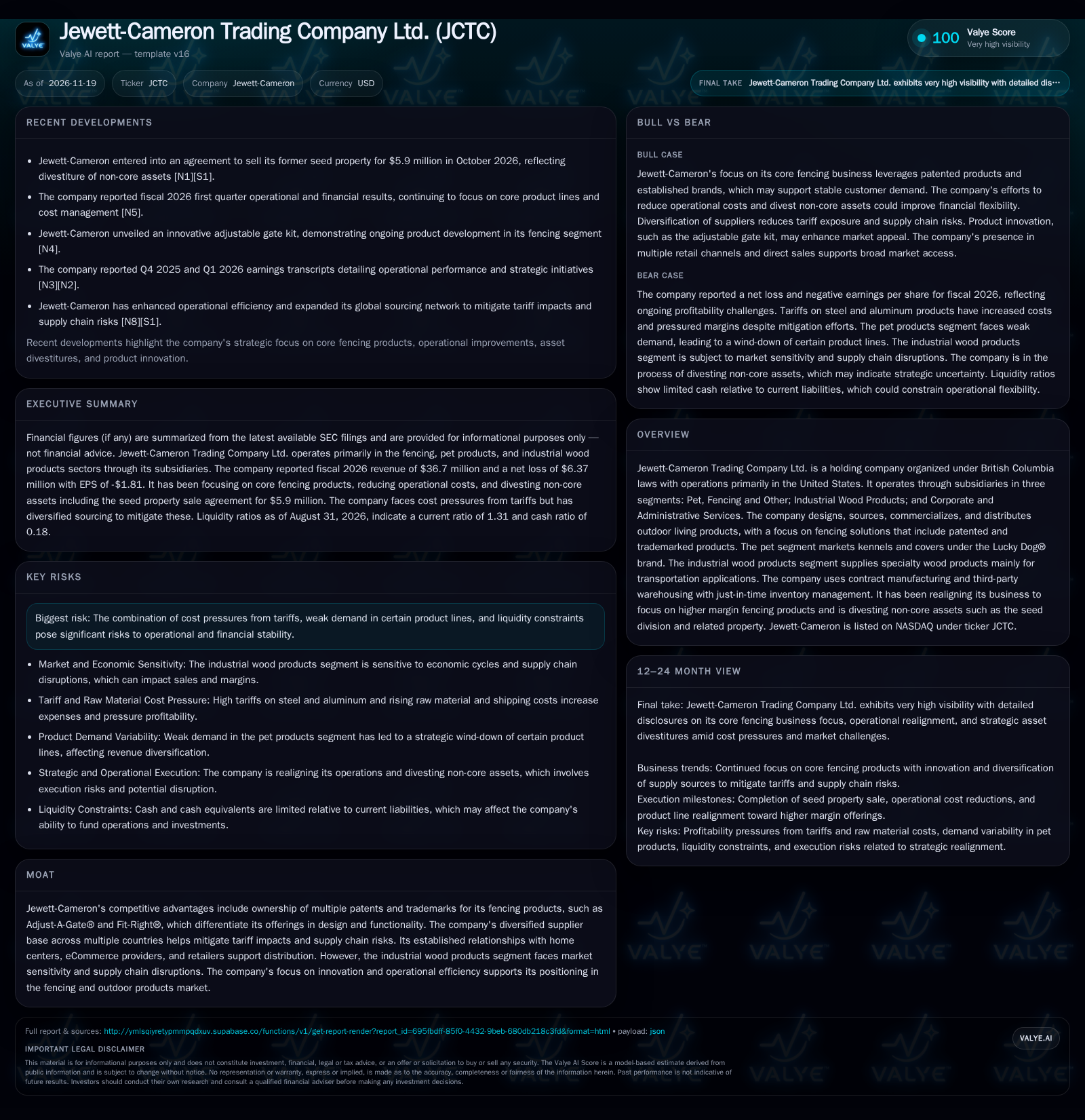
Jewett-Cameron is narrowing its focus to core fencing products, selling non-core assets like its former seed property, and expanding its supplier base to manage tariffs and supply risks.
Jewett-Cameron Trading Company Ltd. is at a pivotal juncture: following consecutive years of declining revenue and mounting losses, the company is divesting non-core assets and concentrating on its patented fencing product portfolio. With the sale of its seed property and the wind-down of weaker product lines, Jewett-Cameron is seeking to streamline operations, reduce costs, and defend margins amid persistent tariff headwinds.
Asset Sales and Strategic Refocusing Define 2026 Operating Reality
Jewett-Cameron’s fiscal 2026 was marked by a decisive shift toward operational streamlining and strategic focus. The company reported a current ratio of 1.31 for the period. [N1] [S1] [N8]
How Fencing Economics and Cost Structure Shape Profit Potential
Jewett-Cameron’s financial model is increasingly centered on fencing products, which benefit from proprietary designs and patent protection, potentially enabling premium pricing and some insulation from pure commodity competition. However, the company’s recent financials reveal significant pressure on both volume and margins, as revenue declined and net losses mounted.[S1]
The fencing segment’s economics are influenced by input cost volatility—particularly steel and aluminum, which are subject to tariffs and global price swings. Jewett-Cameron’s use of contract manufacturing and just-in-time inventory practices helps control working capital needs and fixed overhead, but may limit scale leverage compared to vertically integrated peers. The company’s move to diversify sourcing to Bangladesh and Vietnam could reduce tariff exposure, but may introduce logistics complexities or require new supplier vetting.[S1] [N8]
Operational leverage is a double-edged sword: while cost reductions and asset sales can shrink the breakeven point, declining top-line volume amplifies losses. The company’s ability to restore profitability hinges on stabilizing fencing demand, successfully launching new products (such as the adjustable gate kit), and managing raw material and shipping costs. The company reported cash and liquidity metrics for the period; these figures do not by themselves establish operating runway, investment capacity, financial flexibility, or financing capacity. [S1] [N1] [N4]
The interplay between Jewett-Cameron's contract manufacturing strategy and its cost structure warrants further examination. While outsourcing production can reduce fixed overhead and capital expenditures, it also introduces dependencies on supplier reliability and quality control. In a market where fencing products require consistent quality to maintain brand reputation, any disruptions or quality issues from external manufacturers could erode customer trust and increase warranty or replacement costs. Therefore, the company's ability to establish rigorous supplier standards and maintain close oversight is critical to preserving its value proposition and protecting margins.
Patented Products, Supplier Diversification, and Margin Pressures in a Crowded Market
Jewett-Cameron operates in highly competitive fencing and outdoor product categories, facing rivals ranging from large national brands to private-label and imported products. The company’s main competitive levers are its portfolio of seven granted and three pending patents, which cover innovations such as Adjust-A-Gate® and Fit-Right®.[S1] These patents can help sustain price premiums and deter direct imitation, but do not guarantee customer loyalty or sustained growth in the face of broader market weakness.
Supplier diversification is both a defensive and offensive move: sourcing from Bangladesh and Vietnam reduces single-country risk and helps offset U.S.-China tariff impacts, but may not fully close the cost gap versus larger competitors with greater scale or in-house manufacturing.[S1] [N8] Jewett-Cameron’s established retail and e-commerce distribution relationships provide access to large channels, but the shift away from pet and eco-products may erode shelf presence and customer mindshare in the short term.
The industrial wood products segment, which is under strategic review, faces its own set of competitors and is highly sensitive to economic cycles and infrastructure spending—making it less predictable as a profit contributor or sale candidate.
A Path to Turnaround: Margin Recovery and Fencing Product Momentum
A favorable scenario for Jewett-Cameron would see its streamlined focus on patented fencing products translating into improved top-line stability and margin expansion. If the company successfully launches new products (such as the adjustable gate kit) that gain traction with retailers and end-customers, pricing power and order volumes could improve.[N4] Supplier diversification could further lower input costs if tariffs remain elevated or if new partners offer better terms.
Operational cost reductions and the proceeds from asset sales (e.g., the $5.9 million seed property agreement) could provide enough liquidity to weather near-term challenges and fund targeted growth initiatives.[N1] Evidence confirming this scenario would include sustained or growing fencing segment revenue, improved gross margins, and a return to positive operating cash flow—alongside successful execution of the divestiture and clear progress in new product adoption.
Stabilization Hinges on Fencing Demand and Cost Discipline
The most plausible trajectory is one of operational stabilization, where Jewett-Cameron’s fencing business achieves modest revenue growth or flattens after recent declines, while ongoing cost discipline and supplier diversification partially offset margin pressure. The company completes its seed property sale, further reduces working capital tied up in excess inventory, and maintains a leaner cost structure.
In this scenario, net losses could narrow but may persist if raw material costs remain high or if the fencing market weakens further. The industrial wood products segment remains under review and is not a major growth engine. Confirmation would come from steady fencing segment sales, evidence of margin stabilization (if disclosed), and successful completion of announced divestitures. A falsifying signal would be continued top-line declines, further net losses, or delays in asset sales that prolong liquidity constraints.
Liquidity Risk and Revenue Erosion Threaten Business Continuity
In a negative scenario, fencing demand continues to soften or competitive pressures intensify, leading to further revenue declines. Raw material inflation and tariffs persist, supplier diversification fails to deliver sufficient cost relief, and new product launches do not gain meaningful traction. Meanwhile, the company’s limited cash and reported cash ratio leave little margin for error.[S1]
If asset sales are delayed or generate less cash than expected, working capital could become constrained, potentially impacting the company’s ability to meet obligations or invest in inventory for peak seasons. A sharper downturn in the industrial wood products segment or execution missteps in the ongoing strategic realignment could further erode confidence. Evidence for this scenario would be another year of deepening losses, deteriorating liquidity ratios, and negative operating cash flow despite cost-cutting efforts.
Milestones and Metrics That Will Determine the Success of Jewett-Cameron's Strategic Reset
Completion and cash realization from the $5.9 million seed property sale; delays or shortfalls would signal potential liquidity stress.
Quarterly fencing segment revenue and gross margin trends—sustained declines or margin compression would undermine the turnaround thesis.
Progress in supplier diversification (if disclosed), especially evidence of reduced cost of goods sold or improved input availability.
Sales performance of newly launched fencing products, such as the adjustable gate kit; strong initial orders or channel uptake would support recovery.
Operating cash flow direction—return to positive figures would indicate improved business health.
Status and outcome of the strategic review of the industrial wood products segment; a successful divestiture or turnaround could provide incremental value.
Inventory days and working capital efficiency metrics (if disclosed), as excess inventory has been a drag on past performance.
Any new or expanded retail/e-commerce distribution deals, which would test the company’s ability to regain market share post-divestiture.
Disclaimer: This is research-only, informational analysis and not investment advice. It may include AI-generated interpretation and general industry context. Always verify important details using primary sources.

Comments