
Maximus, Inc.: Margin Resilience, Government Tech Modernization, and the Stakes of Segmental Divergence
Maximus faces a pivotal juncture as core U.S. Federal Services margins expand, while state and international segments contract. The company’s push into AI-enabled solutions and its exposure to regulatory and performance risks shape both its upside potential and the durability of its public-sector franchise.
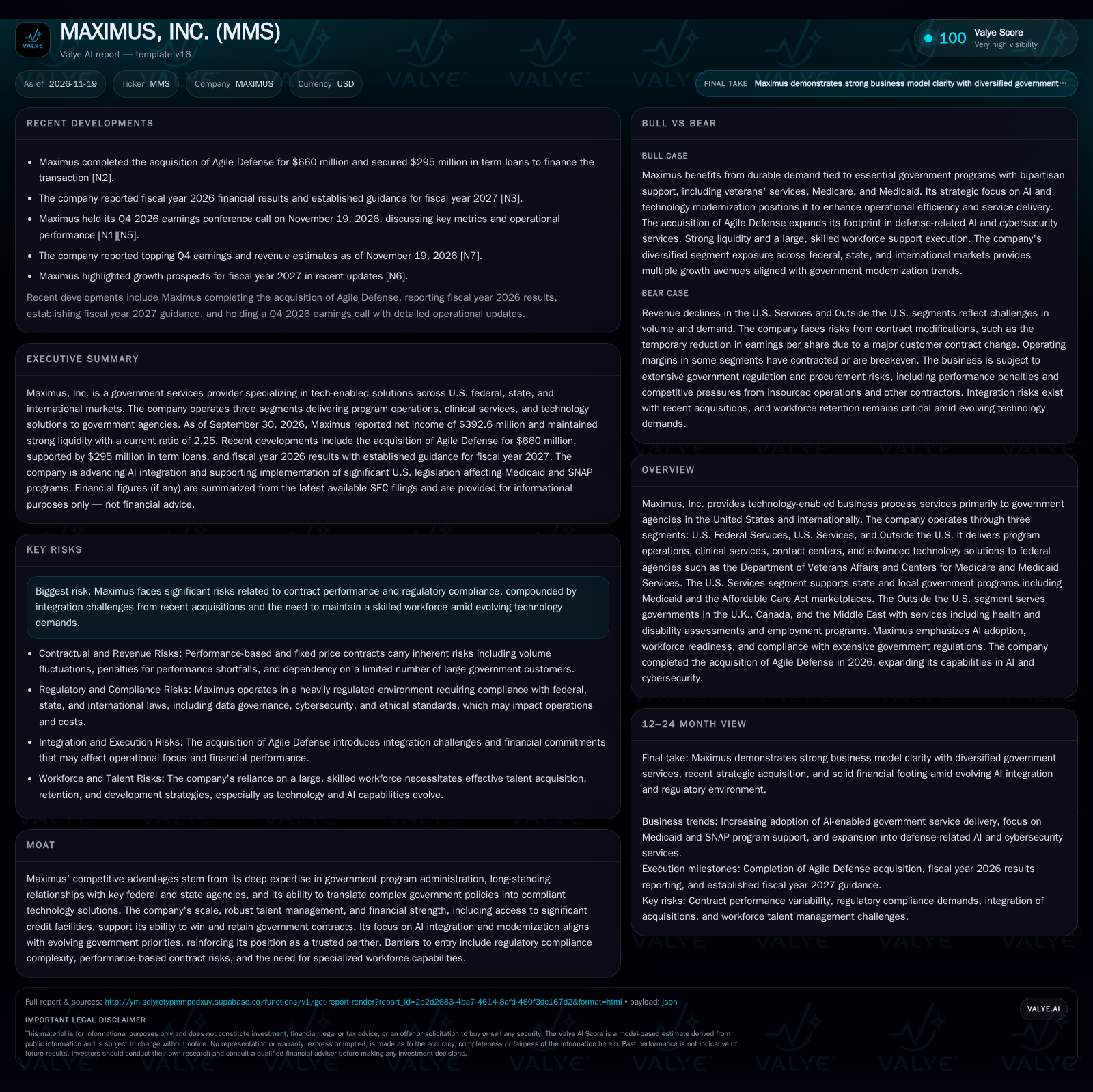
Maximus reported a net income of $392.6 million for fiscal 2026, with a notable margin improvement in its U.S. Federal Services segment. However, revenue contracted across state and international operations. The company’s AI initiatives and compliance capabilities position it for modernization opportunities, but contract and regulatory risks remain central to the investment debate. Fiscal 2027 guidance points to renewed growth prospects, but segment divergence and contract exposure are key watchpoints. [S1] [S2] [N3] [N6]
Maximus, Inc., a leading provider of technology-enabled business process services to government agencies, is at a strategic crossroads. While its core U.S. Federal Services segment has delivered margin expansion and operational resilience, the company faces headwinds from declining state and international revenues. With a sharpened focus on AI-driven modernization and compliance, Maximus is positioning itself to capture emerging opportunities in public-sector transformation. However, its future trajectory depends on navigating contract volatility, regulatory complexity, and the divergent performance of its business segments. The company’s fiscal 2027 guidance suggests optimism, but underlying risks and execution challenges demand close scrutiny. [S1] [S2] [N3] [N6]
Segmental Divergence and Margin Trends Define the Current Landscape
Maximus reported net income of $392.6 million for fiscal 2026, with basic EPS of $7.32 and diluted EPS of $7.27 as of September 30, 2026. The company’s U.S. Federal Services segment achieved a notable operating margin expansion to 17.5% for the nine months ended June 30, 2026, up from 15.3% in the prior year, despite total revenue for the same period declining by 4.4% to $3.93 billion. In contrast, the U.S. Services segment saw a 6.4% revenue decline and operated at a margin of 9.1%, while the Outside the U.S. segment experienced an 8.4% revenue contraction and posted an operating loss. Liquidity metrics showed $279.97 million in cash and equivalents, a current ratio of 2.25, and a cash ratio of 0.35. Fiscal 2027 guidance and Q4 2026 results point to optimism about future growth, but the divergence between segment performance and the exposure to contract structures are material to understanding Maximus’s current position. [S1] [S2] [N3] [N6]
How Maximus Makes Money: Contract Mechanics, Margin Levers, and Capital Structure
Maximus generates revenue through a portfolio of government contracts that include performance-based, cost-plus, fixed price, and time and materials arrangements. The economics of these contracts vary: performance-based and fixed price structures offer potential for higher margins but expose the company to risk if volume or performance targets are missed, while cost-plus contracts provide greater margin stability but generally lower profitability. The company’s scale enables it to bid competitively for large, complex government projects, and its ability to deliver technology-enabled process improvements and compliance solutions can support margin expansion, particularly in federal contracts where operational complexity and regulatory requirements are high.
Operating leverage is driven by the mix of contracts and the efficiency gains from technology adoption, notably AI tools that can automate case management and customer engagement. While fixed costs are substantial—given a workforce of over 33,700 employees and 7,700 contingent workers—incremental revenue from expanded or renewed contracts can yield outsized profit contributions. However, when state or international contract volumes decline, as seen in recent results, fixed labor and compliance costs can compress margins or even result in segment losses.
The company reported cash and liquidity metrics for the period; these figures do not by themselves establish operating runway, investment capacity, financial flexibility, or financing capacity. [S1]
Government Services Competition: Scale, Compliance, and Technology as Differentiators
Maximus operates in a competitive landscape populated by large government contractors, IT services providers, and specialized consultancies. Its core advantages stem from deep domain expertise in government program administration, long-standing relationships with federal and state agencies, and an ability to translate evolving policy into compliant, scalable solutions. This embeddedness creates switching frictions for government clients, who face high operational and political costs in changing vendors.
However, the market is characterized by periodic re-bidding, insourcing pressures, and the constant threat of new entrants—especially as governments seek cost savings and digital transformation. The increasing role of AI and automation could level the playing field for tech-savvy competitors or enable government agencies to internalize more functions. Regulatory compliance remains a significant barrier to entry, but also a cost center that can erode margins if not managed efficiently.
The company’s ability to integrate AI and advanced analytics into its service offerings is increasingly central to its competitive positioning. While Maximus’s scale and compliance track record offer an advantage in securing large contracts, the durability of this moat depends on continued investment in talent, technology, and risk management.
AI-Led Modernization Unlocks Margin Expansion and New Contract Wins
If Maximus successfully deploys AI-driven solutions across its operational footprint, it could substantially reduce labor intensity, accelerate case processing, and deliver measurable value to government clients. This would support higher margins, particularly in performance-based and fixed price contracts, where operational efficiency translates directly to profitability. The company’s involvement in implementing major legislation—such as the One Big Beautiful Bill Act (OBBBA)—positions it to capture incremental revenue from expanded Medicaid and SNAP program engagement.
Upside would be confirmed by sustained or accelerating margin improvement in the U.S. Federal Services segment, successful renewal or expansion of large federal contracts, and a return to growth in state and international operations as AI-enabled offerings gain traction. Additional evidence would include new contract awards tied to AI capabilities, improved gross profit despite flat or declining revenue, and public sector clients citing Maximus’s technology leadership as a selection factor. [S1] [S2] [N6]
Segmental Divergence Persists Amid Incremental Modernization Gains
The most plausible trajectory is that Maximus maintains its strong position in federal contracts, with margin resilience supported by ongoing process improvements and selective AI adoption. State and international segments may continue to lag, pressured by budget constraints, competitive re-bidding, and slower technology uptake by local governments. Revenue growth could be modest, driven by incremental contract wins and program expansions, while overall margin profile is shaped by the mix shift toward higher-value federal work.
Confirmation of this scenario would come from stable or gradually improving operating margins in the federal segment, muted recovery in state and international revenues, and continued investment in talent and compliance. Evidence against this base case would be a sharp rebound in state/local contract volumes or unexpected margin compression in the federal segment due to contract losses or cost overruns. [S2] [N3]
Contract Volatility, Compliance Costs, and Margin Compression Erode Value
Adverse scenarios could materialize if Maximus faces significant contract losses, performance penalties, or unfavorable re-bidding outcomes—particularly in its state and international segments where recent revenue declines have already pressured margins. If governments accelerate insourcing or competitors undercut on price with more advanced digital offerings, Maximus could see further revenue contraction and operating losses outside its federal core.
Regulatory or compliance failures, or delays in successfully integrating AI into its offerings, could drive up costs and expose the company to penalties or reputational damage. This would be reflected in declining operating margins, contract non-renewals, or negative working capital trends. Downside evidence would include operating losses spreading to the U.S. Services segment, deteriorating gross profit despite stable revenue, and incremental compliance or restructuring charges. [S2]
Testing the Maximus Thesis: What Could Confirm or Challenge the Story Next
Operating margin trends by segment—especially whether federal margin expansion persists and if state/international segments stabilize or recover. [S2]
New contract awards or renewals, particularly those explicitly tied to AI-enabled services or major legislative implementations. [N6]
Revenue and gross profit mix shift toward higher-margin federal contracts versus lower-margin state/international work. [S2]
Evidence of successful AI integration (e.g., automation of case management, reduced labor costs, improved client outcomes)—if disclosed.
Contract re-bidding outcomes, including win rates and pricing/volume changes versus prior periods—if disclosed.
Compliance incidents, regulatory penalties, or material cybersecurity/data governance events impacting operations or client trust—if disclosed.
Trends in workforce retention, talent acquisition, and employee engagement, especially as AI adoption changes skill requirements—if disclosed.
Disclaimer: This is research-only, informational analysis and not investment advice. It may include AI-generated interpretation and general industry context. Always verify important details using primary sources.

Comments