
Post Holdings: Navigating Retail Pressures with Foodservice Ambitions and Premium Cereal Gains
Post Holdings faces a critical juncture as retail headwinds threaten core food sales, but market share wins in premium cereal and a pivot toward foodservice growth offer potential offsets. The company's financial profile shows moderate short-term flexibility, placing execution risk at the center of its near-term outlook.
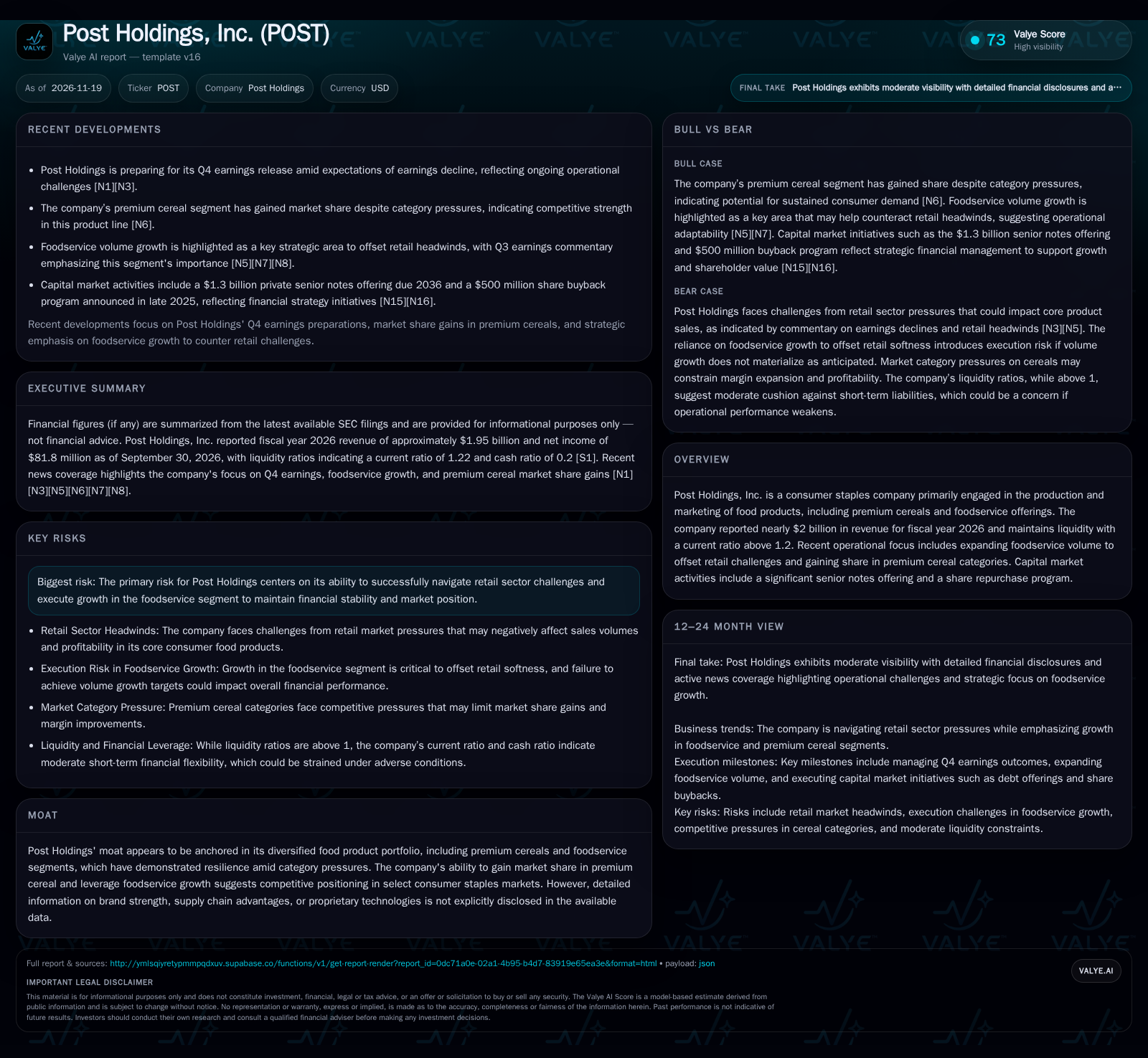
Post Holdings reported $1.95 billion in FY26 revenue and $81.8 million in net income, with a current ratio of 1.22 and a cash ratio of 0.2 as of September 30, 2026. The company’s premium cereal segment has gained share despite category pressures, while foodservice is positioned as a key growth lever to counter retail softness. Execution in foodservice and continued share gains in premium cereal are pivotal for future performance, but liquidity is only moderately above minimum comfort levels [S1] [N6] [N7] [N8].
Post Holdings, Inc. stands at a strategic crossroads as it contends with persistent retail headwinds in its core consumer food businesses. With Q4 earnings expected to decline, the stakes are rising for Post to prove that its operational pivot can deliver durable results amid a challenging consumer staples landscape.
Recent Performance: Solid Revenue, Squeezed Margins, and a Strategic Pivot
Post Holdings reported fiscal 2026 revenue of approximately $1.95 billion and net income of $81.8 million, reflecting a stable but not rapidly expanding business [S1]. Basic EPS was $1.87, with diluted EPS at $1.68 [S1]. The company reported cash and liquidity metrics for the period; these figures do not by themselves establish operating runway, investment capacity, financial flexibility, or financing capacity. [S1]
Recent news and management commentary point to two major developments: first, the premium cereal segment has managed to gain market share even as the broader category faces pressure [N6]. Second, foodservice has emerged as the company’s growth focus, with management underscoring its importance in offsetting retail softness [N5] [N7] [N8].
Q4 earnings are expected to decline, highlighting the persistent operational and market challenges Post faces [N1] [N3]. This creates urgency around the success of its foodservice strategy and the sustainability of recent share gains in premium cereals.
How Post Holdings Generates—and Risks—Profit: Volume, Mix, and Margin Levers
Post Holdings’ revenue streams are anchored in branded consumer foods, with premium cereals and foodservice as key segments. In the premium cereal category, margins are typically higher than value or private label offerings due to brand premiums, but the category’s overall volume is mature and subject to competitive pricing and input cost pressures. Share gains may help offset category contraction, but the question is whether these gains are sufficient to drive significant margin expansion or merely cushion declines.
The foodservice segment, which supplies products to institutional buyers such as restaurants, hotels, and schools, could offer volume growth and operational leverage if scale is achieved. However, foodservice contracts often carry lower per-unit margins than branded retail, and customer concentration or lumpy demand cycles can introduce volatility. Success in this channel may depend on the company’s ability to streamline production, leverage distribution, and negotiate favorable terms.
Both segments are sensitive to commodity inflation, labor costs, and logistics. Post’s fixed cost base—common in food manufacturing—means that incremental volume can drive meaningful margin expansion if pricing holds.
Sustaining Share Gains Amid Category Pressure and Foodservice Competition
Post’s competitive position in premium cereals is currently supported by recent share gains, which suggest effective brand positioning and perhaps innovation or targeted marketing [N6]. However, the cereal aisle remains a crowded space, with private label and large branded competitors vying for shelf space and promotional dollars. The ability to sustain share gains will likely hinge on continued investment in brand equity, differentiated product offerings, and price discipline in the face of inflationary pressures.
In foodservice, Post competes not only with other branded food manufacturers but also with specialized foodservice suppliers and private label providers. This segment is characterized by intense price competition, a need for reliable supply chains, and the importance of customer relationships. Switching costs for institutional buyers are generally low, so Post must demonstrate either superior value, reliability, or service to grow and retain accounts.
The company’s diversified product portfolio provides some resilience, but no single product line or channel appears to offer an insurmountable moat. The absence of explicit evidence of proprietary technology, unique supply chain advantages, or enduring contractual relationships means that Post’s edge may be more about operational execution and adaptability than structural barriers to entry.
A Virtuous Cycle: Foodservice Expansion and Premium Cereal Resilience Drive Margin Upside
The most favorable scenario for Post would see its foodservice business achieve sustained volume growth, leveraging existing manufacturing and distribution infrastructure to deliver operating leverage. If the company can secure long-term contracts or deepen relationships with major foodservice customers, revenue visibility and margins could improve, particularly if commodity cost inflation moderates.
Simultaneously, if premium cereal share gains prove durable, Post could benefit from a mix shift toward higher-margin products, offsetting volume pressure in the broader category. Success in both segments could allow for reinvestment in innovation, targeted marketing, or debt reduction, further strengthening the business.
Evidence confirming this upside would include sequential foodservice revenue and volume growth outpacing retail declines, stable or expanding gross margins, and disclosure of new or renewed multi-year foodservice agreements. Market share data showing continued premium cereal outperformance would further bolster the case.
Incremental Progress and Persistent Frictions Define the Most Likely Outcome
The most plausible near-term scenario is that Post manages to partially offset retail weakness with gradual foodservice gains, but neither segment delivers breakout performance. Premium cereal share gains slow as competitors respond, and foodservice volumes grow, but pricing pressure and integration costs keep margins in check.
Commodity cost fluctuations and shifting consumer preferences continue to create volatility, but Post’s diversified portfolio helps absorb shocks.
This scenario would be confirmed by flat to modestly rising topline, stable but not expanding margins, and management commentary focused on operational discipline rather than transformative growth. Any acceleration or deceleration in foodservice or premium cereal KPIs would help falsify or confirm this base case.
Execution Risk and Category Contraction Could Amplify Earnings Declines
If foodservice expansion fails to materialize—due to competitive losses, operational missteps, or a downturn in institutional demand—Post could lose its primary offset to retail headwinds. A reversal in premium cereal market share, whether from aggressive competitor promotions or shifting consumer tastes, would further pressure both revenue and margin.
This could force cutbacks in marketing, innovation, or even lead to asset sales in a worst-case scenario.
Downside confirmation would include sequential declines in both foodservice and retail segments, margin compression, negative free cash flow, and management guidance cuts. Evidence of lost contracts or material category share losses would heighten concern.
Milestones That Will Define Whether Post Holdings’ Pivot Succeeds
Quarterly foodservice revenue and volume trends: Sustained sequential growth would support the thesis that this segment is becoming a durable offset to retail softness.
Premium cereal market share data: Continued gains, if disclosed, would suggest brand strength and category resilience; stagnation or reversal would be an early warning sign.
Gross margin trajectory: Expansion would indicate successful mix shift or cost management; compression would suggest competitive or inflationary pressures are winning.
Disclosure of major new or renewed foodservice contracts: Multi-year or scaled agreements would demonstrate progress in institutional channel penetration.
Management commentary on commodity costs and pricing power: Updates here would clarify the company’s ability to pass through inflation or protect margins.
Any divestitures, asset sales, or restructuring announcements: These would signal increasing urgency and may be a response to more acute operational pressure.
EPS and free cash flow generation: Trends here, especially negative turns, would provide a clear signal of underlying business health.
Disclaimer: This is research-only, informational analysis and not investment advice. It may include AI-generated interpretation and general industry context. Always verify important details using primary sources.

Comments