
USANA Health Sciences: Direct Selling Model Under Pressure as Regulatory and Channel Dynamics Shift
USANA’s omni-channel expansion and recent acquisitions aim to diversify revenue, but persistent losses, evolving compensation structures, and regulatory scrutiny—especially in core Asian markets—pose material challenges to restoring growth and profitability.
USANA Health Sciences continues to face declining sales and net losses despite a diversified product and channel strategy. Acquisitions and new channel initiatives offer growth potential but introduce integration risk and heightened operational complexity. Monitoring the effectiveness of compensation plan changes, channel mix evolution, and regulatory developments will be crucial for assessing USANA’s ability to stabilize and return to profitable growth. [S2] [N4] [N5]
USANA Health Sciences is at a strategic crossroads: while its science-based nutritional and personal care portfolio is now distributed across direct selling, e-commerce, and retail channels, the company is grappling with persistent net losses and intensifying regulatory scrutiny in its core markets. The latest results reveal both the cost and complexity of maintaining a large Brand Partner network, even as USANA invests in new customer segments and partnerships. The critical question is whether omni-channel diversification and evolving compensation models can offset mounting pressures in the traditional direct selling framework and restore profitable growth. [S2] [N4] [N5]
Recent Losses, Channel Shifts, and Regulatory Overhang Define the Current Landscape
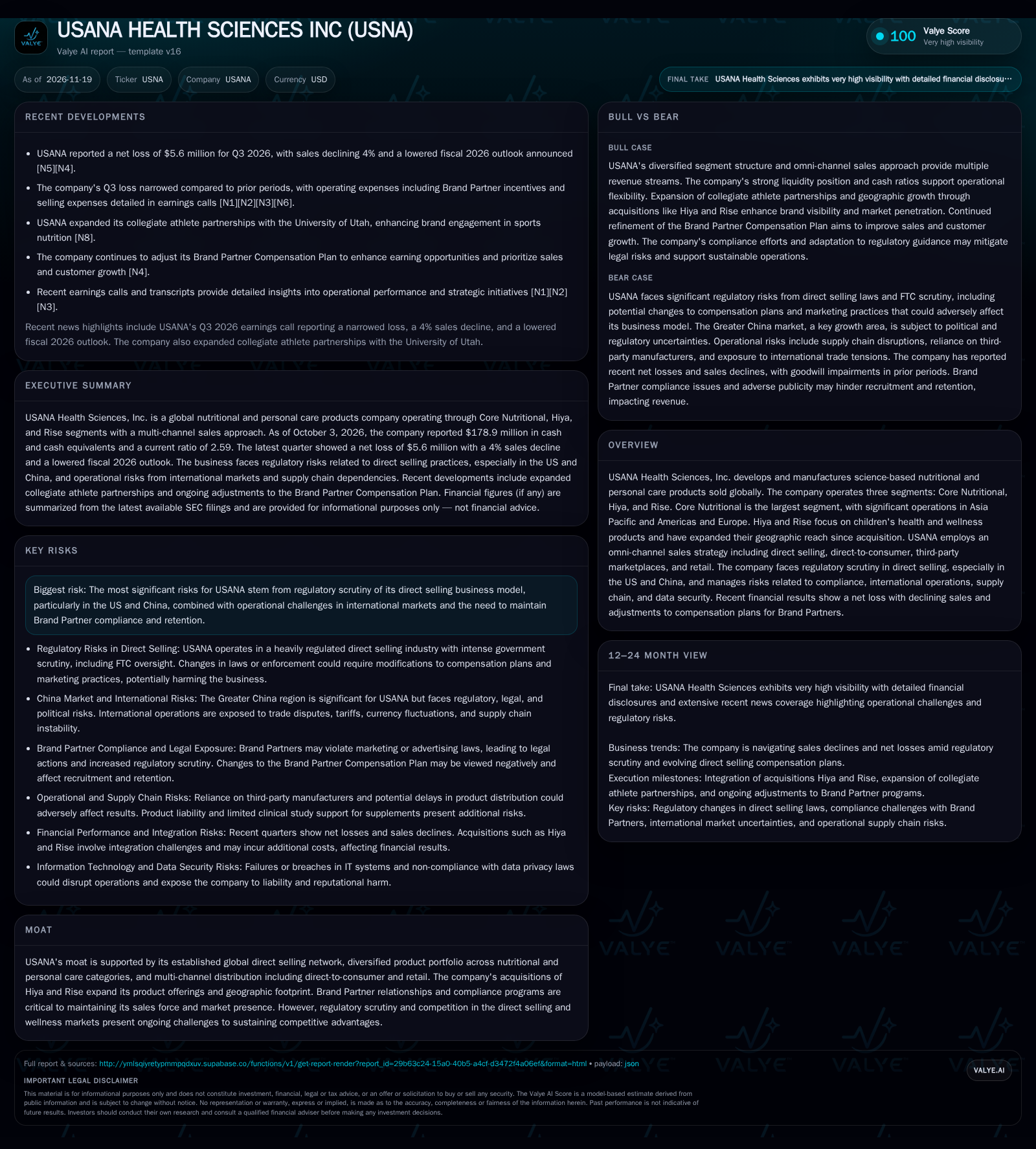
USANA’s Q3 2026 results show net sales of $205.9 million and a net loss of $5.6 million, continuing a trend of declining sales and negative earnings. Brand Partner incentives remain a major expense at $71.9 million for the quarter—over one-third of gross profit—highlighting the ongoing cost of sustaining the direct selling network. The company reported $178.9 million in cash and a current ratio of 2.59 as of October 3, 2026; however, this balance sheet position has not translated into operating profitability. Regulatory scrutiny—especially in the direct selling model’s two most important markets, the US and Greater China—remains a persistent threat, with the company repeatedly adjusting its Brand Partner Compensation Plan to adapt to evolving legal and market realities. [S2] [N4] [N5]
Omni-Channel Model and Direct Selling Economics: Margin Structure and Volume Pressures
USANA’s business economics are shaped by a mix of high-margin nutritional products and a cost-heavy direct selling infrastructure. Gross margins are buoyed by in-house manufacturing and science-based formulations, but Brand Partner incentives represent a structurally high fixed cost: $71.9 million in Q3 2026, or roughly 35% of net sales. This cost is variable with sales but sticky in practice, as reductions could harm recruitment and retention. The move toward omni-channel distribution—direct-to-consumer, third-party marketplaces, and retail—potentially allows for broader reach and reduced reliance on the direct selling network. However, these channels typically involve different margin structures: direct-to-consumer may offer higher margins but require increased marketing spend, while retail and third-party marketplaces can compress margins due to wholesale pricing and promotional allowances. The integration of Hiya and Rise introduces new product categories and customer segments (notably children's health), but also adds operational complexity and integration costs. Capital requirements remain moderate given the asset-light nature of direct selling and e-commerce, but regulatory compliance and technology investments could drive incremental spend.
Direct Selling Legacy Meets Modern Wellness: Competitive Dynamics and Substitution Threats
USANA’s competitive position is rooted in its global direct selling network, product reputation, and science-driven formulations. However, the broader wellness industry is undergoing rapid channel and consumer preference shifts. Traditional direct selling faces pressure from regulatory scrutiny, negative public perception, and the rise of digital-first brands that leverage influencer marketing or direct-to-consumer e-commerce. Large incumbents and specialized wellness startups alike are competing on brand authenticity, clean ingredients, and digital engagement—areas where legacy direct sellers may lag. USANA’s expansion into collegiate athlete partnerships and children’s wellness via Hiya are attempts to modernize the brand and tap new demographics. The question is whether these efforts can offset the structural challenges of direct selling, especially as regulatory changes could weaken the recruiting-driven model and as consumers increasingly favor transparent, subscription-based, or retail experiences. Substitution risk is high: nutritional supplements are widely available through mass retail, specialty stores, and digital platforms, all with lower distribution costs and, often, greater price transparency.
If Compensation Reform and Channel Diversification Reignite Growth
A favorable outcome for USANA would involve the successful transformation of its sales mix: omni-channel expansion (especially direct-to-consumer and retail) supplements or replaces declining direct selling volumes, while compensation plan reforms retain top Brand Partners and attract a new generation of sellers. Integration of Hiya and Rise could unlock cross-selling opportunities and access to new demographics, particularly in family and children’s health. Regulatory compliance efforts, if effective, may reduce legal risk and public scrutiny, allowing for steadier operations in critical markets like Greater China. Evidence that would confirm this scenario includes a return to net profitability, stabilization or growth in total sales (especially outside the traditional Brand Partner channel), improved Brand Partner productivity, and increased contribution from newly acquired brands and channels. Announcements of new partnerships, successful athlete endorsements, or growing digital/retail sales would further support the upside case.
Multi-Channel Evolution Continues, but Margin Recovery Remains Elusive
The most plausible trajectory is that USANA continues to experience modest sales declines or stagnation in its core direct selling business, partially offset by incremental gains in direct-to-consumer and retail channels. Brand Partner incentives remain a high expense, with compensation plan adjustments having only limited success in improving productivity or retention. Integration of Hiya and Rise contributes to top-line diversification but does not fully offset declines in legacy segments, and margin pressure persists due to higher marketing and channel costs. Regulatory risks remain elevated, particularly in Greater China, leading to ongoing compliance investments and episodic operational disruptions. Confirmation of this scenario would include continued operating losses or minimal profits, flat or modestly declining sales, and ongoing changes to the Brand Partner model. Evidence to the contrary would be a more rapid sales rebound, significant cost discipline, or a clear shift in channel profitability.
Regulatory Clampdown and Channel Cannibalization Accelerate Declines
In a more adverse scenario, regulatory changes in the US or China fundamentally impair the direct selling model—through restrictions on compensation structures, increased scrutiny, or adverse publicity—leading to accelerated Brand Partner attrition and rapid sales declines. If omni-channel expansion fails to scale or cannibalizes existing sales at lower margins, the company could see sustained net losses and potential impairment of acquired brands. Integration difficulties with Hiya and Rise could further erode profitability, while supply chain or IT disruptions exacerbate operational risk. Confirmation of this scenario would be a sharp drop in sales, significant reduction in the active Brand Partner count, large restructuring or impairment charges, and possible cash burn despite the currently reported cash and current ratio.
Markers to Test USANA’s Rebound Potential and Business Model Evolution
Quarterly trends in net sales and operating profit, especially by segment and channel, will be critical for assessing whether omni-channel and acquisition strategies are offsetting legacy declines.
Brand Partner count, productivity, and churn rates—if disclosed—would provide insight into the health and sustainability of the direct selling network.
Sales mix evolution: tracking the proportion of revenue from direct-to-consumer, retail, and third-party marketplaces versus traditional direct selling.
Updates on regulatory investigations, compliance actions, or changes in local laws—especially in Greater China and the US—will be essential signals.
Integration milestones and financial contribution from Hiya and Rise, including any cross-selling or channel synergies.
Gross margin trends, as a gauge for channel mix impact, promotional intensity, and cost structure shifts.
Evidence of successful new customer acquisition through athlete partnerships, retail expansion, or digital marketing campaigns.
Disclaimer: This is research-only, informational analysis and not investment advice. It may include AI-generated interpretation and general industry context. Always verify important details using primary sources.

Comments