
UGI’s Strategic LPG Spin-Off: Implications for Focus, Risk, and Value Creation
UGI Corporation’s planned separation of its global LPG business marks a fundamental shift in business model, risk profile, and capital structure. As the company prepares to divide along utility and LPG lines, the outcomes will hinge on execution, regulatory approvals, and the ability of each new entity to manage concentrated risks and seize focused opportunities.
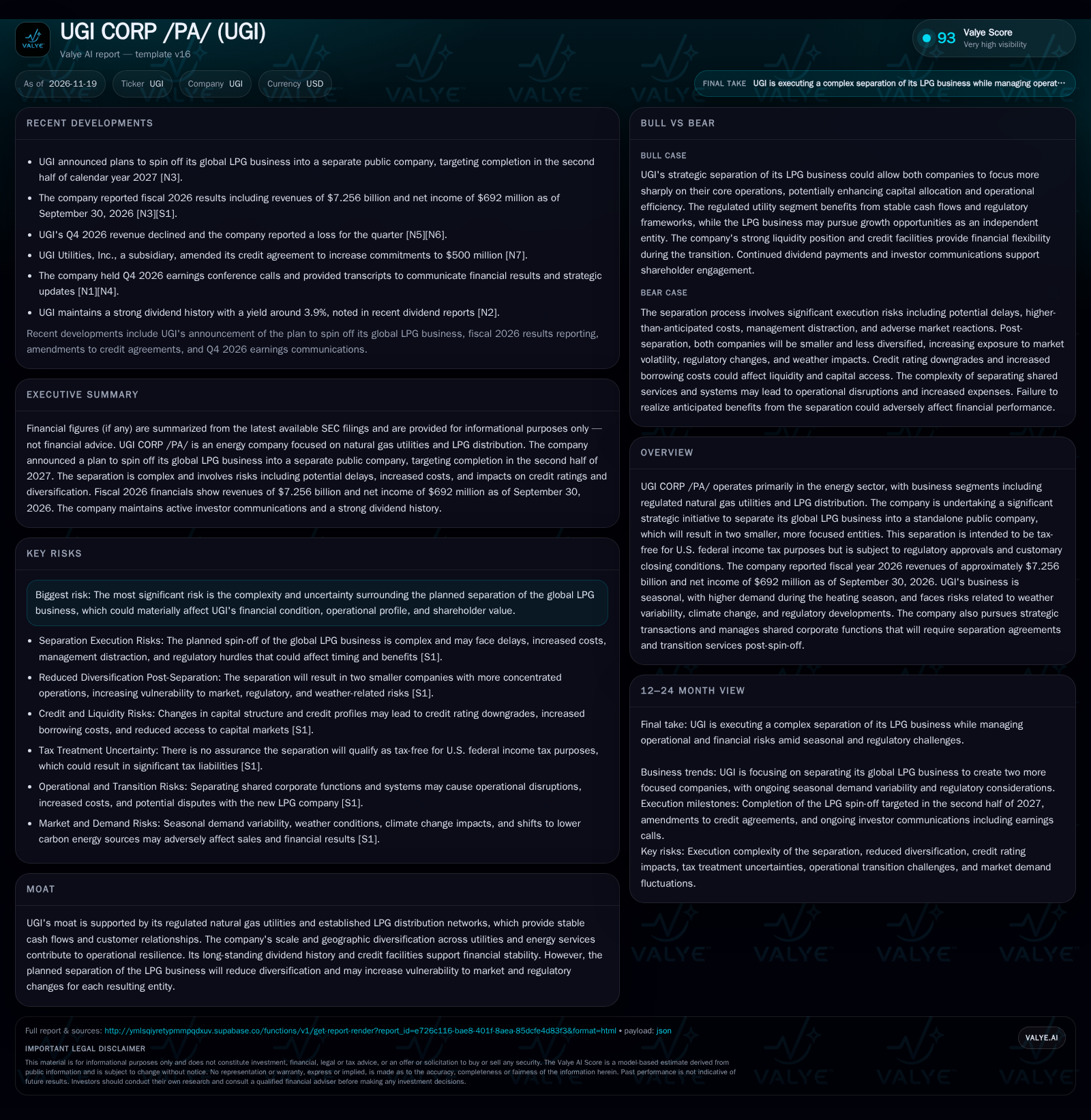
UGI Corporation’s announced plan to spin off its global LPG business will transform it into two distinct, more focused companies—one centered on regulated natural gas infrastructure, the other on LPG distribution. This move, targeted for completion in the second half of 2027, creates both opportunities for sharper operational focus and heightened risks from reduced diversification, execution complexity, and potentially higher borrowing costs. Financial results for fiscal 2026 underscore the importance of the LPG segment, which contributed over half of consolidated revenue and over a third of EBIT, highlighting what will be at stake as the company’s profile changes dramatically.
UGI Corporation’s decision to spin off its global LPG business by late 2027 represents a pivotal realignment of both strategic focus and risk exposure. With LPG accounting for more than half of 2026 revenues and over a third of operating earnings, the separation will fundamentally reshape UGI’s business mix, concentrating its future on regulated natural gas utilities and energy infrastructure. This move promises greater operational focus but also heightens risks around execution, potential financial flexibility, and market volatility—testing management’s ability to deliver value through structural change in a sector already facing climate, regulatory, and demand headwinds.
LPG Spin-Off Sets the Stage for Fundamental Business Realignment
UGI Corporation has announced the planned spin-off of its global LPG business, with the separation intended to be completed in the second half of 2027, pending regulatory approvals and closing conditions [N3] [S1]. The transaction is designed to be tax-free for U.S. federal income tax purposes, though this outcome is not guaranteed and remains subject to IRS and legal review [S1].
This move is transformative: in fiscal 2026, UGI International and AmeriGas Propane (the LPG businesses) delivered 56% of consolidated revenues and 36% of EBIT, making the separation a major shift in both business mix and earnings base [S1]. Post-spin, UGI will comprise regulated natural gas utilities and energy services, while the new entity will focus solely on LPG distribution [S1].
The separation introduces execution complexity and risk. UGI cites possible delays, increased costs, management distraction, and adverse market reactions as potential hurdles [S1]. Additionally, both resulting companies will become smaller, less diversified, and more sensitive to their respective sectoral risks.
How the Economics of Regulated Utilities and LPG Distribution Could Diverge
Post-separation, UGI’s economic engine will pivot to regulated natural gas utilities and energy infrastructure, which typically offer stable, predictable returns driven by rate base investments and regulatory frameworks. These businesses generally exhibit lower volatility, protected margins, and long-term capital needs, with profitability tied to allowed returns and the pace of infrastructure investment.
The LPG business, by contrast, derives economics from volume-driven distribution, margin management, and operational efficiency. LPG margins can be more exposed to commodity price changes, competitive pressure, and weather-driven demand swings. While the LPG segment’s global reach and brand strength have historically provided scale benefits, as a standalone entity it may face higher customer concentration and region-specific regulatory or market risks.
Both businesses are capital-intensive, but their funding needs and capital access may diverge. The company reported cash and liquidity metrics for the period; these figures do not by themselves establish operating runway, investment capacity, financial flexibility, or financing capacity. [S1]
Separation Reshapes Competitive Dynamics Across Two Energy Markets
UGI’s regulated utility business will remain shielded from direct competition due to its franchise territories, but it will still face regulatory scrutiny, infrastructure upgrade costs, and long-term challenges from decarbonization and electrification trends. The ability to invest efficiently in grid modernization and gas infrastructure—while managing rate cases—will determine its future margin and growth potential.
The LPG entity will enter a more fragmented, competitive landscape. Scale, logistics efficiency, and customer service have historically been moats in LPG distribution, but as a smaller, focused company, it may be more exposed to aggressive regional competitors and substitution risk from electrification or alternative fuels. The company’s past global diversification provided some resilience to local shocks; post-separation, this buffer will be reduced, and market-specific risks (such as regulatory tightening or weather volatility) could have outsized impacts.
Both businesses will lose the cross-segment diversification that previously helped buffer cyclical or exogenous shocks—a key consideration if either faces adverse regulatory or market conditions.
Sharper Focus and Capital Allocation Unlock Value in Both Entities
The most favorable scenario is that the separation enables each company to pursue its core opportunities with greater discipline, unlocking operational efficiency and optimizing capital allocation. For UGI’s utility/infrastructure business, a streamlined focus could improve regulatory relationships, accelerate infrastructure investments, and enhance returns on capital through lower overhead and targeted spending.
The LPG spin-off could pursue growth in niche or underpenetrated markets, expand through strategic M&A, or improve margins via cost rationalization. If management executes the separation smoothly, mitigates transition costs, and both entities maintain or improve their credit profiles, investors could reward the clearer, more focused business models with higher valuations.
Evidence confirming this scenario would include: timely completion of the spin-off; stable or improved credit ratings; post-separation operating margin improvement; and successful execution of transition service agreements without major disruption. Additional signs would be new growth initiatives, disciplined capital expenditures, and positive market reaction to the new entities’ strategic plans.
Execution Complexity Yields Mixed Results Amid Sector Headwinds
The most plausible outcome is a mixed transition: the separation is completed, but both companies face adjustment pains. Transition costs, management distraction, and some loss of scale efficiencies offset immediate gains from sharper focus. The utility business experiences steady but modest growth, supported by regulated returns but challenged by decarbonization mandates and infrastructure investment needs.
The LPG company delivers stable revenue but faces margin pressure from commodity volatility and regional competition. Both entities operate with somewhat higher capital costs, reflecting reduced diversification and scale. The market assigns cautious valuations, awaiting proof of execution and clarity on long-term growth strategies.
This scenario is confirmed if separation milestones are met but with some delays or cost overruns; both companies maintain adequate but not improved credit profiles; and initial post-spin results show stable but unremarkable financial performance. A lack of material margin expansion or new strategic initiatives would also indicate a base case outcome.
Separation Disrupts Operations, Raises Costs, and Weakens Financial Profile
In a negative scenario, the complexity of the spin-off leads to significant execution missteps: regulatory or legal delays increase costs; transition service agreements prove contentious or ineffective; and operational disruptions impair customer service or supply chains.
Both new companies face downgrades in credit ratings, increasing borrowing costs and limiting capital investment. The loss of diversification heightens sensitivity to adverse weather, commodity price swings, or regulatory shocks. The LPG entity, lacking scale, loses market share to larger or more nimble competitors, while the utility business struggles with rising infrastructure costs and regulatory headwinds.
This scenario would be confirmed by material delays or cost overruns in the separation, impaired service reliability, significant credit rating downgrades, or sharp declines in operating margins. Market reaction would likely be negative, with share price underperformance and possible calls for further restructuring or asset sales.
Milestones and Metrics That Will Shape UGI’s Post-Spin Trajectory
Progress against the announced timeline for completing the LPG separation, including regulatory and tax approvals.
Trends in credit ratings and borrowing costs for both the utility and LPG entities, especially post-separation.
Operating margin and EBIT performance for each segment, particularly in the first full year after the spin-off.
Separation and transition costs versus management’s initial estimates, including any disclosed one-time charges.
Evidence of operational disruptions or customer attrition during the transition period, if disclosed.
Capital expenditure levels and strategic investment decisions by both entities post-separation.
Market reaction to the separation—both in terms of share price and analyst/investor commentary.
Any updates on management team composition and governance structures for each new company.
Disclaimer: This is research-only, informational analysis and not investment advice. It may include AI-generated interpretation and general industry context. Always verify important details using primary sources.

Comments