
Brand Engagement Network: AI Engagement Ambitions Confront Integration and Liquidity Hurdles
Brand Engagement Network Inc. is pursuing an expansive AI-driven engagement strategy through its proprietary iSKYE platform, industry partnerships, and the acquisition of Cataneo GmbH.
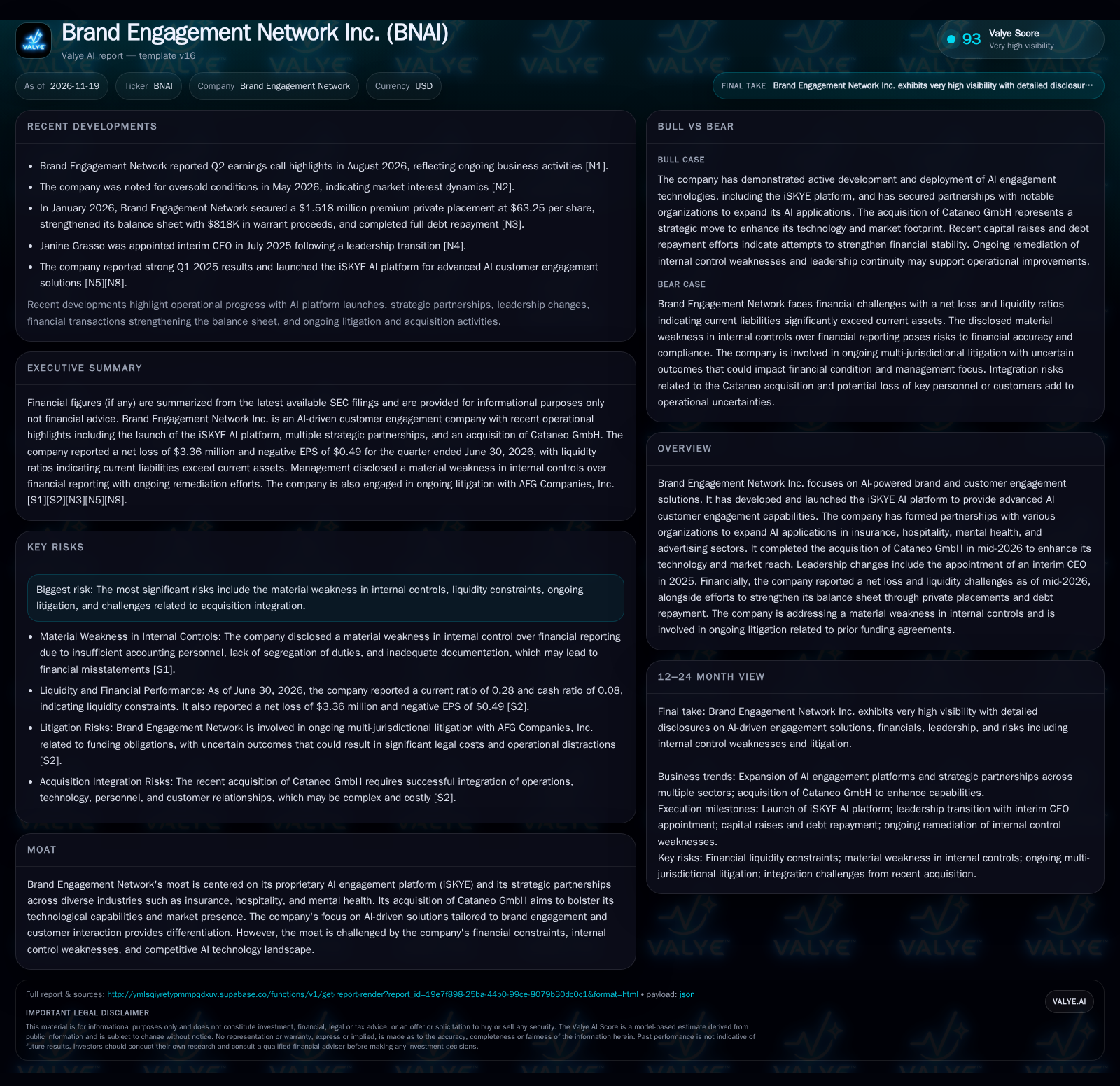
Brand Engagement Network has launched the iSKYE AI platform and acquired Cataneo GmbH to extend its reach in AI-powered customer and brand engagement.While the company is expanding into new verticals and geographies through partnerships, ongoing net losses, a reported current ratio, and unresolved material weaknesses in internal controls create material uncertainty about its ability to realize the commercial potential of its technology and integrations. Litigation and integration risks further complicate the path to sustainable growth. [S2] [N3] [N5] [N8]
Brand Engagement Network Inc. is positioning itself as a next-generation provider of AI-powered customer and brand engagement solutions, leveraging its proprietary iSKYE platform and recent acquisition of Cataneo GmbH to expand across industries and geographies. As management pursues integration and remediation, the commercial realization of its AI ambitions will depend on its capacity to monetize platforms, manage risk, and stabilize its financial position.
Recent Moves Signal Ambition but Underscore Financial and Operational Strains
Brand Engagement Network’s operational strategy has centered on the launch of the iSKYE AI platform for advanced customer engagement, the acquisition of Cataneo GmbH to enhance media and advertising capabilities, and the formation of partnerships spanning insurance, hospitality, and mental health sectors. These moves suggest a multi-pronged approach to market expansion and technology deployment. The company reported cash and liquidity metrics for the period; these figures do not by themselves establish operating runway, investment capacity, financial flexibility, or financing capacity. The company is also contending with a material weakness in internal control over financial reporting, and is engaged in ongoing multi-jurisdictional litigation related to funding obligations, with uncertain financial and operational outcomes. [S2] [S1] [N3] [N5] [N8]
The interplay between aggressive expansion and financial strain highlights a common challenge in technology-driven growth companies: balancing innovation investment with operational discipline. While Brand Engagement Network’s strategic moves demonstrate ambition, the unresolved internal control weaknesses may impair the company’s ability to provide reliable financial information, potentially hindering investor confidence and access to capital. Moreover, ongoing litigation introduces uncertainty that could divert management focus and resources away from core business activities. This combination of factors suggests that the company’s near-term trajectory will depend not only on market acceptance of its AI platform but also on its capacity to strengthen governance, manage legal risks, and preserve liquidity under pressure.
How AI Engagement Could Drive Revenue—But Margin Leverage Remains Unproven
Brand Engagement Network’s business model is predicated on monetizing proprietary AI-driven engagement platforms through enterprise software, SaaS, and partnership-driven deployments in verticals including insurance, hospitality, media, and mental health. The iSKYE platform and Cataneo’s MYDAS media software provide the backbone for potential recurring revenue streams via licensing, usage-based fees, or managed services. However, the company’s current financials suggest that fixed costs (R&D, SG&A, integration expenses) are outpacing revenue generation, leading to persistent operating losses. Without detailed disclosure of contract terms, customer retention, or platform-specific unit economics, it remains unclear if the company can achieve operating leverage as it scales. The acquisition of Cataneo introduces integration costs and may require additional investment before synergies or cross-sell opportunities materialize. Capital needs could remain high if the company must fund ongoing development, sales cycles, or working capital gaps while pursuing growth.
The pathway to profitability in AI engagement platforms often requires achieving significant scale to amortize substantial upfront investments in R&D and integration. If Brand Engagement Network can secure larger enterprise contracts with predictable revenue streams, it may improve its cost structure through economies of scale and operational efficiencies. However, the heterogeneity of client needs across sectors like insurance and hospitality could complicate standardization, potentially increasing customization costs and elongating sales cycles. Additionally, the success of usage-based or managed service pricing models depends heavily on sustained client adoption and platform performance, which, if not met, could pressure margins further. A thorough assessment of customer acquisition costs relative to lifetime value would help clarify the sustainability of the company’s revenue model.
AI Differentiation Faces an Evolving Landscape and Entrenched Rivals
Brand Engagement Network’s competitive proposition rests on the proprietary nature of its AI models (including the Engagement Language Model), integration capabilities, and sector-specific partnerships. In theory, this could create switching frictions for enterprise clients and allow for premium pricing if the platform demonstrably improves engagement outcomes. However, the AI-powered customer engagement space is highly competitive and features well-capitalized technology companies, established enterprise software vendors, and emerging AI specialists—many with broader product suites, deeper data assets, or more robust distribution. The integration of Cataneo’s media software may provide a wedge into media and advertising, but established players in those verticals already offer advanced scheduling, analytics, and monetization tools. The question is whether Brand Engagement Network’s technology can deliver enough incremental value or cost efficiency to displace incumbent solutions or justify enterprise adoption at scale.
In a rapidly evolving AI engagement market, differentiation hinges not only on proprietary technology but also on the ability to integrate seamlessly with existing enterprise IT ecosystems. Brand Engagement Network’s integration capabilities could create competitive advantage if they reduce implementation friction and enable faster time-to-value for clients. However, entrenched competitors benefit from established customer relationships and comprehensive product suites that may bundle engagement tools with broader enterprise solutions, raising the bar for Brand Engagement Network to justify switching costs. Moreover, data privacy and security considerations increasingly influence enterprise purchasing decisions; thus, demonstrating robust compliance and risk management could be essential to winning and retaining clients in regulated industries. The company’s capacity to innovate while maintaining trust will be critical in sustaining differentiation.
Platform Monetization and Integration Success Could Unlock Rapid Scaling
A favorable scenario would see Brand Engagement Network successfully integrating Cataneo’s technology and customer base, leveraging the iSKYE platform to win multi-year contracts across insurance, hospitality, and media, and demonstrating clear ROI to enterprise clients. If partnerships lead to repeatable, scalable deployments and the company can convert pilots into long-term SaaS or licensing agreements, operating leverage could improve as fixed costs are amortized over a growing revenue base. Evidence that would support this scenario includes sustained sequential revenue growth, increasing contract backlog or annual recurring revenue (if disclosed), and improved gross and operating margins. Rapid remediation of internal control weaknesses and resolution of litigation without material cost would further de-risk the story. Confirmation would come from customer case studies, industry awards, or new partnerships with marquee enterprise clients.
Execution Hurdles and Capital Demands Likely to Temper Growth Ambitions
The most plausible near-term outcome is that Brand Engagement Network continues to invest in technology, partnership development, and integration, but faces an extended period of negative cash flow and limited operating leverage. Sales cycles in enterprise AI are often long, and new deployments may be slow to convert into recurring, high-margin revenue. Integration of Cataneo may yield incremental capabilities, but associated costs and management distraction could dilute near-term performance. The company may need to seek additional capital or strategic partnerships to bridge funding gaps, particularly if litigation or integration costs escalate. Confirmation of this scenario would include continued net losses, stagnant or modest revenue growth, and recurring disclosures of liquidity management actions. Evidence to the contrary would be a sudden inflection in revenue, gross margin expansion, or successful closure of large-scale enterprise deals.
Liquidity Stress or Adverse Litigation Could Force Strategic Retrenchment
An adverse scenario would unfold if the company’s liquidity position deteriorates further, forcing it to delay technology investments, curtail sales efforts, or seek dilutive financing on unfavorable terms. Prolonged unresolved internal control weaknesses could trigger regulatory scrutiny or erode customer trust, impairing new business. If the litigation with AFG Companies, Inc. results in a significant adverse judgment or settlement, the financial strain could require asset sales, restructuring, or a strategic review. Integration difficulties with Cataneo, such as loss of key personnel or customer churn, could exacerbate the situation. Evidence supporting this scenario would include further debt raises, capital structure changes, layoff announcements, or missed reporting deadlines.
Milestones That Will Determine If Brand Engagement Network’s AI Thesis Holds
Sequential revenue growth and the mix of recurring versus project-based or one-off revenues—if disclosed—would clarify the trajectory toward sustainable operating leverage.
Progress reports on the integration of Cataneo GmbH, including customer retention, cross-selling, and platform enhancements, would help evaluate synergy realization.
Updates on the remediation of material weaknesses in internal control, such as new personnel hires and process implementations, would be critical to confidence in future financial reporting.
Resolution or material developments in the litigation with AFG Companies, Inc., including settlement terms or court rulings, could materially alter the company’s liquidity and focus.
Any additional capital raising activity, including private placements, warrant exercises, or debt issuance, would signal ongoing funding needs and investor appetite.
Evidence of significant enterprise customer wins, expanded partnerships, or large-scale deployments of the iSKYE or Cataneo platforms would support the adoption thesis.
Disclosure of customer churn rates, contract renewals, or retention metrics (if provided) would help test the durability of customer relationships and recurring revenue streams.
Gross and operating margin trends, particularly as integration and partnership activity ramps, would indicate whether the company can achieve positive unit economics at scale.
Disclaimer: This is research-only, informational analysis and not investment advice. It may include AI-generated interpretation and general industry context. Always verify important details using primary sources.

Comments