
Omnitek Engineering: Conversion Tech at a Crossroads of Regulation, Economics, and Financial Strain
Omnitek’s patented engine conversion technology targets a global push toward alternative fuels, but sharp revenue declines, swelling costs, and mounting liquidity pressure now test the company’s ability to scale and sustain its competitive edge.
Omnitek Engineering’s diesel-to-alternative fuel conversion kits and engines offer a lower-cost compliance path for fleets amid tightening emissions rules. [S1] [S2]
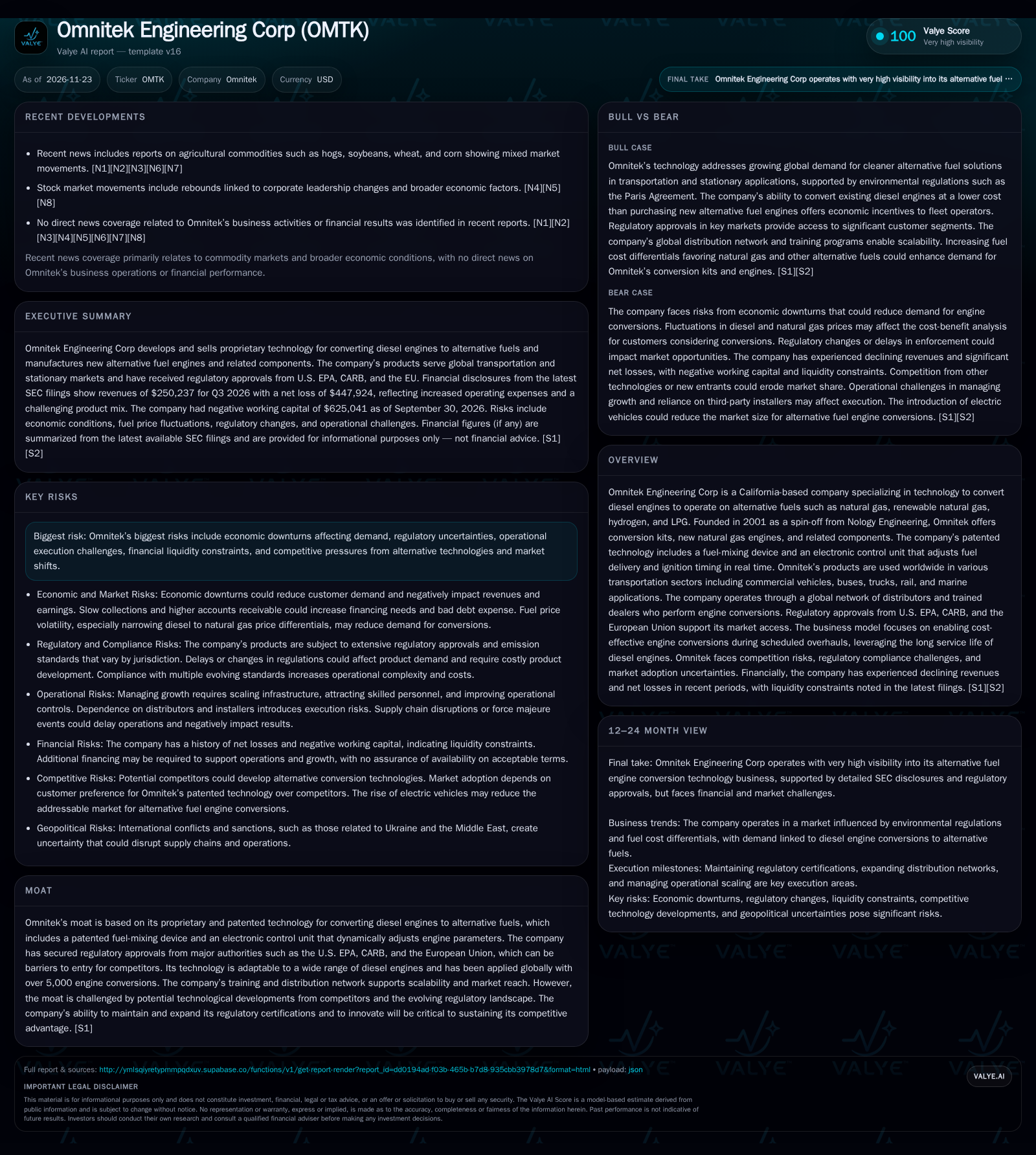
Omnitek Engineering Corp sits at the nexus of regulatory momentum for cleaner transportation and the economic realities of fleet operations. Its core business—converting diesel engines to run on cleaner, lower-cost fuels—addresses a growing market imperative as governments tighten emissions standards worldwide. Yet, as recent filings reveal, Omnitek’s financial profile is deteriorating: revenues have fallen, costs are up sharply, and negative working capital now threatens operational flexibility. The company’s future hinges not just on the strength of its technology and regulatory approvals, but on its ability to restore growth, secure funding, and navigate a shifting landscape where electrification, competition, and macroeconomic volatility are reshaping the playing field. [S1] [S2]
Recent Financial Deterioration and Its Strategic Implications
Omnitek’s Q3 2026 financials mark a sharp reversal from the prior year: revenue fell to $250,237, and the company swung from a net profit to a net loss of $447,924. The deterioration was driven by a less favorable product mix and a significant rise in operating expenses, which more than tripled versus the year-ago period. Most notably, the company now operates with negative working capital of $625,041 and a cash balance of only $8,421, resulting in a current ratio of 0.63. The company reported cash and liquidity metrics for the period; these figures do not by themselves establish operating runway, investment capacity, financial flexibility, or financing capacity. [S2]
Despite these headwinds, Omnitek retains a high gross margin (51% in Q3), suggesting that its core conversion technology and product economics remain fundamentally sound. However, rising overheads and execution costs are eroding this advantage, and the company’s ability to address fixed cost absorption is now critical. [S2]
How Conversion Economics and Cost Structure Shape Omnitek’s Prospects
Omnitek’s core business model is built around enabling fleets to convert existing diesel engines to run on alternative fuels—primarily CNG, LNG, RNG, hydrogen, or LPG. Conversion kits provide a lower upfront cost compared to full engine replacement, appealing to cost-conscious commercial operators facing regulatory mandates or fuel price volatility. The company’s gross margins, historically in the mid-40s to low-50s percent range, reflect the value of its proprietary intellectual property and the relatively modular nature of its kits. However, volume is highly sensitive to regulatory enforcement cycles, fuel price spreads, and customers’ fleet replacement timelines.
Most fixed costs reside in engineering, regulatory compliance, and G&A, while variable costs are tied to kit production and dealer support. Omnitek does not perform installations directly but trains third-party dealers, which reduces capital intensity and enables scalability—but also limits direct control over customer experience and adoption velocity. In principle, operating leverage should improve with rising kit volumes and recurring component sales, but recent results show that cost inflation and underutilization can quickly erode profitability. [S2]
Barriers, Substitutes, and the Shifting Alternative Powertrain Landscape
Omnitek’s competitive position rests on three pillars: proprietary patents covering its fuel-mixing and electronic control systems, regulatory approvals in key markets (U.S. EPA, CARB, EU), and a global network of trained distributors and installers. These assets provide some moat against new entrants, as regulatory compliance and technical validation are costly and time-consuming. However, the market for alternative fuel engine conversions is highly dynamic. Competing technologies—notably factory-built natural gas engines, hybrid powertrains, and increasingly, battery-electric vehicles—are capturing share, especially as total cost of ownership for electrification continues to decline.
The company’s value proposition is strongest in regions or applications where diesel-to-alternative conversions offer the best payback—typically heavy-duty, high-utilization fleets facing regulatory deadlines or high fuel costs. Yet, Omnitek’s moat is vulnerable to rapid regulatory shifts (such as outright bans on combustion engines), supply chain disruptions, or technological leapfrogging by electric or hydrogen OEMs. The company’s dependence on third-party dealers also exposes it to inconsistent quality and customer satisfaction, which can slow market adoption or dilute brand value.
Regulatory Tailwinds and Fuel Price Spreads Drive a Conversion Surge
In a favorable scenario, governments accelerate enforcement of emissions standards, widening the addressable market for diesel-to-alternative conversions. Sharp increases in diesel prices relative to natural gas or hydrogen further improve the payback for Omnitek’s kits, spurring fleet operators to convert rather than replace vehicles. The company leverages its regulatory approvals and dealer network to scale volumes, improving fixed cost absorption and restoring profitability—even as operating expenses grow to support expanded reach.
Confirmation of this scenario would come from a sustained rebound in quarterly revenues, improved operating margin, and successful closure of new dealer or OEM partnerships. Announcements of large fleet conversion projects or expansion into new regions with supportive regulation would also validate the thesis. If Omnitek can secure external financing or strategic investment to shore up liquidity and invest in growth, the flywheel could accelerate.
Navigating Tight Liquidity While Pursuing Niche Market Opportunities
The most plausible trajectory is that Omnitek remains a niche player, capturing intermittent growth spurts as regional regulations tighten or as specific fleets seek cost-effective compliance. Revenue may remain volatile, tied closely to the timing of large projects, product mix, and unpredictable regulatory rollouts. Gross margins hold up, but persistently high operating expenses and negative working capital constrain the pace of reinvestment and product development.
Evidence for this scenario includes quarterly revenue and gross margin stability, ongoing dealer activity, and periodic regulatory wins. However, ongoing losses and liquidity stress would force the company to seek bridge financing, restructure costs, or curtail growth initiatives. The company’s ability to maintain regulatory certifications and support its dealer network will be critical to avoiding further erosion of market relevance.
Liquidity Crisis or Irreversible Share Loss Amid Electrification and Execution Gaps
In a negative scenario, Omnitek’s liquidity position deteriorates further, forcing abrupt cutbacks, missed obligations, or a halt to operations. The accelerating adoption of electric vehicles, combined with regulatory shifts away from all combustion technologies, sharply reduces the addressable market for conversions. Execution missteps—such as dealer attrition, supply chain disruption, or regulatory non-compliance—compound the problem, leading to lost customers and impaired reputation.
Warning signs would include further revenue declines, worsening net losses, missed payroll or payables, or disclosure of going-concern uncertainties. The inability to raise additional capital or secure strategic partnerships would confirm the risk of business discontinuity.
Milestones and External Forces That Will Shape Omnitek’s Thesis
Quarterly revenue growth or decline, and any disclosure of large fleet conversion contracts or geographic expansion, will test whether demand is recovering or eroding. [S2]
Updates on dealer network size, activity, or new strategic partnerships would clarify Omnitek’s ability to scale without direct installation.
Gross margin trends, especially in the face of changing product mix or input costs, will show whether the company is maintaining pricing power and cost discipline. [S2]
Disclosure of new regulatory approvals, certifications, or changes in environmental policy will directly affect the company’s market access and competitive moat. [S1]
Cash flow from operations and any new financing or capital raises will be critical to monitor, given current liquidity constraints. [S2]
Announced advances in electric or hydrogen vehicle adoption rates, especially in key Omnitek markets, would signal potential market shrinkage.
If disclosed, customer retention rates for converted fleets and repeat kit/component sales would provide insight into product stickiness and aftermarket opportunity.
Any evidence of supply chain disruptions, dealer attrition, or quality control issues would indicate execution risk that could amplify financial strain.
Disclaimer: This is research-only, informational analysis and not investment advice. It may include AI-generated interpretation and general industry context. Always verify important details using primary sources.

Comments