
OZ Vision Inc.: Pursuing Survival and Diversification in the Face of Acute Financial Distress
With a legacy in logistics and a speculative foray into combat sports, OZ Vision Inc. faces existential financial risk, customer concentration, and unproven diversification. The company's future hinges on execution, capital access, and the ability to convert dormant assets into viable operating businesses.
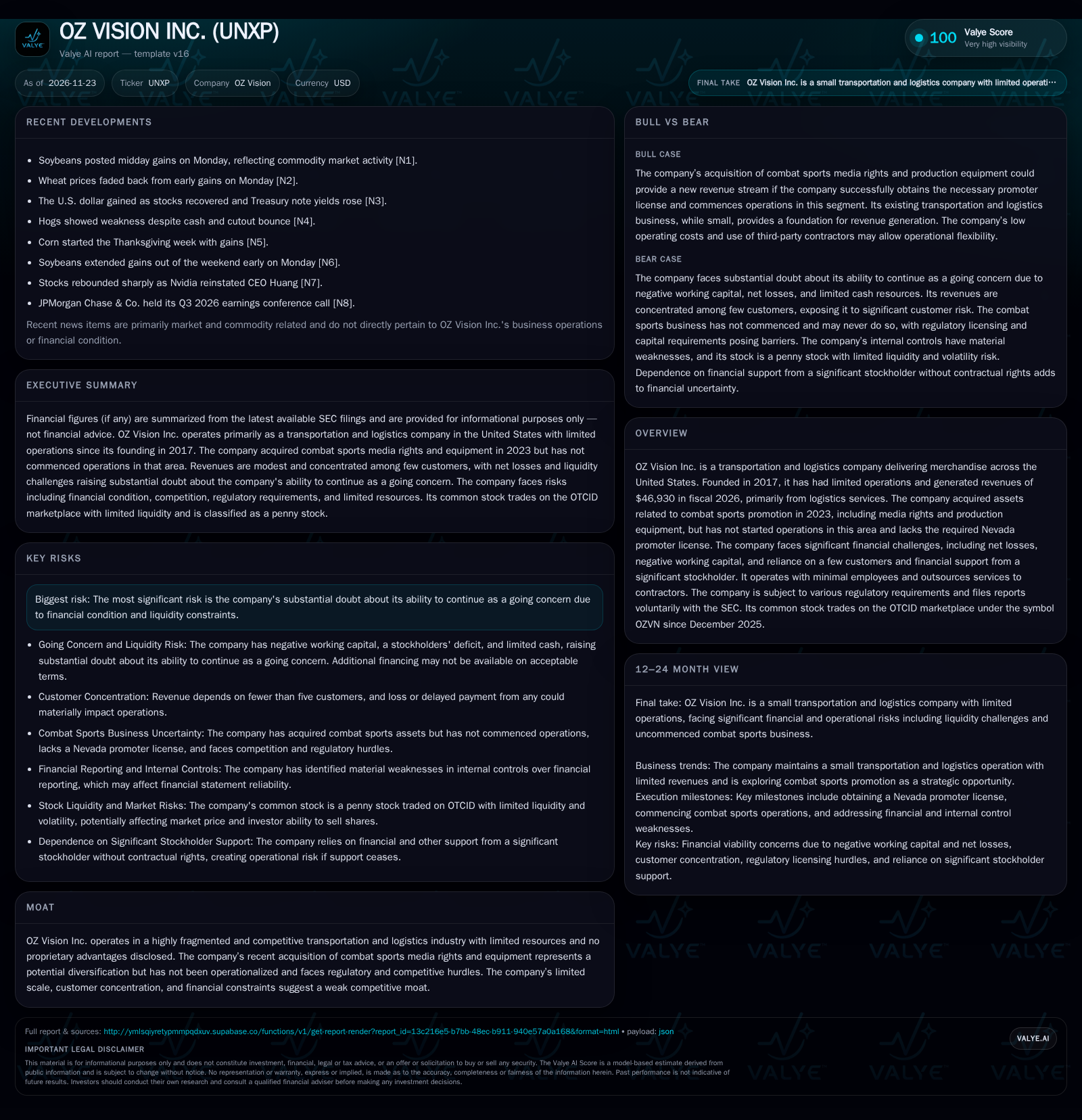
Despite acquiring combat sports media assets in 2023, it has yet to operationalize this segment and lacks required regulatory licensing. The firm’s future depends on stabilizing its core logistics business, launching its combat sports venture, and addressing chronic financial instability. Execution risk is high, and customer concentration exposes the company to abrupt revenue shocks. Ongoing dependence on non-contractual shareholder support and persistent internal control weaknesses compound going-concern risk. [S1]
OZ Vision Inc. stands at a precarious crossroads, straddling a tiny logistics operation and a yet-to-launch combat sports media venture. With declining revenues, persistent net losses, and a severe liquidity shortfall, the company’s survival is far from assured. The 2023 acquisition of combat sports media rights and production equipment remains an unproven diversification, hindered by licensing and operational barriers. Meanwhile, reliance on a handful of logistics customers and non-contractual shareholder support underscores the fragility of its business model. For OZ Vision, the next chapter will depend on its ability to stabilize logistics revenues, launch new ventures, and secure lasting capital.
Acute Liquidity Shortfall and Dormant Diversification Efforts Define Present Reality
As of June 30, 2026, OZ Vision Inc. reported annual revenue of $46,930, down from $54,232 the prior year, with net losses of $58,671 and negative working capital. Cash and cash equivalents stood at just $4,388 against current liabilities of $1,204,517, resulting in a stockholders' deficit of $589,712 and an accumulated deficit of $2.78 million. The firm’s revenue is almost entirely derived from a handful of logistics customers, intensifying customer concentration risk. Operationally, the company has not advanced its 2023 acquisition of combat sports media rights and production equipment, lacking a Nevada promoter license and leaving these assets idle. OZ Vision continues to rely on financial support from a significant stockholder, but there are no contractual guarantees for such support, sharpening going-concern risks. [S1]
Micro-Scale Logistics Margins, Fixed Public Costs, and the Challenge of Asset Monetization
OZ Vision’s logistics business appears to operate on slim gross margins, typical for small players in the fragmented U.S. transportation sector where scale and route density are critical for profitability. The company outsources all operational activities to third-party contractors, minimizing fixed labor costs but likely sacrificing pricing power and margin. With only the CEO as a direct employee, overhead is low, but annual public company costs of $40,000–$70,000 are proportionally large relative to revenues, eroding any path to profitability absent significant scale-up.
The company’s asset base includes production and stage equipment acquired for a prospective combat sports venture, but these assets have not generated revenue and some were lost to theft. The underlying economics of a combat sports business—if launched—would hinge on event promotion, media rights monetization, sponsorship, and potentially streaming or pay-per-view models. However, regulatory licensing, upfront production costs, and event-specific risks would require material upfront capital and operational expertise. Without a functioning licensing pathway and working capital, asset monetization remains speculative. [S1]
The fixed costs associated with maintaining a public company status, while seemingly modest in absolute terms, represent a disproportionately high burden relative to OZ Vision’s current revenue scale. This dynamic creates a structural barrier to profitability that cannot be overcome without either a significant increase in operational scale or a reduction in overhead through strategic partnerships or outsourcing of administrative functions. Moreover, the reliance on third-party contractors, while reducing fixed labor expenses, introduces variability and potential quality control issues that could further compress margins if not managed carefully. The interplay between these cost structures and the company’s revenue volatility necessitates a clear path to scale or alternative revenue sources to achieve sustainable operations.
From a capital allocation perspective, the dormant combat sports assets represent both a sunk cost and a contingent opportunity. Monetizing these assets efficiently depends on overcoming regulatory hurdles and establishing a credible operational framework, which requires upfront investment and expertise that OZ Vision currently lacks. The risk profile of entering combat sports promotion is heightened by event-specific uncertainties such as attendance variability, sponsorship acquisition, and media rights negotiations. Consequently, any capital committed to this venture must be weighed against the opportunity cost of shoring up the core logistics business or addressing liquidity constraints. Strategic prioritization and phased investment could mitigate downside risk while preserving optionality.
Fragmented Logistics Market and Barriers to Entry in Combat Sports Promotion
OZ Vision competes in the U.S. transportation and logistics industry, which is characterized by intense fragmentation, thin margins, and dominant national and regional players with cost advantages from scale, technology, and integrated platforms. As a micro-operator reliant on third-party contractors, OZ Vision lacks proprietary assets, route density, or brand recognition, making it vulnerable to pricing pressure and customer churn. Customer concentration further weakens its negotiating leverage.
In combat sports promotion, barriers to entry are high: regulatory licensing (such as the Nevada promoter license), established relationships with athletes and venues, and access to distribution platforms and sponsors. Incumbents in this space benefit from brand, media partnerships, and scale, while new entrants face significant upfront costs and regulatory scrutiny. OZ Vision’s acquisition of media rights and equipment offers a theoretical pathway to diversification, but without licensing and operational execution, it does not confer any current competitive advantage. [S1]
Unlocking Value Through Successful Combat Sports Launch and Logistics Stabilization
A favorable scenario would see OZ Vision secure a Nevada promoter license, operationalize its combat sports assets, and successfully stage live events. This could open up new revenue streams from ticket sales, media licensing, sponsorships, and digital content, potentially transforming the company’s scale and profile. If the logistics business stabilizes or grows—perhaps through customer diversification or new service offerings—the company could achieve breakeven scale and reduce its dependency on individual clients.
Confirmation of this scenario would require evidence of a granted promoter license, announced and executed combat sports events, new revenue line items from media or sponsorships, and customer wins or expansion in logistics. Falsification would occur if licensing efforts stall, combat sports assets remain idle, or logistics revenues continue to decline. [S1]
Status Quo: Persistent Losses, Customer Risk, and Unproven Diversification
The most plausible near-term trajectory is continued reliance on a handful of logistics customers, with revenues fluctuating in a narrow band and ongoing net losses. Combat sports assets likely remain dormant absent new capital or licensing breakthroughs.
In this scenario, OZ Vision remains dependent on discretionary financial support from a significant stockholder and faces the constant threat of customer attrition or payment delays. Confirmation would be ongoing modest logistics revenue, continued net losses, and no operational updates regarding the combat sports venture. Falsification would be signaled by substantial new capital, customer diversification, or tangible steps toward launching the combat sports segment. [S1]
Acute Distress: Customer Loss, Capital Withdrawal, and Eventual Insolvency
The adverse chain begins with the loss of one or more key logistics customers, triggering a sharp drop in revenue and worsening cash flow. Without contractual support from the significant stockholder, the company could face an immediate liquidity crisis, potentially leading to default on obligations or forced asset sales. Persistent internal control weaknesses and a lack of operational progress in combat sports would further undermine any path to recovery.
This scenario would be confirmed by reported customer losses, further declines in revenue, cessation of stockholder advances, or public disclosures regarding default, legal action, or bankruptcy proceedings. Falsification would require evidence of new customer wins, a binding financing commitment, or operational progress in either business segment. [S1]
Milestones and Metrics That Will Determine the Viability of OZ Vision’s Dual Strategy
Updates regarding the successful application for and issuance of a Nevada promoter license for combat sports events.
Disclosure of executed contracts or announced dates for live combat sports events, indicating operationalization of the new business line.
Revenue breakdowns by segment (logistics vs. combat sports) if disclosed, to assess diversification progress.
Customer concentration metrics—specifically, the number of active logistics customers and any disclosed customer churn or additions.
Reported changes in working capital and cash levels, especially after any new financing or material payments.
Announcements of new financing arrangements, equity issuances, or binding commitments from the significant stockholder.
Remediation of material weaknesses in internal controls over financial reporting, as disclosed in future filings.
Disclosures regarding theft recovery, insurance proceeds, or impairment of stored production equipment.
Disclaimer: This is research-only, informational analysis and not investment advice. It may include AI-generated interpretation and general industry context. Always verify important details using primary sources.

Comments