
Mosaic ImmunoEngineering: Strategic Ambition Meets Acute Funding and Execution Hurdles in Cancer Immunotherapy
Mosaic ImmunoEngineering’s aspiration to build a pipeline of innovative cancer immunotherapies is sharply constrained by near-zero liquidity and unresolved strategic transactions, raising the stakes for capital formation and partnership execution as existential requirements.
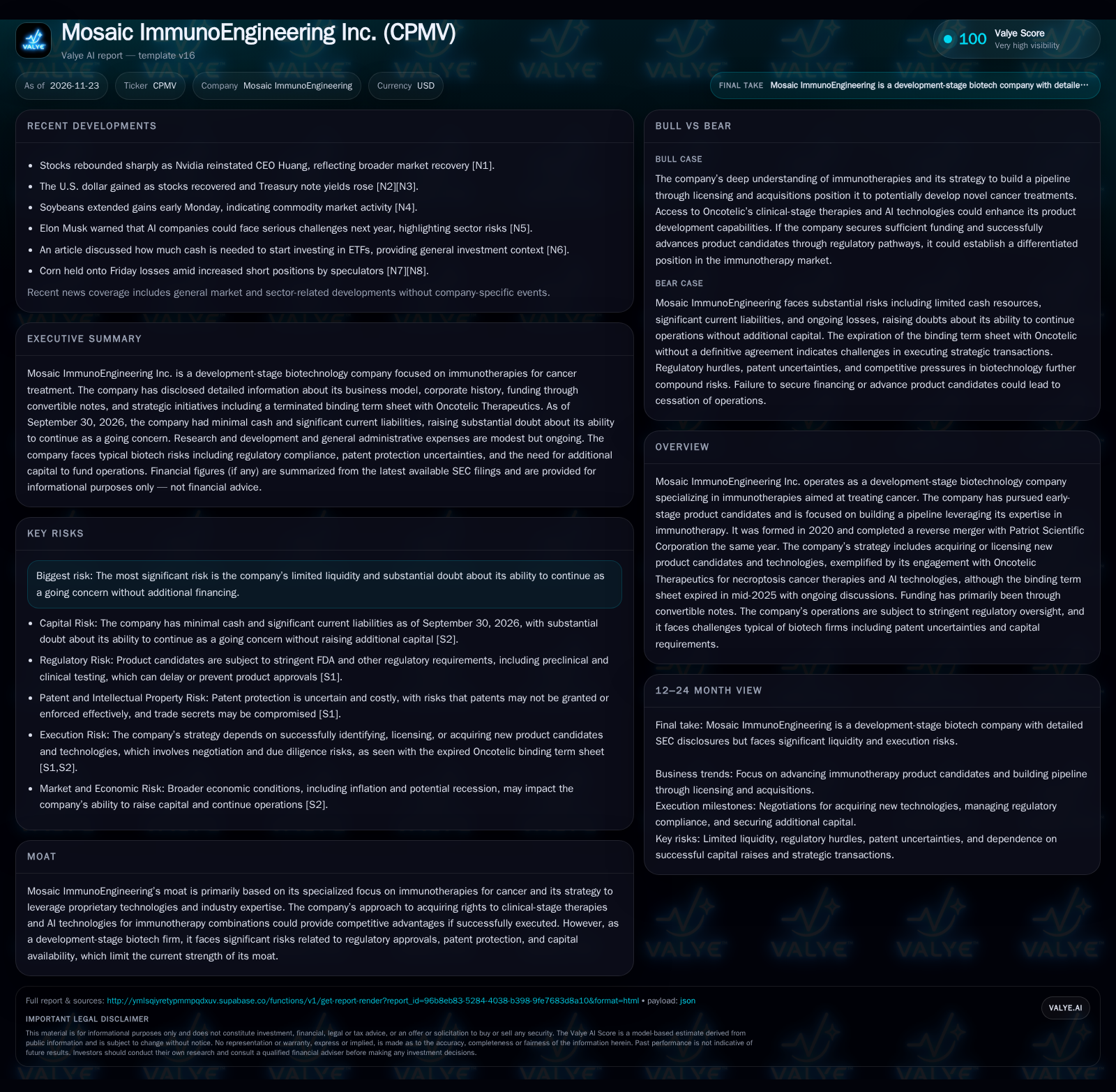
Mosaic ImmunoEngineering is a development-stage biotech company focused on immunotherapies for cancer. It faces immediate going-concern risk, with only $151 in cash versus $6.47 million in current liabilities as of September 2026, and no revenue to date. Its strategy hinges on acquiring or licensing promising assets—such as clinical-stage necroptosis therapies and AI technologies—but a key term sheet expired without a deal. The company’s future depends on securing capital and successfully executing partnerships or acquisitions in a highly competitive and capital-intensive sector. [S2]
Mosaic ImmunoEngineering operates at the intersection of high scientific ambition and acute financial vulnerability. As a development-stage biotechnology company, its mission is to advance novel immunotherapies for cancer—a field where technical promise must be matched by relentless execution and substantial capital. Today, Mosaic’s near-zero cash position and lapsed strategic transactions leave its future contingent on its ability to raise funds and secure transformational partnerships. The company’s current state is a case study in how capital structure, execution risk, and sector dynamics can converge to define the very survival of early-stage biotech ventures.
Liquidity Crisis and Lapsed Deal Frame Mosaic’s Immediate Outlook
As of September 30, 2026, Mosaic ImmunoEngineering reported just $151 in cash and cash equivalents, set against approximately $6.47 million in current liabilities, resulting in a current and cash ratio effectively at zero [S2]. This acute liquidity shortfall leaves the company with substantial doubt as to its ability to continue as a going concern. The company has not generated any revenue, and its most recent financing was a $200,000 convertible note in December 2024 [S1] [S2].
Strategically, Mosaic’s pipeline expansion ambitions hinge on external transactions: notably, a binding term sheet with Oncotelic Therapeutics in April 2024 for rights to clinical-stage necroptosis therapies and AI technologies. However, this term sheet expired on June 30, 2025, without a definitive agreement, and only ongoing discussions remain [S1] [S2].
The company reported cash and liquidity metrics for the period; these figures do not by themselves establish operating runway, investment capacity, financial flexibility, or financing capacity. [S2]
Pipeline Aspirations Versus the Realities of Biotech Economics
Mosaic ImmunoEngineering’s business model is typical of early-stage biotech: value is created by discovering or acquiring promising therapeutic candidates, advancing them through preclinical and clinical milestones, and ultimately monetizing them via out-licensing, partnerships, or direct commercialization. The company’s current focus is immunotherapy for cancer—a segment with high unmet need and potentially large addressable markets, but also one of the most capital-intensive and risky in the sector.
With no approved products or revenue, Mosaic depends entirely on external capital to fund operations and R&D. Its cost structure is currently dominated by G&A rather than R&D, suggesting that pipeline activity is at a preclinical or negotiation-heavy stage rather than active clinical development [S2]. The economics of the business are highly sensitive to the timing and terms of any asset acquisition or strategic partnership, as well as the ability to secure funding before cash runs out.
If Mosaic were to secure rights to a clinical-stage asset, development costs would rise substantially, requiring multi-million-dollar annual outlays for trials, manufacturing, and regulatory submissions. The company’s historical reliance on convertible notes highlights the challenge of equity dilution and debt overhang in the absence of institutional or strategic capital.
Competitive Landscape: Innovation, Access, and Survivability
The immuno-oncology field is intensely competitive, with large pharmaceutical companies, mid-sized biotech firms, and well-capitalized startups all vying to develop next-generation therapies. Mosaic’s potential edge lies in its willingness to pursue novel modalities—such as necroptosis-based approaches and AI-driven combination strategies—through aggressive in-licensing or acquisition.
However, the company’s acute funding shortfall and lack of proprietary late-stage assets severely limit its ability to compete for deals or talent. Larger competitors can offer better deal terms to licensors and have the resources to weather clinical and regulatory setbacks. The absence of recurring revenue, validated technology, or a differentiated platform makes Mosaic’s competitive position highly contingent on the successful execution of transformative transactions.
Switching costs for potential partners or licensors are low; Mosaic must differentiate on speed, flexibility, or creative deal structures. In the absence of a robust IP portfolio, the company’s reliance on confidentiality agreements and pending patents leaves it exposed to both competitive and legal risks.
Transformative Capital and Partnership Could Ignite Pipeline Momentum
A favorable pathway for Mosaic would require the successful closing of a major financing round or strategic partnership, possibly involving the acquisition of clinical-stage assets like those previously discussed with Oncotelic. Such a transaction could provide both the capital and the technological foundation to relaunch product development, catalyze investor interest, and attract talent.
Confirmation of this scenario would come from announcements of a significant equity or debt raise, or a new licensing/acquisition agreement with clear development milestones and funding commitments. Evidence would also include a ramp-up in R&D spending, the hiring of development staff, and clear communication regarding clinical development timelines.
If Mosaic can secure a differentiated asset—especially with AI-enabled combination potential—it could position itself as a partner of choice for larger pharma or as a future acquisition target, provided it can show early clinical progress.
Protracted Negotiations and Minimal Operations Define the Status Quo
The most plausible scenario is that Mosaic continues to operate in a capital-constrained mode, pursuing negotiations with potential licensors, acquirers, or investors but without closing a transformative deal in the near term. Operations would remain limited to essential G&A and the maintenance of existing IP and corporate infrastructure.
Evidence would include continued low R&D and G&A spend, limited or no new hires, and the absence of major transaction announcements. The company may attempt small bridge financings or convertible note deals to extend its runway, but these would likely be highly dilutive.
If no meaningful capital or assets are secured, Mosaic could drift toward a potentially leading shell status, preserving optionality for future reverse mergers or asset sales but without advancing any therapeutic programs.
Failure to Secure Funding or Partnerships Triggers Operational Wind-Down
The adverse scenario is straightforward: Mosaic is unable to raise additional capital or secure a strategic transaction, forcing it to wind down operations or pursue bankruptcy protection. This outcome could be precipitated by further erosion of stakeholder confidence, inability to meet obligations, or a complete absence of partnership interest.
Confirmation would include public disclosures regarding layoffs, asset sales, dissolution plans, or bankruptcy filings. A cessation of SEC filings or a going-concern qualification in audit reports would also be strong indicators.
In this scenario, remaining value—if any—would be realized through the sale of IP, net operating loss carryforwards, or other residual assets, but common shareholders would likely be wiped out.
Milestones That Will Determine Mosaic ImmunoEngineering’s Fate
Announcement of a significant equity, debt, or partnership financing that materially extends the company’s operational runway.
Closure of a new licensing or acquisition deal for a clinical-stage immunotherapy asset, with disclosed development milestones and funding commitments.
Disclosure of meaningful increases in R&D spending or the initiation of clinical studies, which would indicate active pipeline advancement.
Hiring of scientific or clinical development personnel, or the appointment of experienced biotech executives to the management team.
Filing of new patent applications or the granting of key patents in major pharmaceutical markets, as evidence of IP portfolio development.
Any updates regarding the status of negotiations with Oncotelic Therapeutics or similar counterparties.
Regulatory submissions (e.g., IND filings) or acceptance of product candidates into clinical trials, if disclosed.
Auditor commentary or SEC filings that clarify the company’s going-concern status or any announced plans for restructuring, asset sales, or dissolution.
Disclaimer: This is research-only, informational analysis and not investment advice. It may include AI-generated interpretation and general industry context. Always verify important details using primary sources.

Comments