
RMTG’s Vertically Integrated Regenerative Medicine Model Confronts Liquidity Stress and Global Expansion Risks
Regenerative Medical Technology Group Inc. (RMTG) is building a multi-pronged, international regenerative medicine ecosystem, blending physician education, biologics manufacturing, clinical franchises, and digital platforms.
RMTG’s ambitious global regenerative medicine platform combines training, manufacturing, clinical centers, and AI-driven digital tools. Execution on global expansion and digital integration will be decisive for RMTG’s viability and long-term value creation. [S1] [S2]
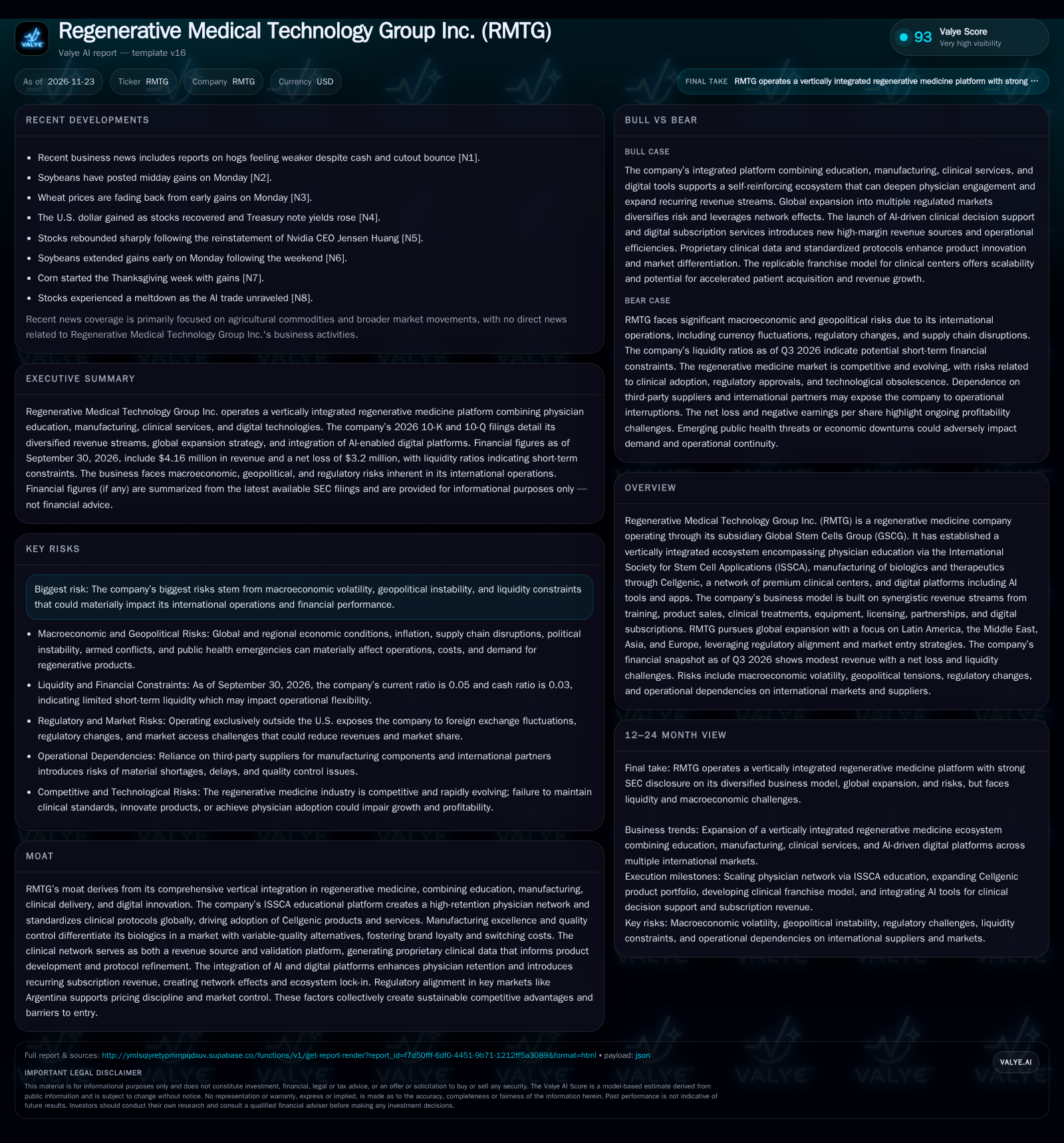
Regenerative Medical Technology Group Inc. (RMTG) is attempting to build a global regenerative medicine powerhouse by uniting physician education, proprietary biologics, premium clinical centers, and AI-powered digital platforms under one roof. The company’s vision is to create an ecosystem that drives recurring revenue and physician loyalty across multiple international markets. The next phase will test whether RMTG’s integrated approach can deliver both clinical and commercial traction before financial constraints force a strategic reset.
Acute Liquidity Stress and Global Operating Footprint Define the Near-Term Backdrop
As of September 30, 2026, RMTG reported $4.16 million in revenue and a net loss of $3.2 million, with cash and equivalents of $1.51 million and current assets of $2.5 million versus $45.7 million in current liabilities. The company reported cash and liquidity metrics for the period; these figures do not by themselves establish operating runway, investment capacity, financial flexibility, or financing capacity. All revenue is derived from customers outside the United States, with Argentina serving as a strategic foothold for Latin America expansion. These facts suggest that while the business is generating top-line traction, it is confronting urgent funding needs and heightened exposure to foreign exchange and geopolitical risks. [S1] [S2]
The company’s international revenue concentration, while providing access to emerging markets with potentially less saturated demand, also introduces complex currency risk dynamics. Fluctuations in foreign exchange rates can materially impact reported revenue and cost structures, especially given the mismatch between local operating expenses and dollar-denominated liabilities or capital requirements. This exposure necessitates active hedging strategies or natural hedges through diversified geographic operations, which may be challenging given the company’s current scale and liquidity constraints. Additionally, geopolitical tensions and trade policies in key markets could disrupt supply chains or restrict cross-border capital flows, further complicating operational stability and financial planning.
How RMTG’s Ecosystem Model Could Unlock Recurring Revenue and Operating Leverage
RMTG’s business model is built on four synergistic pillars: physician education (ISSCA), biologics manufacturing (Cellgenic), premium clinical centers, and digital platforms. Each pillar is designed to reinforce the others—educational programs drive protocol standardization and physician loyalty, which in turn stimulate demand for Cellgenic’s exosomes, stem cells, and combination therapies. The clinical network serves both as a revenue source and a validation platform for new products and protocols, while digital tools aim to generate subscription revenue and operational efficiencies.
The economics could be attractive if the company succeeds in scaling: physician training and digital subscriptions are high-margin, low-capital intensity revenue streams, while manufacturing and clinical services can benefit from operating leverage as volume grows. However, the capital needs for international expansion, clinical buildout, regulatory compliance, and digital platform development are substantial. Gross margins may be pressured by the need to maintain quality and regulatory standards across fragmented geographies and supply chains. The question is whether RMTG can reach sufficient scale and recurring revenue to cover fixed costs before liquidity constraints become acute.
The interplay between high-margin, low-capital physician education and subscription services and capital-intensive manufacturing and clinical operations creates a delicate balancing act. If the company can accelerate digital platform adoption and physician certification enrollments, it may generate a more predictable and scalable revenue base that cushions the volatility inherent in clinical services and biologics sales. However, the timing mismatch between upfront investments in clinical infrastructure and the gradual ramp-up of recurring revenues could strain cash flows. Moreover, regulatory compliance costs and quality assurance in biologics manufacturing are ongoing fixed expenses that may limit margin expansion unless offset by significant volume growth or operational efficiencies.
Vertical Integration and Standardization as Potential Differentiators—But Competitive Risks Persist
RMTG’s vertically integrated approach—spanning education, manufacturing, clinical delivery, and digital engagement—aims to create ecosystem lock-in and switching costs. ISSCA’s position as a global leader in regenerative medicine education could help build a loyal physician base and drive adoption of proprietary therapies. Cellgenic’s focus on quality and innovation in biologics may differentiate it from fragmented, lower-quality competitors, especially in emerging markets.
However, the regenerative medicine landscape is crowded and rapidly evolving, with competitors ranging from traditional pharmaceutical firms to specialty biologics manufacturers, technology-enabled clinical networks, and regional clinics. Regulatory uncertainty, the pace of scientific innovation, and the risk of new entrants or disruptive therapies could erode any temporary advantage. Additionally, RMTG’s exclusive focus outside the U.S. exposes it to local incumbents, regulatory unpredictability, and market access barriers.
While vertical integration can foster ecosystem lock-in, it also increases operational complexity and execution risk. Managing diverse business lines across multiple international jurisdictions requires robust governance, supply chain coordination, and regulatory expertise. If any segment underperforms or faces regulatory hurdles, the integrated model’s synergies may unravel, affecting the entire value chain. Furthermore, competitors focusing on niche segments—such as specialized biologics or digital platforms—may achieve faster innovation cycles or cost advantages. RMTG’s ability to maintain differentiation depends not only on integration but also on continuous innovation, regulatory agility, and strategic partnerships to mitigate regional market entry barriers and competitive pressures.
If Recurring Revenue and Ecosystem Effects Take Hold, Margin Expansion and Global Scale Become Plausible
The most favorable scenario is one in which RMTG’s integrated model achieves critical mass: ISSCA continues to expand its physician training and certification footprint, driving protocol adoption and recurring product demand. Cellgenic’s manufacturing scales efficiently, leveraging proprietary data from the clinical network to refine and differentiate its biologics portfolio. The clinical franchise model is successfully replicated in additional geographies, validating efficacy and attracting more patients and partners.
Digital platforms (AI decision support, physician networking, and clinical workflow tools) gain traction, generating recurring subscription revenue and cementing physician loyalty. As ecosystem effects deepen, RMTG could command pricing power, realize operating leverage, and reduce customer acquisition costs. Evidence that would confirm this scenario includes accelerating training enrollments, rising digital subscription revenue, expanding clinical center count, and improving gross and operating margins.
Most Likely Trajectory: Selective Expansion Amid Ongoing Financial Strain
The most plausible path is that RMTG continues to grow its international physician network and clinical presence, but progress is tempered by capital constraints and the complexity of operating in diverse regulatory environments. Incremental gains in training, product sales, and digital engagement help support top-line growth, but fixed costs and the need for ongoing investment in digital and clinical infrastructure keep the company in a loss-making position for the foreseeable future.
The company may be forced to prioritize a handful of core markets (such as Argentina and select Latin American countries) where regulatory alignment and distribution relationships are strongest. Expansion into new geographies or significant scaling of the digital platform could be delayed until additional funding is secured. Confirmation of this scenario would include steady but moderate revenue growth, continued net losses, and periodic capital raises or partnership announcements.
Liquidity Crunch, Regulatory Shocks, or Product Adoption Stalls Could Force a Strategic Reset
In a less favorable scenario, RMTG’s liquidity crisis becomes acute before recurring revenue streams can scale, forcing asset sales, business line divestitures, or a fire-sale capital raise on highly dilutive terms. Regulatory setbacks or clinical trial failures in key markets could undermine product adoption or trigger costly delays. Supply chain disruptions or quality-control lapses could damage brand reputation, especially in the sensitive biologics sector.
If physician engagement falters or digital platforms fail to generate adoption, the ecosystem could unravel, with declining product sales and clinical utilization. Evidence that would confirm this scenario includes further deterioration in liquidity ratios, missed payroll or supplier payments, adverse regulatory or legal disclosures, or a sharp drop in training and clinical activity.
Milestones That Will Determine If RMTG’s Ecosystem Model Can Survive and Scale
The pace of new physician enrollments and certifications in ISSCA programs—if disclosed—would indicate traction in network expansion and protocol standardization.
Growth in digital platform adoption and subscription revenue, including active users of the ISSCA AI Platform and App, would help validate the technology-enabled recurring revenue thesis.
Expansion of the clinical center network, especially outside Argentina, would demonstrate replicability of the franchise model and international demand.
Trends in gross margin and operating margin, if detailed, would provide evidence of operating leverage and the impact of scale.
Regulatory developments or approvals in new geographies would signal progress on market-access and de-risking international expansion.
Retention rates for trained physicians and repeat product sales would help assess the strength of ecosystem lock-in and customer loyalty.
Any material negative developments—such as missed financial obligations, adverse clinical outcomes, or supply chain disruptions—would challenge the viability of the current model.
Disclaimer: This is research-only, informational analysis and not investment advice. It may include AI-generated interpretation and general industry context. Always verify important details using primary sources.

Comments