
SPINDLETOP OIL & GAS CO: Reserve Growth, Cost Management, and the Stakes of Regulatory Pressure
SPINDLETOP OIL & GAS CO has expanded its proved reserves and tightened costs, but faces a rising tide of asset retirement obligations and remains exposed to commodity price swings. The ability to translate a larger reserves base into sustainable cash flow and manage regulatory liabilities will define its next chapters.
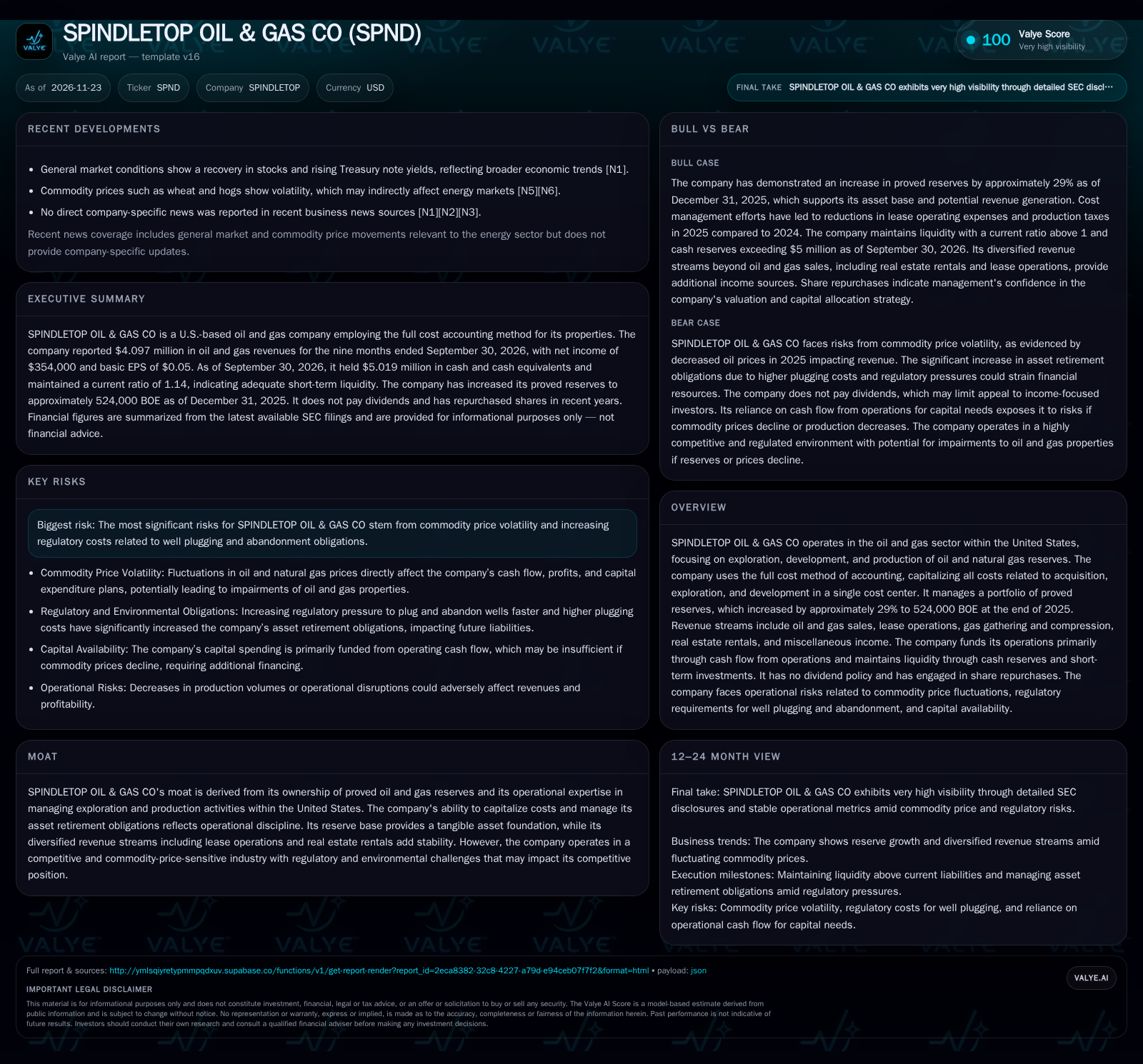
SPINDLETOP OIL & GAS CO increased its proved reserves by 29% to 524,000 BOE at 2025 year-end, with $4.1 million in oil and gas revenue and $354,000 net income for the first nine months of 2026. Liquidity remains above current liabilities, but a significant rise in asset retirement obligations due to regulatory pressures raises questions about long-term capital allocation. The company’s performance will depend on its ability to monetize reserves, manage plugging costs, and navigate ongoing commodity price volatility. [S2]
SPINDLETOP OIL & GAS CO’s latest disclosures paint a picture of incremental operational progress and mounting regulatory headwinds. With a notable 29% expansion in proved reserves, the company has strengthened its asset foundation, and recent cost controls have supported profitability despite oil price declines. Yet, the sharply higher asset retirement obligations—stemming from increased regulatory scrutiny and plugging costs—introduce a new layer of financial complexity. The company’s ability to convert reserves into recurring cash flow while managing capital demands for well abandonment will determine whether recent gains can be sustained or are eroded by industry and regulatory pressures. [S1] [S2]
Reserve Expansion and Regulatory Costs: The Current Landscape
SPINDLETOP OIL & GAS CO reported a substantial increase in proved reserves, growing from 406,000 BOE at the end of 2024 to 524,000 BOE at December 31, 2025—a nearly 29% rise. This expansion bolsters the company’s future production potential and asset value on the balance sheet. For the nine months ended September 30, 2026, oil and gas revenues reached $4.097 million, contributing to total revenues of $4.513 million and net income of $354,000. The company reported cash and liquidity metrics for the period; these figures do not by themselves establish operating runway, investment capacity, financial flexibility, or financing capacity. A notable development is the significant increase in asset retirement obligations in 2025, attributed to higher plugging costs and intensified regulatory pressure—raising questions about future capital requirements and potential strain on cash flow. [S1] [S2]
How SPINDLETOP Turns Reserves into Revenue—and the Cost Pressures Ahead
SPINDLETOP OIL & GAS CO’s core business model is to acquire, explore, develop, and produce oil and natural gas reserves in the U.S., monetizing those assets through commodity sales. The company uses the full cost accounting method, which capitalizes all exploration and development costs into a single pool, smoothing out period-to-period earnings volatility but potentially deferring impairment recognition if commodity prices drop sharply. Revenue is generated primarily from oil and gas sales, supplemented by lease operations, gas gathering, and real estate rentals.
The economics are highly sensitive to commodity price fluctuations: a decrease in oil prices during 2025 reduced oil revenue, but was partially offset by higher natural gas prices. Cost discipline is evident; lease operating expenses and production taxes declined in 2025 versus 2024, supporting margins. However, fixed costs related to asset retirement obligations (AROs) are rising, with regulatory-driven increases in plugging costs representing a durable headwind. Operating leverage is moderate: while higher production volumes can drive incremental margins, the company’s ability to scale is constrained by the finite reserve base and the need to continually replenish assets in a depleting resource business.
Competitive Standing in a Fragmented, Cost-Sensitive Industry
SPINDLETOP operates in the intensely competitive U.S. independent oil and gas sector, populated by both small independents and larger, better-capitalized peers. Its core advantages lie in an expanding reserve base, diversified revenue streams (including non-E&P sources like real estate rentals), and a demonstrated ability to manage costs. However, the company lacks meaningful scale, which limits negotiating power with service providers and can lead to higher per-unit operating costs. Larger competitors may also have more sophisticated hedging programs and access to lower-cost capital, better positioning them to weather commodity downturns or regulatory shocks.
Substitution risk—namely, the long-term transition to renewables and electrification—remains a distant but gradually intensifying threat to oil and gas demand. Regulatory trends are a more immediate competitive pressure, as smaller operators like SPINDLETOP may be disproportionately affected by increases in plugging and environmental compliance costs. The company’s ability to extract value from its reserves and maintain production at acceptable costs will be the key factor in defending its competitive position.
Unlocking Value: Reserve Monetization and Cost Containment Lead to Cash Flow Growth
A favorable scenario emerges if SPINDLETOP can efficiently convert its expanded reserve base into higher production volumes, capturing upside from stable or rising commodity prices. Continued discipline in lease operating expenses and taxes—combined with incremental contributions from gas gathering and real estate rentals—could expand margins and generate stronger operating cash flow. If regulatory plugging costs plateau and AROs stabilize, the company may be able to allocate more capital to growth or opportunistic share repurchases.
Confirmation would come from sustained increases in production and revenue, further reductions in unit costs, and evidence that ARO growth is moderating. An additional signal would be the company’s ability to fund capital expenditures and plugging obligations entirely from internally generated cash flow, with no material need for outside financing. Falsification would occur if production stagnates despite higher reserves, or if AROs continue to outpace cash flow growth, crowding out reinvestment.
Sustained Operations Amid Commodity and Regulatory Volatility
The most plausible trajectory for SPINDLETOP is steady but modest growth, with production levels and revenues tracking the movement of underlying commodity prices. Cost control efforts are likely to offset some, but not all, inflationary and regulatory pressures. The company will fund plugging obligations and modest capital expenditures from operating cash flow, but any sharp decline in oil or natural gas prices would quickly pressure margins.
This scenario is confirmed by stable reserve replacement ratios, a current ratio hovering above 1, and a roughly flat or gradually rising trend in net income and operating cash flow. Weakness in commodity prices or a further step-up in regulatory costs would challenge the base case, signaling the need for external financing or asset sales to meet obligations.
When Obligations Outrun Cash Flow: The Risk of Regulatory and Price Squeeze
A downside scenario materializes if oil and gas prices drop significantly, compressing revenue and eroding the company’s ability to cover both operating costs and escalating asset retirement obligations. In this environment, increased regulatory scrutiny could drive plugging costs even higher, forcing the company to divert cash away from reinvestment or, in the worst case, seek external capital under unfavorable terms.
Confirmation would be a sharp drop in cash balances, a current ratio falling below 1, or negative operating cash flow. A rising trend in AROs that outpaces both revenue growth and cost savings would be another warning sign. If the company is unable to maintain production or replace reserves, the risk of impairments and balance sheet stress would increase.
Testing the Thesis: What Will Determine SPINDLETOP’s Trajectory
Quarterly production volumes for both oil and natural gas—if disclosed—would clarify whether reserve growth is translating into higher output.
The trajectory of asset retirement obligations relative to cash flow and capital expenditures will show if regulatory costs are becoming unmanageable.
Unit costs for lease operating expenses and production taxes: further reductions would reinforce the company’s cost discipline.
Trends in realized commodity prices versus benchmark indices would help determine the company’s exposure to price swings and hedging effectiveness, if any.
Changes in cash and current ratios: a deterioration could signal emerging liquidity stress or an inability to fund both operations and regulatory obligations.
Incremental revenue and margin contributions from non-E&P businesses (real estate rentals, gas gathering) would provide evidence of revenue diversification.
Any new financing activity, asset sales, or capital raises would indicate pressure on internal funding capacity.
Disclosure of reserve replacement ratio and future development plans would help test the sustainability of the company’s growth.
Disclaimer: This is research-only, informational analysis and not investment advice. It may include AI-generated interpretation and general industry context. Always verify important details using primary sources.

Comments