
Bioxytran’s Platform Vision Meets Clinical Promise and Liquidity Pressures
The company’s long-term value hinges on overcoming immediate funding hurdles to execute late-stage trials and prove its novel platform technologies in large indications like viral infections and hypoxia-related diseases.
The company’s long-term value hinges on overcoming immediate funding hurdles to execute late-stage trials and prove its novel platform technologies in large indications like viral infections and hypoxia-related diseases. Success would require both clinical validation and substantial new capital.
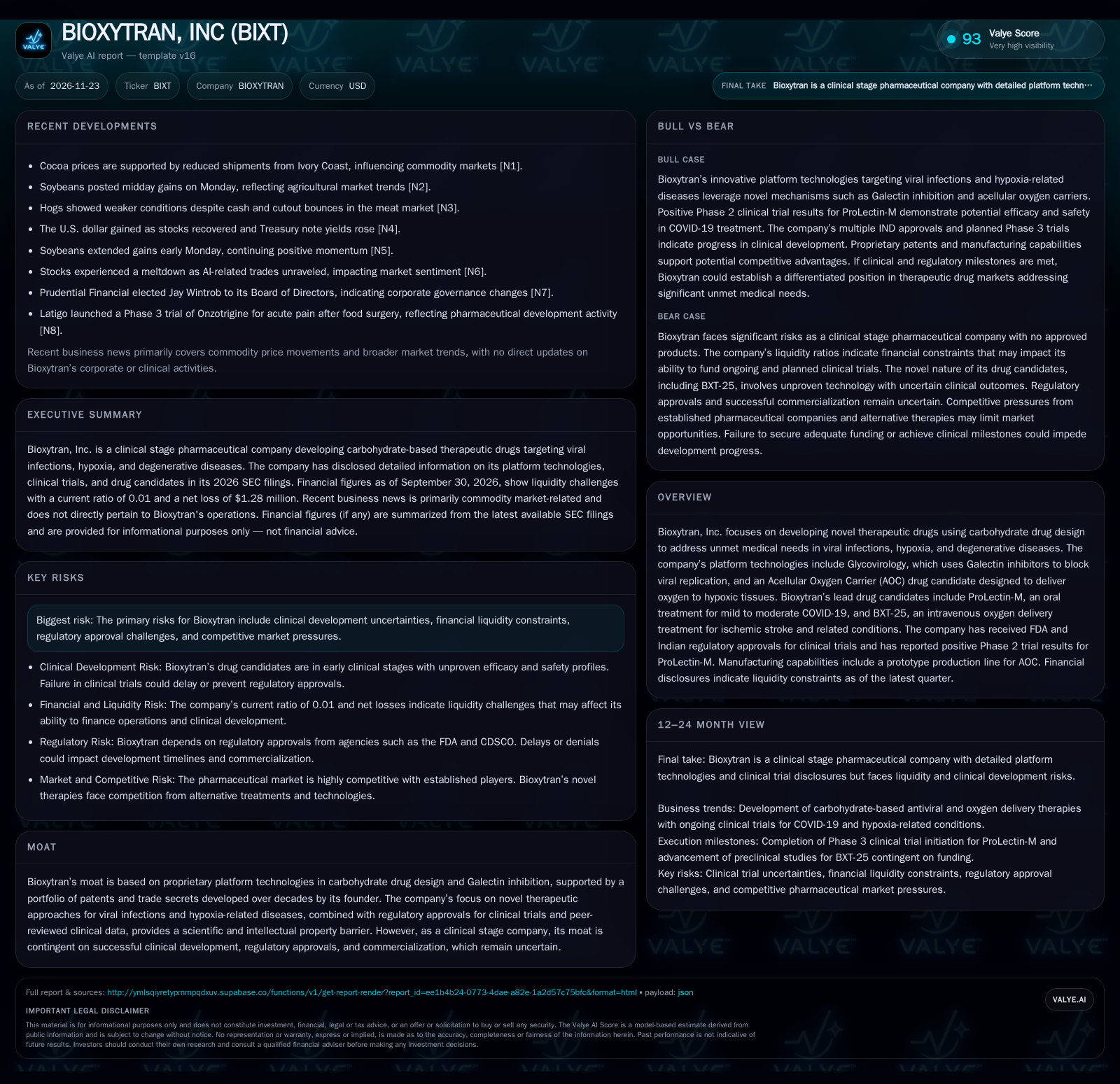
Bioxytran, Inc. is advancing two novel platform technologies: galectin-inhibiting antivirals for COVID-19 and related conditions, and a unique acellular oxygen carrier for hypoxia-driven disease. While its lead drug, ProLectin-M, has demonstrated highly encouraging Phase 2 results and regulatory agencies have approved expanded clinical trials, the company’s balance sheet reveals severe liquidity pressure with minimal cash and a heavy current liability load. With a planned Phase 3 trial for ProLectin-M hinging on new funding, Bioxytran’s ability to translate scientific progress into commercial or partnership value is now fundamentally a race against time.
Clinical Advances and Regulatory Gains Amid Financial Strain
Bioxytran’s most material recent developments are tightly interwoven: its lead oral antiviral, ProLectin-M, achieved a 100% viral clearance response rate by day 7 in Phase 2 COVID-19 patients compared to 6% for placebo, with no serious adverse events reported [S1]. The company holds both FDA and Indian CDSCO IND approvals for clinical trials of ProLectin-M and its acellular oxygen carrier, BXT-25 [S1]. [S2] The company’s planned Phase 3 trial for ProLectin-M, a pivotal milestone for potential approval and commercial validation, is explicitly contingent on raising new capital [S1]. These facts set up a binary near-term outlook: without a timely infusion of funds, clinical momentum could stall despite promising early-stage data.
Therapeutic Platform Approaches: Balancing Promise with Cash Demands and Outcome Uncertainty
Bioxytran’s economics are governed by the typical dynamics of early-stage drug development: high upfront R&D investment, negligible current revenue, and the prospect of exponential value if pivotal trials succeed. For ProLectin-M and the broader galectin inhibitor platform, commercial viability depends on demonstrating not just efficacy and safety in larger trials, but also differentiation against established antivirals and future pandemic therapies. If successful, oral COVID-19 antivirals could command premium pricing in both acute and prophylactic settings, but market access, payer negotiations, and competitive intensity would dictate realized margins.
The acellular oxygen carrier (BXT-25) program, targeting stroke and trauma, represents a potentially larger but riskier market, with even steeper development costs, complex regulatory pathways, and the need for sophisticated manufacturing infrastructure. Both platforms, if proven, could generate substantial licensing or acquisition interest from larger pharmaceutical players seeking novel mechanisms in infectious disease and hypoxia. Until then, the company’s operational leverage is negative: each additional trial or manufacturing investment deepens losses unless offset by milestone funding, grants, or partnerships. Acute liquidity needs make non-dilutive funding or strategic partnerships especially valuable, but also difficult to secure without late-stage validation.
Proprietary Science Navigates a Competitive Therapeutic Landscape
Bioxytran’s competitive position is defined by the novelty of its carbohydrate drug design and galectin inhibition approach, supported by a portfolio of patents and trade secrets. This could provide a scientific and intellectual property moat if clinical significance and regulatory approval are achieved. However, the antiviral and oxygen therapeutics markets are highly competitive, with established pharmaceutical companies, generics, and alternative modalities (such as monoclonal antibodies, small molecule antivirals, and biologics) all vying for share.
For COVID-19 and future respiratory viruses, incumbents with established distribution, regulatory relationships, and robust clinical datasets represent formidable barriers. The acellular oxygen carrier space has seen decades of failed or stalled development, largely due to safety, efficacy, and manufacturing challenges—suggesting that even with promising animal data, clinical translation is far from assured. Bioxytran’s differentiation thus hinges on demonstrating unique clinical benefits, safety, and scalability, with the added challenge of building commercial infrastructure or securing a partner in an environment where larger peers can outspend and outmaneuver smaller innovators.
Unlocking Platform Value Through Clinical Breakthroughs and Capital Infusion
The most favorable scenario for Bioxytran involves two reinforcing outcomes: (1) successful fundraising or a strategic partnership provides sufficient capital to launch and complete a pivotal Phase 3 trial for ProLectin-M, and (2) the trial replicates the strong efficacy and safety results seen in Phase 2, leading to regulatory approval. This would position Bioxytran as a first-in-class oral galectin-inhibiting antiviral, potentially attracting significant licensing, acquisition, or commercialization deals.
Confirmation of this scenario would require disclosures of a substantial financing round, non-dilutive grant awards, or partnership with a larger pharmaceutical company. Early initiation of the Phase 3 trial, followed by interim data echoing earlier response rates and safety, would further validate the company’s technology. Additional progress in the BXT-25 program, such as successful human safety data or external investment in the platform, would amplify upside optionality.
Clinical and Funding Setbacks Impact Platform Development Pace
The most plausible path is that Bioxytran struggles to secure timely, non-dilutive financing, resulting in delayed initiation of its Phase 3 trial for ProLectin-M. The company may be forced to seek highly dilutive equity, bridge loans, or asset sales, which could limit its long-term share of future economics even if the platform eventually succeeds. Meanwhile, ongoing preclinical work on BXT-25 may continue at a minimal pace due to resource constraints.
Evidence supporting this middle path would include public announcements of small-scale financings, delayed trial start dates, or cost-control measures. At the same time, a lack of clinical setbacks or regulatory obstacles would allow the company to preserve some option value, but the risk of losing scientific or market momentum increases with each quarter of delay. If Bioxytran can eventually secure funding and launch its pivotal trial, the window for value realization remains open, albeit with greater dilution and commercial risk.
Liquidity Shortfalls Threaten Clinical Programs and Platform Viability
In the adverse scenario, Bioxytran fails to secure new funding in time to meet obligations, forcing it to halt ongoing and planned clinical programs. This could result in staff reductions, loss of key scientific personnel, impairment of intellectual property, and a collapse in negotiating leverage with potential partners or acquirers. Without continued trial progress, regulatory approvals would lapse, and the company may face delisting or bankruptcy.
Signs confirming this scenario would include a failure to announce new funding or trial starts, regulatory filings indicating going concern risks, layoffs, or asset sales at distressed valuations. A rapid deterioration in scientific staff or board composition, or loss of IND status for key programs, would further signal that the platform’s long-term value is being irreparably eroded.
Bioxytran’s Upcoming Milestones Shaping Future Prospects
Disclosure of new financing rounds, non-dilutive grants, or strategic partnerships sufficient to fund the planned Phase 3 trial for ProLectin-M.
Public confirmation of Phase 3 trial initiation for ProLectin-M, including clinical site activation and patient enrollment updates.
Interim or final data releases from the Phase 3 trial that replicate or approach the efficacy and safety profile seen in Phase 2.
Progress reports or IND filings for the BXT-25 acellular oxygen carrier program, especially any transition to human clinical trials.
Disclosures (if any) of licensing, acquisition interest, or commercial collaborations with larger pharmaceutical companies.
Turnover among key scientific, clinical, or executive personnel, which could signal internal stress or loss of operational continuity.
Disclaimer: This is research-only, informational analysis and not investment advice. It may include AI-generated interpretation and general industry context. Always verify important details using primary sources.

Comments