
EON Resources: Permian Basin Growth, Liquidity Strain, and the Stakes of Capital Efficiency
EON Resources Inc. is showing operational momentum in the Permian Basin, with a recent surge in revenue and sharply reduced net losses.
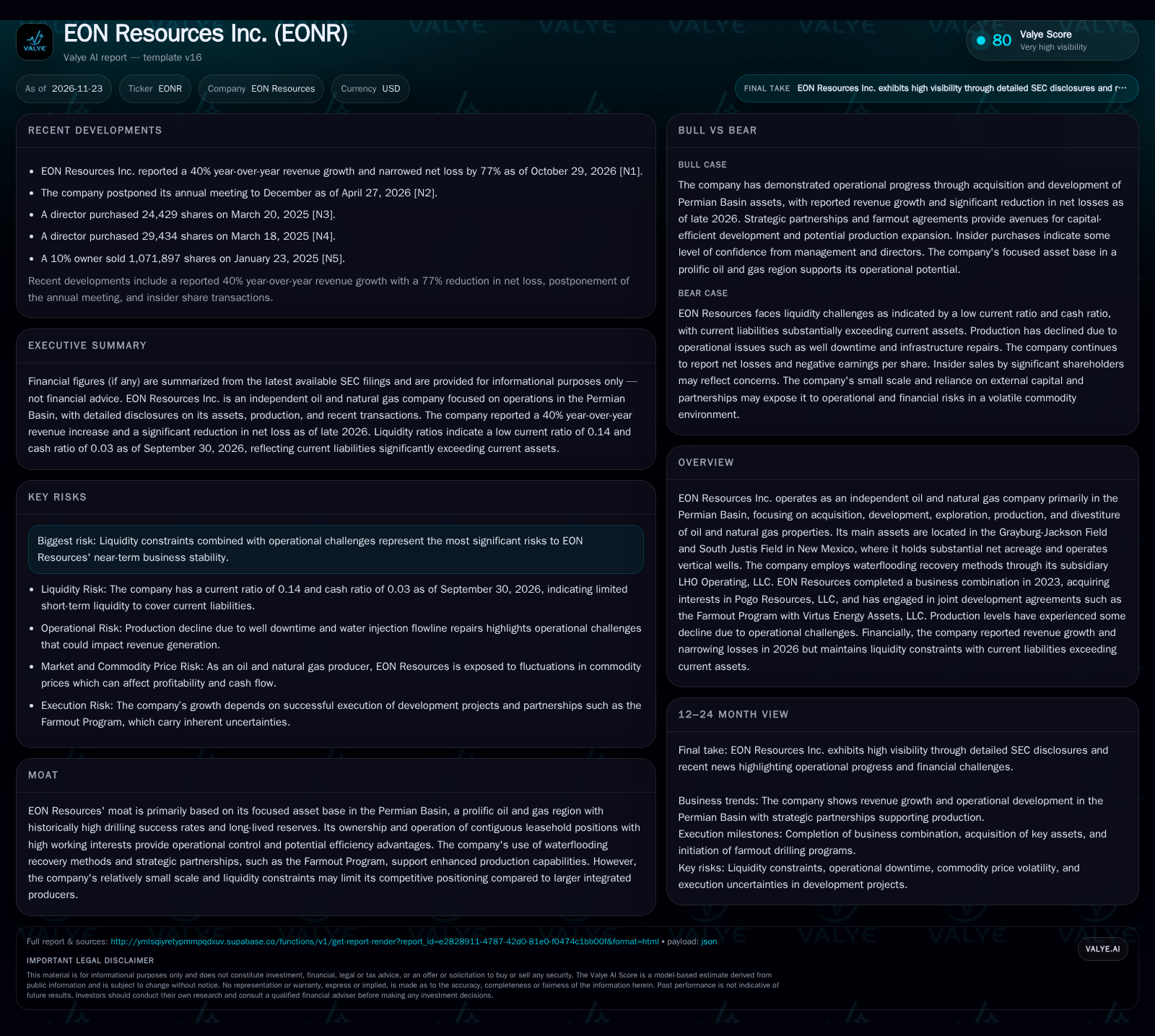
EON Resources reported 40% year-over-year revenue growth and a 77% reduction in net loss as of late 2026, reflecting operational progress in the Permian Basin. Production dipped in 2025 due to infrastructure repairs, and the company’s ability to fund further development or withstand commodity price swings remains uncertain. Partnerships and farmout agreements offer a path to capital-efficient growth, but execution risk and capital access are central to the outlook. [S1] [S2] [N1]
The company’s 2026 financials show headline growth and sharply reduced losses, yet with a current ratio of just 0.14, EON faces a narrow window to translate operational gains into sustainable cash flow or secure new capital. Its trajectory will be defined not only by well performance and commodity prices, but by the discipline and creativity with which it addresses its funding gap and development obligations.
Recent Financial Performance and Liquidity Pressures Define the Near-Term Outlook
EON Resources reported a 40% year-over-year revenue increase and narrowed its net loss by 77% as of October 2026, indicating operational progress and improved cost management. However, the company’s balance sheet as of September 30, 2026, shows cash and equivalents of $1.14 million against current liabilities of $36.06 million, resulting in a current ratio of 0.14 and a cash ratio of 0.03. Production averaged 734 BOE/day for 2025, down from the prior year due to well downtime and flowline repairs, highlighting operational volatility. The company’s asset base covers 13,700 net acres in the Grayburg-Jackson Field and 5,400 net acres in South Justis Field, both operated with near-total working interest. [S1] [S2] [N1]
How EON Resources’ Asset Model and Cost Structure Shape Its Economic Leverage
EON Resources’ business model is anchored in the acquisition, development, and exploitation of mature oil and gas fields using waterflooding recovery methods. The company’s high working interest and operational control across its Permian Basin acreage provide it with flexibility in development pacing and cost management, but also concentrate exposure to operational and commodity risks. Waterflooding offers the potential for stable, multi-year production profiles, but typically requires up-front capital for infrastructure and ongoing investment to maintain reservoir pressure and optimize recovery rates. Given EON’s small scale and limited staff (20 employees), fixed costs may be relatively high per barrel, and the company is vulnerable to production interruptions or cost overruns.
The revenue model is volume-driven, with realized pricing tied directly to oil and gas benchmarks, exposing EON to commodity price volatility. While the company reported a 40% increase in revenue in 2026, the drop in production due to downtime illustrates the operational leverage—and risk—embedded in the model. Capital needs are persistent: even with farmout arrangements that can reduce up-front outlays, the company must fund its share of drilling, workover, and infrastructure costs. Until production volumes and realized prices consistently cover operating and development expenses, EON’s path to positive free cash flow and self-funded growth remains precarious.
Permian Basin Focus: Advantages and Structural Disadvantages in a Crowded Field
EON Resources’ main competitive advantage is its concentrated, high-working-interest acreage in the Permian Basin—a region with established infrastructure, proven geology, and a deep service ecosystem. This focus allows for operational efficiencies, potential economies of scale (if production ramps), and the ability to implement technical enhancements like waterflooding. However, EON’s small scale and thin capitalization are major disadvantages relative to larger independent and integrated producers, which can spread risk across larger portfolios, access capital markets more efficiently, and weather commodity cycles with less distress.
Competition in the Permian is intense, with many peers pursuing similar asset exploitation and cost optimization strategies. Larger players can often outbid smaller firms for acreage, talent, and services, and are better positioned to absorb setbacks or invest in advanced recovery techniques. EON’s reliance on partnerships and farmout programs reflects both a pragmatic use of external capital and a necessity born of limited internal resources. The challenge is to leverage operational control and technical skill into sustainable margins and production growth before liquidity constraints force asset sales or operational retrenchment.
Unlocking Asset Value Through Operational Execution and Capital-Light Growth
If commodity prices remain supportive, even moderate volume growth could drive meaningful margin expansion given the company’s already demonstrated ability to reduce losses. The farmout program with Virtus Energy Assets, LLC, if executed efficiently, could enable EON to book reserves and grow production without proportionally increasing capital outlays.
Confirmation of this scenario would come from several quarters of stable or rising production volumes, continued revenue growth outpacing cost inflation, and a visible improvement in liquidity ratios. Additional evidence would include disclosure of new successful wells, positive reserve revisions, or the ability to extend payables and negotiate favorable terms with service providers. A reversal of the recent production decline, or third-party validation of asset value through joint ventures or asset sales at attractive multiples, would further support the upside thesis. [S1] [N1]
Maintaining Operations While Managing Through Volatility and Funding Gaps
The most plausible near-term outlook is that EON Resources continues to operate under liquidity strain, balancing incremental production gains from waterflooding and farmout drilling against the risk of further operational disruptions and working capital shortfalls. The company may be able to maintain or modestly grow production if infrastructure reliability improves and partnerships perform as planned, but will likely remain dependent on external capital—whether through asset sales, farmout proceeds, or new debt/equity issuance—to bridge funding gaps. Revenue growth could be offset by persistent cost pressures and the need to service current liabilities.
Evidence supporting this scenario would include flat or slightly positive production trends, continued reporting of net losses (albeit at a reduced rate), and periodic balance-sheet stress reflected in payables management or delayed capital projects. The company may pursue further partnership arrangements, asset monetizations, or restructuring of existing obligations to buy time for operational improvements to take effect. Any significant commodity price downturn or major operational setback, however, could tip the balance toward forced asset sales or more severe financial distress.
Liquidity Crunch Forcing Distressed Asset Sales or Operational Retrenchment
In a downside scenario, EON Resources is unable to resolve its acute liquidity mismatch, with cash and equivalents insufficient to meet near-term liabilities and no timely access to new capital. Production could remain flat or decline further due to additional downtime, infrastructure failures, or inability to fund necessary workovers and drilling. In this environment, the company may be forced to sell core assets at distressed prices, relinquish working interests under unfavorable terms, or sharply curtail operations to preserve cash.
This scenario would be confirmed by further deterioration in liquidity metrics, covenant breaches (if debt is outstanding), or public disclosure of asset sales well below book value. Warning signs could include management turnover, missed payments to vendors, or the announcement of restructuring advisors. A sharp drop in commodity prices would accelerate distress, as would any operational incident that further undermines cash generation.
Operational and Financial Milestones That Will Determine EON’s Next Chapter
Quarterly production volumes, especially signs of recovery or further decline, will be critical for gauging operational momentum.
Liquidity developments—such as new financing, asset sales, or renegotiation of payables—should be tracked for their impact on the company’s ability to bridge its funding gap.
Execution and results of the Virtus Energy Assets, LLC farmout program: drilling outcomes, reserve additions, and changes in working interest exposure would help test the thesis.
Quarterly revenue growth relative to cost trends will indicate whether operational leverage is moving in EON’s favor.
Disclosure of new joint ventures, partnerships, or asset divestitures could signal shifts in strategy or access to external capital.
Updates on infrastructure reliability and downtime (if disclosed), as further disruptions could impair both revenue and cash flow.
Management’s ability to reduce or defer current liabilities without sacrificing operational capability will be a telling sign of near-term viability.
Commodity price trends—especially for Permian Basin oil and gas—remain a critical external variable for EON’s cash flow outlook.
Disclaimer: This is research-only, informational analysis and not investment advice. It may include AI-generated interpretation and general industry context. Always verify important details using primary sources.

Comments