
BioNexus Gene Lab Corp: Strategic Platform Bets Amid Financial Strain and Commercialization Hurdles
With exclusive ASEAN rights to an AI-enabled oncology screening platform and a legacy chemicals distribution business, BioNexus faces a pivotal juncture. Recurring losses, substantial going concern warnings, and uncertain regulatory progress for its VitaGuard™ system highlight the tension between ambitious growth plans and pressing financial realities.
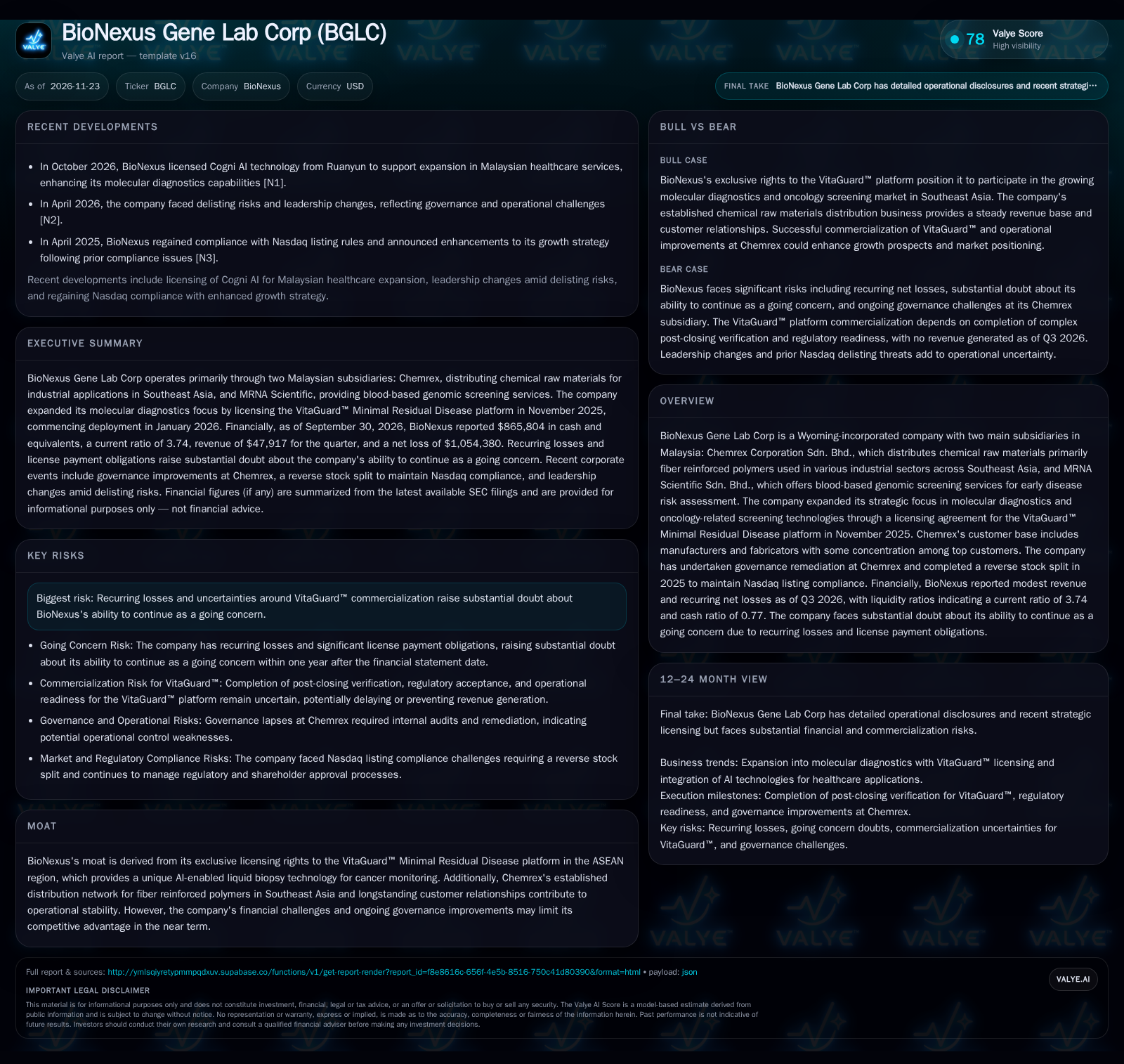
BioNexus Gene Lab Corp controls two Malaysian subsidiaries: Chemrex, a chemical distributor, and MRNA Scientific, which offers genomic diagnostics. The company holds exclusive ASEAN rights to the AI-powered VitaGuard™ cancer monitoring platform, but as of Q3 2026, it has not generated revenue from VitaGuard™ and continues to post recurring losses. Liquidity metrics are positive, yet the company faces substantial doubt about its ability to continue as a going concern due to ongoing losses and license payment obligations. Commercial success now depends on achieving regulatory and operational readiness for VitaGuard™ and shoring up governance at Chemrex. [S2] [N1] [N2]
BioNexus Gene Lab Corp stands at a strategic crossroads. Its legacy chemicals distribution business provides a measure of revenue stability, but the company’s future increasingly hinges on the successful commercialization of its AI-driven molecular diagnostics platforms—most notably VitaGuard™, an exclusive liquid biopsy system for minimal residual disease monitoring. As of Q3 2026, however, VitaGuard™ had not yet contributed revenue, and BioNexus continues to post recurring losses with substantial doubt about its going concern status. The challenge now is translating technology bets and new partnerships into tangible commercial outcomes, while navigating regulatory, operational, and financial headwinds.
Recent Developments Highlight Strategic Shifts and Financial Strain
BioNexus Gene Lab Corp reported $47,917 in revenue and a net loss of $1,054,380 for the quarter ended September 30, 2026, continuing a pattern of recurring losses. As of that date, the company’s cash and equivalents stood at $865,804, with a current ratio of 3.74 and a cash ratio of 0.77—metrics that indicate reported liquidity position but do not offset the broader concern about ongoing negative earnings. [S2]
The company’s most significant new initiative is the exclusive licensing of the VitaGuard™ Minimal Residual Disease platform for ASEAN markets, secured in late 2025. Despite commencing deployment in January 2026, VitaGuard™ had not generated any revenue by the end of Q3 2026, as commercialization remains contingent on post-closing verification and regulatory milestones. [S2]
BioNexus also licensed Cogni AI from Ruanyun in October 2026 to enhance its diagnostics offerings for Malaysian healthcare, signaling continued investment in AI-enabled health technologies. However, operational and financial risks remain acute, with the company acknowledging substantial doubt about its ability to continue as a going concern due to recurring net losses and license payment obligations. [S2] [N1]
Underlying Economics: Dual Business Engines with Divergent Risk Profiles
BioNexus’s revenue streams are split between Chemrex, which distributes chemical raw materials (notably fiber reinforced polymers) to industrial customers, and MRNA Scientific, focused on genomics-based disease risk assessment. Chemrex’s business is characterized by relatively stable, transactional sales to manufacturers and fabricators across Southeast Asia, but with notable customer concentration—its top five customers represented over 27% of Chemrex’s revenue in fiscal 2025. This concentration exposes the company to potential revenue volatility if large customers shift suppliers or reduce purchasing. [S2]
MRNA Scientific’s genomic screening, and especially the anticipated VitaGuard™ platform, represent a higher-margin, higher-risk opportunity. If successfully commercialized, liquid biopsy services can command premium pricing due to their value in early cancer detection and recurrence monitoring. However, this segment is capital-intensive—requiring ongoing R&D, regulatory approvals, and significant upfront investment in operational readiness. The company’s recurring net losses and license payment obligations suggest that the diagnostics business is not yet self-sustaining, and will likely require additional capital or improved margins to be viable at scale.
Operating leverage in the diagnostics segment could be substantial if fixed costs are covered and the VitaGuard™ platform achieves regulatory and commercial traction. However, absent revenue from VitaGuard™, current fixed costs exacerbate losses. The company reported cash and liquidity metrics for the period; these figures do not by themselves establish operating runway, investment capacity, financial flexibility, or financing capacity.
Market Positioning: Differentiation Versus Execution and Regulatory Risk
BioNexus’s competitive thesis in diagnostics hinges on its exclusive ASEAN rights to VitaGuard™, an AI-powered liquid biopsy system for monitoring minimal residual disease in cancer. This exclusivity could be a durable differentiator if the platform is validated and receives regulatory approval, allowing BioNexus to offer a unique precision oncology solution in a region where such technologies are still emerging. However, the lack of commercial revenue to date underscores the challenge of translating platform rights into market share.
The chemicals distribution arm, Chemrex, operates in a relatively commoditized market, competing with other regional distributors. Its established customer base and supplier relationships provide some stability, but customer concentration and past governance issues limit its defensibility. In diagnostics, BioNexus will face competition from regional hospital labs, global diagnostics players, and emerging digital health startups—all of which may have deeper resources or established regulatory pathways.
Switching costs for chemical customers are likely low, given the widespread availability of raw materials, while switching frictions in diagnostics may be higher if VitaGuard™ demonstrates superior accuracy, provider integration, or regulatory endorsements. The question is whether BioNexus can achieve these advantages before better-capitalized or incumbent players move into the ASEAN molecular diagnostics space.
Unlocking VitaGuard™: Pathways to Margin Expansion and Market Leadership
The most favorable outcome for BioNexus would see the company successfully complete post-closing verification, achieve regulatory approval, and operationalize VitaGuard™ across major ASEAN healthcare markets. In this scenario, the platform’s AI-driven capabilities for minimal residual disease monitoring could differentiate it from conventional diagnostics, enabling premium pricing and rapid adoption among oncologists and hospitals seeking precision oncology solutions.
Confirmation of this scenario would require evidence of regulatory clearance for VitaGuard™, initial commercial contracts or pilot deployments with major healthcare providers, and a material increase in diagnostics segment revenue. Early customer testimonials, clinical validation data, and rising gross margins from diagnostics services would further support the bull thesis. If successful, operating leverage from fixed infrastructure could drive margin expansion, supporting reinvestment in R&D or further regional expansion.
Additional upside could come from successful integration of Cogni AI, enabling cross-selling of digital health analytics or patient management tools alongside molecular diagnostics.
Status Quo: Incremental Progress, Persistent Losses, and Funding Pressure
The most plausible near-term outcome is that BioNexus makes incremental progress on VitaGuard™ commercialization but continues to post recurring losses due to high fixed costs and slow regulatory processes. Chemrex provides a baseline of revenue but remains exposed to customer churn and limited margin expansion.
In this scenario, the company’s liquidity is periodically supplemented by equity offerings (such as the ATM program filed in late 2025), but dilution risk remains high. Commercial traction for VitaGuard™ may be delayed by regulatory hurdles or operational bottlenecks, while Chemrex’s growth is constrained by market competition and customer concentration.
Evidence confirming this base scenario would include continued modest revenue growth, persistent negative net income, and a reliance on external financing to bridge the gap until diagnostics commercialization. Any signs of delayed regulatory approvals or muted uptake of VitaGuard™ would further entrench this outcome.
Failure to Commercialize: Financial Distress and Erosion of Strategic Options
Adverse outcomes would materialize if BioNexus fails to achieve regulatory or operational milestones for VitaGuard™, resulting in no meaningful diagnostics revenue. Continued operating losses, combined with license payment obligations, could force the company to seek dilutive capital raises, asset sales, or even consider wind-down scenarios if going concern risks intensify.
Further governance lapses at Chemrex, customer defections, or the loss of key supplier relationships could exacerbate the pressure, shrinking the reported cash balance and undermining the company’s ability to invest in diagnostics. In this scenario, BioNexus’s exclusive rights to VitaGuard™ and new AI licenses become stranded assets, unable to generate value without commercialization.
Confirmation would come from further going concern warnings, deteriorating current ratios due to cash burn, or the announcement of strategic reviews, asset sales, or failed financing efforts.
Milestones and Metrics That Will Define BioNexus’s Trajectory
Regulatory approval status for VitaGuard™ in key ASEAN markets—official clearances would materially impact the commercialization timeline.
Revenue contribution from VitaGuard™ or other diagnostics platforms—a useful metric would be quarterly diagnostics segment revenue, if disclosed.
Updates on Chemrex customer concentration and retention—any material loss of top customers would signal revenue instability.
Gross margin trends in both chemicals and diagnostics segments—improving margins would suggest scale or pricing power.
Cash burn rate and frequency of external capital raises—persistent negative cash flow or new equity offerings would test financial sustainability.
Progress on integration and commercial deployment of Cogni AI—early customer wins or partnership announcements would test the value of this investment.
Ongoing governance and internal control disclosures—evidence of remediation or new lapses at Chemrex would affect confidence in operational execution.
Disclaimer: This is research-only, informational analysis and not investment advice. It may include AI-generated interpretation and general industry context. Always verify important details using primary sources.

Comments