
Geospace Technologies: Diversification Ambitions Tested by Energy Cyclicality and Deepening Losses
Geospace Technologies’ pivot from energy-centric seismic products to a more diversified portfolio in smart water and industrial sensing is accelerating, but persistent net losses and revenue declines highlight both the urgency and the challenge. Execution risk around segment growth, cost structure, and market adoption will define whether this strategic shift delivers stability or exposes further vulnerabilities.
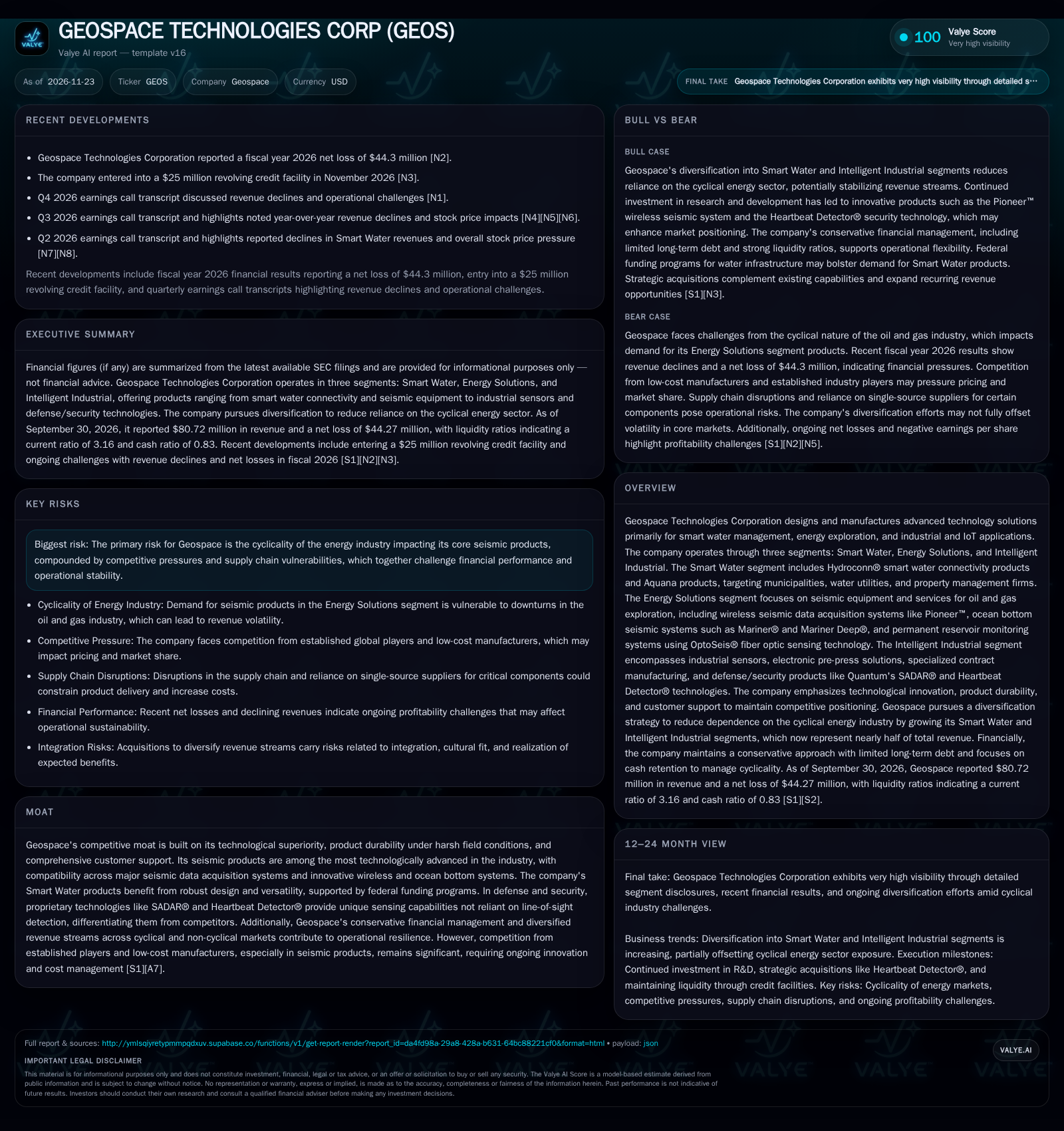
Geospace Technologies is rapidly expanding its Smart Water and Intelligent Industrial segments to offset the volatility of its core Energy Solutions business, which remains exposed to oil and gas cycles. The near-term thesis hinges on whether diversification can drive margin recovery before cyclical headwinds and competitive pressures force deeper restructuring or capital raises. [S1] [S2] [N2] [N3]
Geospace Technologies is at a strategic crossroads. Once heavily reliant on the cyclical oil and gas sector, the company is racing to build out its Smart Water and Intelligent Industrial businesses to stabilize revenues and reduce volatility. Yet fiscal 2026 saw both top-line contraction and a significant net loss, raising the stakes for its diversification strategy. With a new credit facility providing interim breathing room, the central question is whether Geospace can achieve profitable growth in its newer segments before legacy headwinds and competitive pressures erode its options.
Recent Financial Strain and Strategic Pivots Define the Present
Geospace reported $80.72 million in fiscal 2026 revenue and a net loss of $44.27 million, marking a continuation of multi-year net losses and revenue declines. The company’s Smart Water and Intelligent Industrial segments have grown to nearly half of total revenue, underscoring the urgency of its diversification push. To bolster liquidity, Geospace secured a $25 million revolving credit facility in November 2026. These moves follow a year in which quarterly earnings calls highlighted persistent operational and market challenges, especially in the core Energy Solutions segment. The company’s balance sheet remains conservative, with a current ratio of 3.16 and limited long-term debt, but the deepening losses highlight the need for a successful transition to new growth engines. [S1] [N2] [N3] [N7] [N8]
Segment Economics, Cost Structure, and the Path to Margin Recovery
Geospace’s reported revenue mix reflects a transition from dependence on energy exploration equipment—where sales are large, lumpy, and tightly linked to oil and gas capital cycles—toward a more diversified base in Smart Water (infrastructure hardware, connectivity devices) and Intelligent Industrial (sensors, security, contract manufacturing). The economics of these newer segments differ: Smart Water may offer recurring revenue potential through device replacement, monitoring, and service, while Intelligent Industrial’s margin profile is determined by contract mix and technology content. However, both segments are still in scaling phases and face customer adoption frictions, especially given the capital intensity and slow procurement cycles of municipal and industrial buyers.
The Energy Solutions segment remains the largest but is highly cyclical, with significant operating leverage—meaning revenue downturns can quickly turn into steep losses, as seen in 2026. Fixed costs for R&D, manufacturing, and support are substantial, and the company’s negative operating margin underscores that current revenue levels are insufficient to cover these outlays. The company reported cash and liquidity metrics for the period; these figures do not by themselves establish operating runway, investment capacity, financial flexibility, or financing capacity. The new $25 million credit facility extends flexibility but is not a substitute for cash flow from operations.
The question is whether scale in Smart Water and Intelligent Industrial can be achieved fast enough, and at sufficient margin, to offset the drag from Energy Solutions. If the new segments can deliver higher gross margins and more stable demand, the company could eventually achieve positive operating leverage. If not, further cost cuts or restructuring may be necessary.
Technology Edge Versus Intense Competition in Every Segment
Geospace’s competitive moat is based on technology differentiation—durability, reliability, and advanced sensing capabilities—across seismic, water, and industrial products. In seismic, it competes with established global players and low-cost manufacturers, often facing price-based competition and procurement cycles tied to oil and gas spending. In Smart Water, the company benefits from U.S. federal infrastructure funding, but must contend with large industrial conglomerates and specialized connectivity providers offering alternative solutions.
The Intelligent Industrial and defense/security segments, recently bolstered by the Heartbeat Detector® acquisition, open new verticals but bring competition from large defense contractors and emerging technology firms. Here, proprietary features (such as non-line-of-sight detection) may provide temporary differentiation but are unlikely to confer lasting pricing power without rapid adoption and integration into customer workflows.
Customer switching costs in all segments are moderate at best. While reliability and support are important, procurement decisions can quickly shift to alternative suppliers if Geospace’s value proposition slips, especially in price-sensitive or budget-constrained environments. This places a premium on continuous innovation, cost management, and the ability to demonstrate superior total cost of ownership.
If Diversification Takes Hold: Margin Stabilization and New Growth Vectors
A favorable outcome for Geospace would see Smart Water and Intelligent Industrial revenues accelerate, reaching critical mass to offset the drag from Energy Solutions. This could be driven by successful market penetration of Hydroconn® and Aquana products into U.S. municipal and utility markets, aided by federal infrastructure funding, and by scaling of industrial sensor and security deployments in commercial and defense applications. If these segments achieve higher gross margins and more recurring revenue (for example, through monitoring or service contracts), the company could return to operating profitability even if Energy Solutions remains cyclical.
Confirmation of this scenario would come from sequential revenue and margin growth in Smart Water and Intelligent Industrial, successful contract wins or partnerships, and a narrowing of net losses quarter-over-quarter. Additional evidence would include customer renewals, new product launches gaining traction, and improved operating leverage as fixed costs are absorbed by higher volumes.
Diversification Progress Slows but Prevents Severe Contraction
The most plausible near-term trajectory is that Smart Water and Intelligent Industrial continue to grow, but at a pace insufficient to restore overall profitability in the next 12-18 months. Energy Solutions remains volatile, with occasional large orders but overall market weakness.
In this scenario, Geospace’s revenue base gradually becomes less dependent on oil and gas cycles, but persistent net losses force further scrutiny of cost structure and capital allocation. Progress is measured by stabilization, not dramatic growth—net losses may narrow, but operating profitability remains elusive until either the new segments scale further or Energy Solutions experiences a cyclical upturn.
Evidence for this scenario would be continued, but modest, growth in non-energy segments, periodic restructuring charges, and cautious management commentary on outlook. Falsification would come from a sudden return to profitability or, conversely, a sharp deterioration in liquidity or inability to access credit.
Cyclical Weakness and Cost Overhang Trigger Restructuring or Dilution
In a bearish scenario, Energy Solutions continues to contract, with no offsetting acceleration in Smart Water or Intelligent Industrial. Fixed cost absorption worsens, net losses deepen, and cash burn accelerates. The company’s credit facility is drawn down to fund ongoing operations, and management is forced to consider layoffs, asset sales, or an equity raise to shore up liquidity.
Competitive pressures intensify, with price erosion in both legacy and emerging segments. Supply chain disruptions or loss of key contracts could further destabilize operations. Under these conditions, Geospace risks breaching debt covenants or facing investor pressure for a strategic review, including possible divestitures or sale of the company.
Evidence supporting this scenario would include back-to-back quarters of deepening losses, rapid cash drawdown, disclosure of covenant concerns, or announcements of major cost reduction initiatives. Falsification would require a clear inflection in revenue or margin trends before liquidity becomes critical.
Milestones That Will Determine Whether Geospace’s Diversification Pays Off
Quarterly revenue growth rates in Smart Water and Intelligent Industrial—sustained sequential improvement would support the upside thesis, while stagnation would suggest slower progress.
Gross margin trends by segment—rising margins in new segments would indicate successful scaling and pricing discipline.
Contract awards, customer renewals, or large multi-year agreements in Smart Water and defense/security—if disclosed, these would validate market traction.
Cash flow from operations and net cash burn rate—persistent negative cash flow would prompt closer scrutiny of runway and need for additional financing.
Utilization and remaining availability under the $25 million revolving credit facility—rapid drawdown or covenant disclosures would signal liquidity stress.
Updates on integration and revenue contribution from the Heartbeat Detector® acquisition—would help test the pace of segment expansion.
Management commentary on cost structure adjustments or restructuring actions—indications of further belt-tightening or strategic pivots.
Disclaimer: This is research-only, informational analysis and not investment advice. It may include AI-generated interpretation and general industry context. Always verify important details using primary sources.

Comments