
ZeroStack Corp.: Capital Strain, Strategic Repositioning, and the Challenge of Dual-Track Ambitions
ZeroStack Corp. is navigating a high-wire act: repositioning itself as an AI-focused asset manager while maintaining legacy pharmaceutical distribution operations, all amid acute liquidity pressures, recent auditor turnover, and limited business-model transparency.
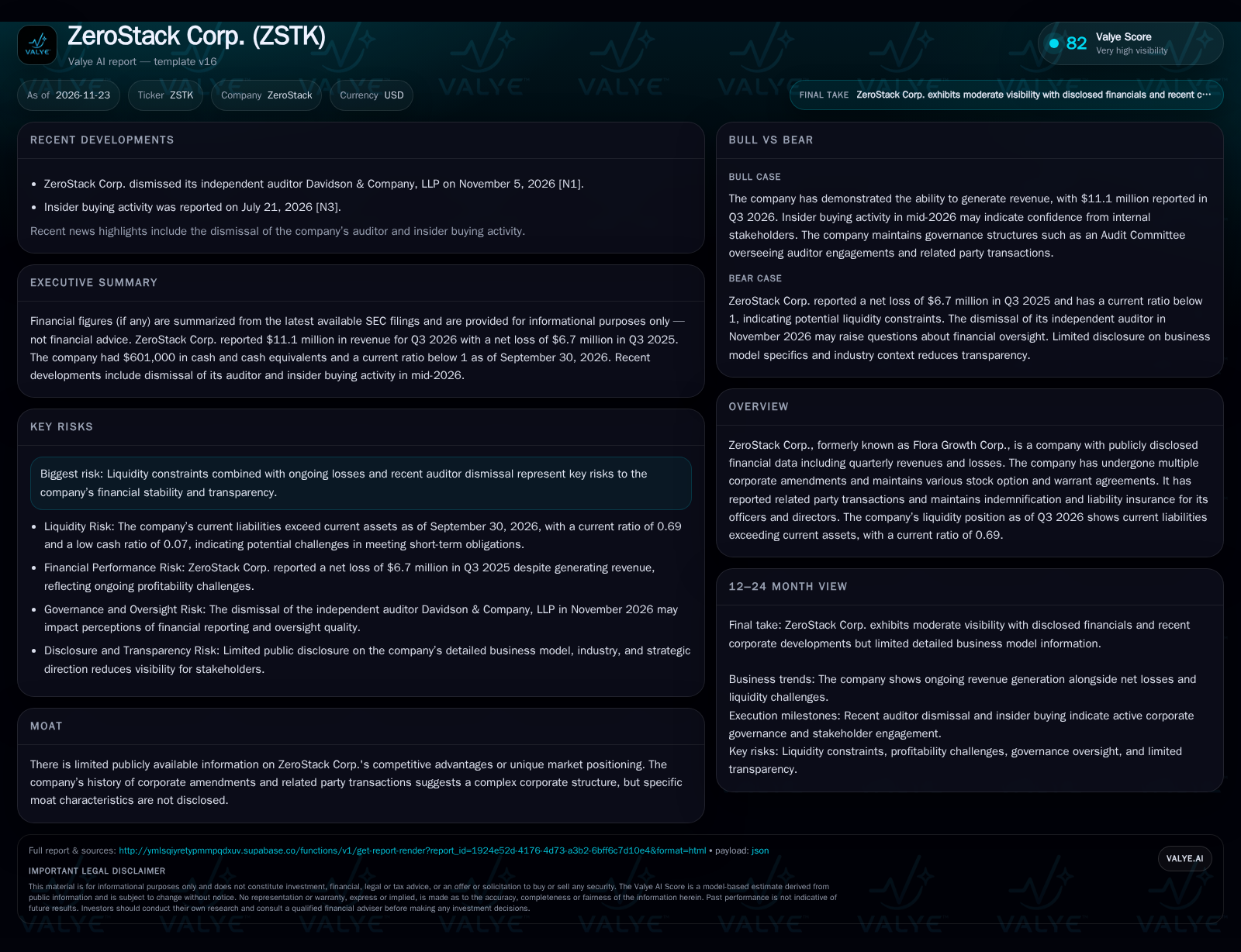
The company’s pivot to a decentralized AI treasury model and continued pharmaceutical distribution through Phatebo GmbH creates complexity and integration risk. Recent auditor dismissal and insider buying activity underscore both governance flux and possible internal confidence. The path forward hinges on capital access, operational focus, and the ability to deliver on dual growth narratives in AI and pharma. [S2] [N1] [N3]
ZeroStack Corp. stands at a crossroads, with its recent transformation from Flora Growth Corp. into an AI-centric asset management and decentralized treasury vehicle layered atop a legacy pharmaceutical distribution business. The dual-track strategy—investing in AI tokens while running a global pharma distribution arm—offers potential upside but also magnifies complexity and execution risk, especially as transparency and capital sufficiency remain in question. [S2] [N1]
Recent Developments: Liquidity Tensions and Strategic Shifts Define ZeroStack’s Outlook
As of September 30, 2026, ZeroStack Corp. reported $11.1 million in revenue for the quarter, but its balance sheet reveals substantial stress: cash and equivalents totaled just $601,000, with current assets of $5.6 million against $8.1 million in current liabilities, yielding a current ratio of 0.69 and a cash ratio of 0.07. This acute working-capital shortfall is compounded by the company’s recent dismissal of its independent auditor on November 5, 2026, which may signal challenges in financial reporting or oversight. Amid these strains, insider buying activity was reported in July 2026—potentially reflecting management’s belief in the company’s prospects, though it does not, on its own, counterbalance the underlying financial and governance pressures. ZeroStack’s strategic repositioning as a decentralized AI treasury and asset manager, while still operating a global pharmaceutical distribution business through Phatebo GmbH, marks a significant corporate pivot that introduces both opportunity and integration risk. [S2] [N1] [N3]
Earnings Power and Funding Needs: The Economics Behind ZeroStack’s Dual Model
ZeroStack’s business model is currently bifurcated: it aspires to become a leading AI-focused asset manager via a decentralized treasury strategy, while also deriving revenue from pharmaceutical distribution through its wholly owned subsidiary, Phatebo GmbH. The Q3 2026 revenue figure of $11.1 million likely reflects contributions from the pharma distribution arm, given the early-stage status of the AI treasury initiative. This segment, in theory, could offer relatively stable gross margins but is typically working-capital intensive, requiring significant inventory and receivables funding—exacerbating liquidity pressures if growth outpaces internal cash generation.
The company’s pivot to AI asset management, notably through investments in 0G Tokens, introduces a different economic profile: returns here are likely volatile, dependent on token appreciation and the broader digital asset market, with limited recurring cash flows absent a scaled asset management platform with fee-based income. Fixed costs, including corporate overhead, compliance, and integration expenses from recent acquisitions, remain high relative to revenue. The company’s history of net losses—including a $6.7 million net loss in Q3 2025—demonstrates that its current scale is insufficient for profitability, and the persistent capital deficit suggests an urgent need for external funding, asset sales, or operational restructuring to avoid deeper financial distress. [S2] [S1]
Competitive Dynamics: Navigating Crowded Asset Management and Pharma Channels
ZeroStack faces fundamentally different competitive landscapes across its two major activities. In AI-focused asset management, the company is entering a field populated by crypto-native funds, decentralized autonomous organizations (DAOs), and institutional digital asset managers—all of whom compete for capital, technical talent, and deal flow. Absent evidence of proprietary technology, differentiated access, or regulatory advantages, ZeroStack may struggle to attract assets or command premium fees.
Pharmaceutical distribution in Germany and globally is a mature, highly regulated sector dominated by large incumbents with scale-driven cost advantages and entrenched customer relationships. While Phatebo GmbH provides market entry, the lack of detailed disclosure on product mix, customer concentration, or regulatory positioning makes it unclear whether ZeroStack can achieve superior margins or defend share against established players. The company’s diverse, acquisitive history and frequent business pivots may further dilute focus and undermine the development of sustainable competitive moats. [S1] [S2]
Unlocking Value: How a Successful Pivot Could Reshape ZeroStack’s Trajectory
If ZeroStack can secure additional capital—through equity, debt, or asset sales—it could stabilize its working capital position and invest in scaling its AI treasury platform. A successful pivot would require demonstrating credible returns from its 0G Token investments or attracting external assets to manage, generating fee income and establishing itself within the growing digital asset management ecosystem.
Evidence confirming this scenario would include: material improvement in liquidity ratios (above 1.0), meaningful fee or investment income from the AI treasury segment, new capital raised or strategic partnerships announced, and segment-level disclosure showing sustainable profitability in pharma distribution. A reversal of recent auditor turnover or upgrades in governance practices would further support a positive re-rating.
Straddling Two Worlds: The Most Likely Outcome for ZeroStack
The most plausible near-term outcome is continued operational strain, with the pharmaceutical distribution business providing some revenue but offering limited margin expansion due to competitive and regulatory headwinds. The AI treasury initiative remains early-stage, with minimal near-term contribution to cash flow or earnings. Ongoing liquidity pressures force management to prioritize short-term cash preservation, potentially constraining both growth and investment in new initiatives.
This scenario would be confirmed by persistent current ratios below 1.0, continued net losses, lack of substantive new capital raises, and limited disclosure or progress on AI asset management milestones. Additional auditor turnover or opaque financial reporting would reinforce the challenges of scaling amid financial and governance uncertainty.
Liquidity Crunch: How Capital Shortfall Could Trigger Strategic or Financial Distress
In an adverse scenario, ZeroStack is unable to raise new capital or monetize assets quickly enough to cover its working capital deficit. Creditors or suppliers may shorten terms or demand prepayment, further straining operations. Regulatory or audit issues could delay filings or trigger compliance events, restricting access to public markets. Under these pressures, the company may be forced to sell core assets at distressed valuations, curtail operations, or pursue restructuring, including bankruptcy protection.
Early warning signs would include further deterioration in liquidity ratios, missed or delayed filings, negative regulatory actions, or disclosure of going-concern warnings in SEC filings. Loss of key personnel or further auditor turnover would amplify distress signals.
Milestones and Metrics That Will Define ZeroStack’s Strategic Viability
Quarterly updates on cash and equivalents, current assets, and current liabilities: sustained improvement or further deterioration will be critical for assessing near-term solvency. [S2]
Disclosure of segment-level revenue and margin for both the AI treasury and pharma distribution arms would help clarify business model viability. A useful metric would be recurring fee income or realized gains from AI investments, if disclosed.
Evidence of new capital raised—whether through equity, debt, or asset divestitures—will signal management’s ability to address the liquidity gap.
Any reversal or stabilization of auditor relationships, or a clean audit opinion, would help restore confidence in governance and financial transparency. [N1]
Progress on AI asset management milestones, such as assets under management (AUM), partnerships, or technology launches, would indicate traction in the new strategic direction.
Updates on regulatory compliance, supplier terms, or credit facility access, particularly for the pharma distribution arm, will be important for operational continuity.
Insider transactions or board changes: additional insider buying (if disclosed) may be supportive, while significant selling or departures could be a negative signal. [N3]
Disclaimer: This is research-only, informational analysis and not investment advice. It may include AI-generated interpretation and general industry context. Always verify important details using primary sources.

Comments