
Iambic Therapeutics Advances AI-Powered Drug Discovery with New Capital, Commercial Viability Still Unclear
With a substantial cash infusion from its October 2026 IPO and a proprietary AI platform targeting novel medicines, Iambic Therapeutics enters the public markets with financial runway and sector buzz. Yet, persistent operating losses and the uncertain economics of AI-enabled drug development pose critical questions about value realization and long-term sustainability.
Iambic Therapeutics pairs strong post-IPO liquidity with an AI-powered drug discovery platform, attracting market and insider interest. However, ongoing losses and a lack of disclosed commercial traction mean that the company’s ability to convert scientific innovation into sustainable revenue remains untested. Execution, partnership formation, and external validation will be essential to realize upside.
Iambic Therapeutics, now publicly listed and flush with over $400 million in cash post-IPO, stands at the intersection of artificial intelligence and drug discovery—a sector attracting both investor excitement and skepticism. The company’s proprietary platform aims to reshape pharmaceutical R&D efficiency, but the commercial path from algorithm to approved medicine is fraught with scientific, regulatory, and business-model risk. With no disclosed revenues and ongoing steep losses, Iambic’s near-term prospects hinge on its ability to demonstrate pipeline progress, secure partnerships, and translate AI-driven insights into tangible value.
IPO Capital Boosts Financial Stability Amid Ongoing Losses and Growing Market Attention
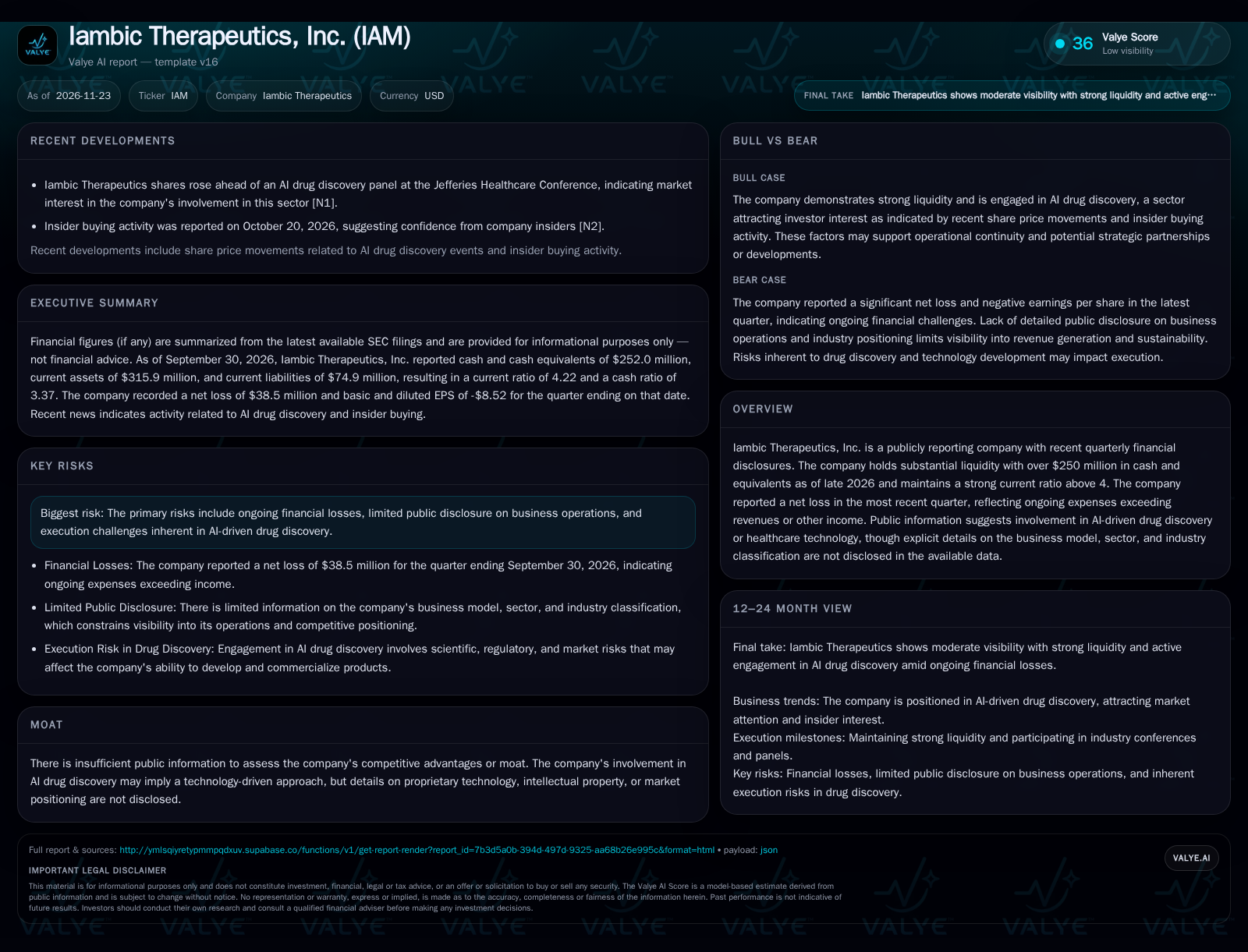
As of September 30, 2026, Iambic Therapeutics reported $252 million in cash and equivalents, with a robust current ratio of 4.22 and a cash ratio of 3.37. In October 2026, the company completed its IPO, raising net proceeds of approximately $156 million, further strengthening its liquidity position [S1]. Despite this, the company recorded a net loss of $38.5 million for the most recent quarter and has accumulated a deficit of $283.8 million since inception. Market interest is evident, with shares rising ahead of an AI drug discovery panel at a major healthcare conference and recent insider buying activity [N1] [N2]. These facts collectively highlight a company with ample financial runway, active investor engagement, and a heavy ongoing investment in R&D, but without a proven commercial engine or disclosed revenue streams.
AI-Driven Drug Discovery’s Potential Impact on Cost Efficiency and Value Creation
Iambic Therapeutics’ core promise lies in leveraging its proprietary AI-driven molecular superintelligence platform to accelerate and optimize the discovery of novel medicines [S1]. In theory, this approach could dramatically reduce the time and capital required for early-stage drug development, shifting the economics from traditional, labor- and time-intensive processes to more scalable, data-driven experimentation. However, the company has not disclosed a current revenue model—whether it intends to license its platform, partner with larger pharmaceutical firms for milestone and royalty payments, or pursue internal pipeline assets through clinical development and eventual commercialization. Each pathway carries distinct implications:
If Iambic primarily pursues internal drug development, it faces high fixed costs, long time horizons, and binary clinical/regulatory risk—typical of biotech companies. Should it focus on partnerships or platform licensing, the economics could shift toward lower upfront investment per program, but with reduced potential upside and dependency on third-party validation. The ability to secure non-dilutive funding via collaborations or licensing would be a critical lever for extending runway and reducing reliance on capital markets.
Operating leverage may be achievable if the platform proves scalable across multiple targets or disease areas, but this depends on demonstrating reproducible success and establishing the platform as a preferred tool for external partners. Until commercial terms, pricing structures, or partnership economics are disclosed, the company’s ability to generate recurring revenue or high-margin income remains hypothetical.
Distinctive Platform Features in a Competitive AI and Pharmaceutical Landscape
Iambic operates in a competitive landscape populated by both legacy pharmaceutical companies integrating AI and a rapidly growing cohort of dedicated AI-driven drug discovery firms. Potential competitors include specialized AI drug discovery startups, established biotech firms with in-house computational platforms, and large pharmaceutical companies partnering with or acquiring AI technology providers. The company’s stated reliance on proprietary experimental data and its molecular superintelligence platform suggests an attempt at differentiation—either through unique data sets, superior algorithms, or integration of experimental and computational workflows [S1].
However, barriers to entry in AI-driven drug discovery are evolving. The field is characterized by rapid advances in general-purpose AI, increased availability of public and licensed biological data, and the commoditization of some computational tools. Sustainable competitive advantage may depend on proprietary data generation, intellectual property protection, and the ability to demonstrate clear improvements in hit rates, cycle time, or cost per program compared to traditional or alternative AI-enabled approaches. Without disclosure of pipeline progress, partnership wins, or validated clinical milestones, Iambic’s relative standing is difficult to gauge.
Clinical and Partnership Milestones Could Confirm Platform Value and Enable Funding Expansion
The most favorable scenario for Iambic would see its AI platform deliver clear, externally validated breakthroughs—either by advancing internally developed drug candidates into successful clinical trials or by securing high-value partnerships with established pharmaceutical companies. Such events could validate the platform’s differentiation, attract additional non-dilutive funding, and could support premium pricing for future collaborations.
Confirmation of this scenario would come from public announcements of major partnerships, upfront or milestone payments, or the achievement of clinical endpoints for Iambic-originated drug candidates. Additional signals would include peer-reviewed publications, regulatory designations (such as Fast Track or Breakthrough Therapy), or the initiation of late-stage clinical trials. Evidence of repeat business with industry partners or platform adoption across multiple therapeutic areas would further support the upside case.
Continued R&D Efforts Yield Gradual Progress Without Immediate Revenue Growth
Incremental progress—such as preclinical proof-of-concept, IND filings, or initial partnership announcements—may be achieved, but without transformative clinical or commercial milestones, the company remains reliant on capital markets or modest collaboration income to sustain operations.
This scenario would be confirmed by ongoing net losses, continued absence of disclosed revenues, and regular updates on R&D progress, conference presentations, and pipeline expansion. Falsification would require either a sharp reduction in R&D spend (suggesting a strategic pivot or distress) or the sudden announcement of significant revenue-generating deals, which would shift the company toward the upside scenario.
Validation Delays or Funding Shortfalls May Prompt Strategic Scale-Backs
The most adverse outcome would occur if Iambic’s platform fails to deliver compelling candidates or secure meaningful partnerships before its cash runway expires. In this scenario, the company could face an inability to raise additional capital on favorable terms, forcing cuts to R&D programs, asset sales, or a search for strategic alternatives under duress.
Early signs of this trajectory would include negative clinical or preclinical results, lack of partnership activity, or management signaling cost reductions and program prioritization. Deterioration of the external funding environment for early-stage biotech and AI firms would compound these risks. Falsification of the downside would require evidence of sustained investor appetite, new financings, or the company’s ability to extend runway through non-dilutive means.
Key Milestones and External Events That Could Transform Iambic’s Market Position
Announcement of major R&D milestones, such as IND filings, initiation of clinical trials, or preclinical proof-of-concept results for internally developed drug candidates.
Disclosure of significant partnership agreements, including upfront payments, milestones, or equity investments from established pharmaceutical companies.
Evidence of recurring or growing revenue streams, if disclosed, from licensing, milestone payments, or platform fees.
Updates on the proprietary data sets and improvements to the AI platform, including technical publications or third-party validation.
Material changes in R&D spending patterns—either acceleration (indicating confidence and opportunity) or cost-cutting (suggesting distress or reprioritization).
Shifts in the regulatory or legal landscape for AI-enabled drug discovery that could impact the company’s ability to operate or differentiate.
Insider buying or selling activity, if disclosed, as a potential signal of management’s outlook and alignment with public shareholders.
Changes in the competitive landscape, including major advances by peer companies or new entrants with disruptive technology.
Disclaimer: This is research-only, informational analysis and not investment advice. It may include AI-generated interpretation and general industry context. Always verify important details using primary sources.

Comments