
Triller Group: Diversification Ambitions Collide with Mounting Losses and Balance Sheet Pressure
Triller Group Inc. attempts to leverage its AI-powered platform and sprawling business segments—from creator economy apps to financial services—in pursuit of scalable growth.
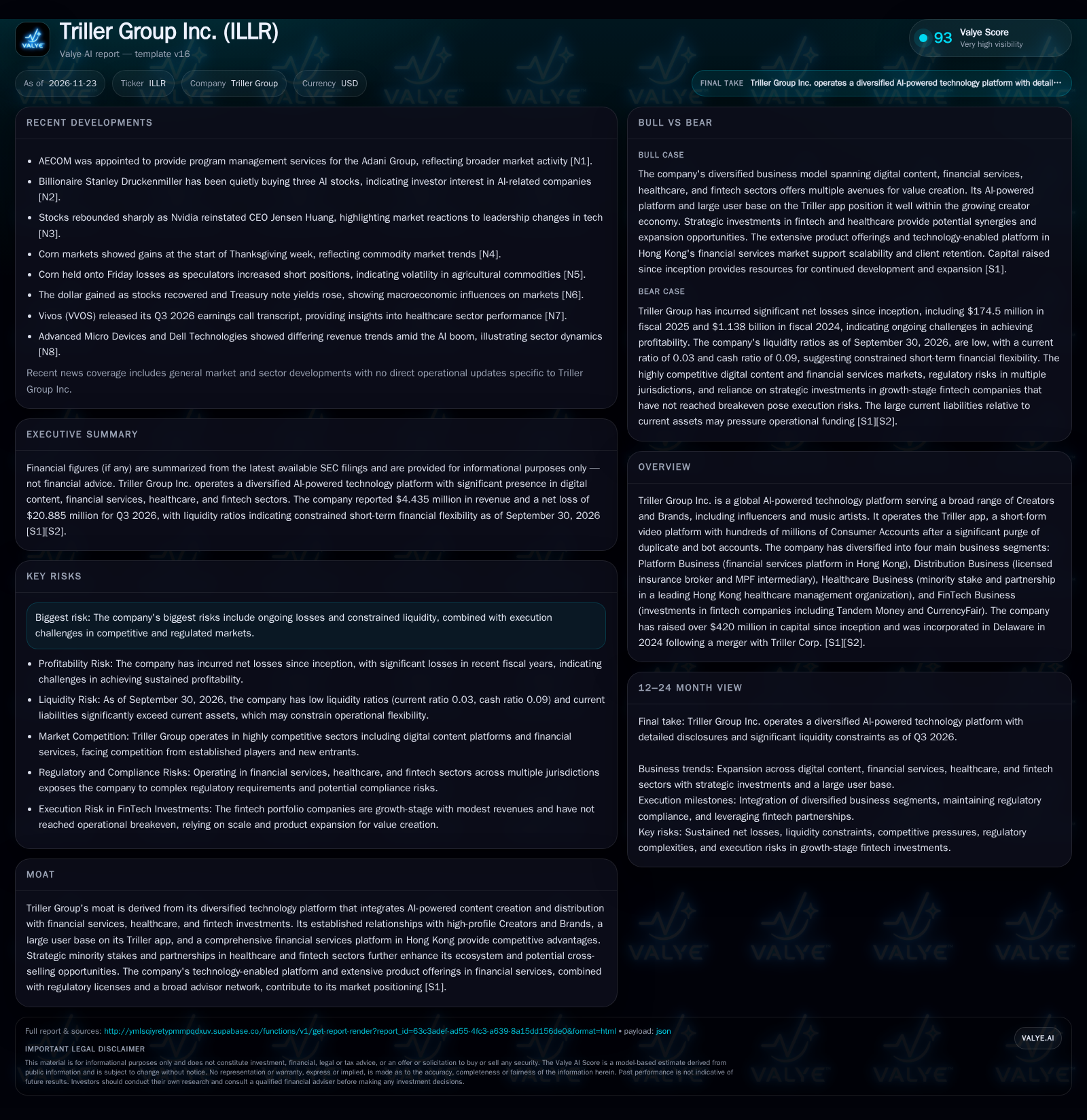
Triller Group Inc. operates a diversified platform spanning digital content, financial services, healthcare, and fintech, highlighted by the Triller app’s large user base and several minority stakes in growth-stage companies. [S1] [S2]
Triller Group Inc. has positioned itself as a global AI-powered platform straddling the worlds of digital content, financial services, healthcare, and fintech—an ambitious diversification play in an era when scale, engagement, and cross-sector synergies are prized. Yet, beneath the surface of its substantial user base and broad product shelf, the company’s latest financials reveal acute operating losses and a balance sheet under severe strain. The central question is whether Triller’s multi-pronged approach can deliver sustainable value before funding and execution risks overwhelm its potential.
Latest Results Reveal Financial Strain and Strategic Complexity
Triller Group reported $4.435 million in revenue for Q3 2026, with a net loss of $20.885 million and basic/diluted EPS of -$0.99. Its current liabilities at quarter-end reached $418.238 million, compared to just $12.731 million in current assets, yielding a current ratio of 0.03 and a cash ratio of 0.09. These figures signal immediate liquidity stress and a pressing need for additional funding or rapid improvement in cash generation. The company’s accumulated losses since inception—$174.5 million in 2025 and over $1.1 billion in 2024—underscore the persistent challenge of reaching profitability. [S2]
The user base remains a double-edged sword: the Triller app reports over 327 million consumer accounts, but this comes after purging over 200 million duplicates and bots, suggesting that headline reach may not directly translate to active, monetizable engagement. [S1]
Triller's diversified structure—spanning digital content, financial services, insurance distribution, healthcare, and fintech investments—complicates both operational focus and the path to sustainable cash flow, particularly given the regulatory and competitive complexity of each domain. [S1]
How Triller Group’s Multi-Segment Model Could (or Might Not) Drive Profits
Triller Group’s economics hinge on extracting value from four disparate segments: the digital content platform (Triller app), a Hong Kong-based financial services platform (OnePlatform), insurance distribution, and minority holdings in fintech and healthcare companies. The Triller app likely relies on advertising, brand partnerships, and potentially creator monetization as primary revenue streams—business models that demand both high engagement and favorable user demographics. However, the prevalence of duplicate and bot accounts in the past raises questions about the true monetizable base and advertiser appeal.
In financial services and insurance, Triller Group’s Platform and Distribution Businesses generate income from commissions, service fees, and product sales—models that can deliver recurring revenue if advisor productivity, client retention, and product breadth are maintained. However, these segments are capital-light but operationally complex, requiring continual regulatory compliance, advisor recruitment, and product shelf management. Margins are typically thin unless the platform achieves substantial scale or leverages technology for cost-efficient distribution.
Minority stakes in Tandem Money and CurrencyFair offer optionality but do not provide near-term cash flow. Unless these fintech investments achieve breakout growth or liquidity events, they are unlikely to offset group-level cash burn. Overall, Triller’s current cost base appears to be outpacing revenue generation, with little evidence yet of operating leverage or scalable margin improvement. [S1] [S2]
Competing on Multiple Fronts: Platform Scale, Regulatory Moats, and Brand Access
The company’s competitive ambitions are broad but exposed. In digital content, Triller faces entrenched platforms such as TikTok, Instagram Reels, and YouTube Shorts, all of which benefit from massive user bases, algorithmic personalization, and deep advertiser relationships. Triller’s differentiated edge could lie in its AI-powered capabilities and high-profile creator relationships, but its ability to drive consistent user engagement and monetization remains unproven at scale.
In Hong Kong’s financial services and insurance market, the OnePlatform and Distribution Businesses compete with established brokers, banks, and digital-first wealth platforms. Regulatory licenses and a 1,500-strong advisor network are entry barriers, but customer loyalty is typically low and switching costs modest in this sector. Sustained differentiation would require proprietary products, superior advisor productivity, or technology-driven client experiences.
The healthcare and fintech stakes offer ecosystem potential but, as minority positions, do not confer operational control or guaranteed synergies. Triller’s diversified approach may prevent it from developing a prominent position in any single vertical, especially if capital and management attention are spread too thin.
Cross-Segment Synergies and Platform Engagement Fuel a Turnaround
A favorable outcome for Triller Group would see the company leverage its large user base and creator partnerships to drive higher engagement and monetization on the Triller app, unlocking new advertising and brand partnership revenues. If the Hong Kong financial platform and insurance distribution arm can scale advisor productivity and capture market share from incumbents, recurring fee income could stabilize cash flows.
Should minority fintech and healthcare investments achieve significant growth or liquidity events, Triller might realize outsized returns that help offset group losses. The company could also benefit from cross-selling between its digital content, financial, and healthcare platforms—using content-driven engagement to drive customer acquisition for financial products.
Evidence that would confirm this scenario includes a marked increase in active, monetizable Triller app users, sustained revenue growth in financial services, improved operating leverage, and successful liquidity events or revaluations from fintech holdings. Announcements of new, high-profile brand partnerships or creator-driven monetization features would further support the bullish case.
Sustained Losses and Incremental Progress Amid Capital Constraints
The most plausible near-term outlook for Triller Group is one of continued operating losses and incremental progress in monetizing its user base and expanding financial services. The company may achieve modest revenue growth across segments, but the magnitude of its current liabilities and persistent cash burn will likely necessitate either external funding or aggressive cost-cutting.
Operational complexity and regulatory demands in each business line could limit the pace of integration and cross-segment synergy realization. Minority investments in fintech and healthcare may remain illiquid and non-contributory to cash flow. Unless Triller can demonstrate clear improvements in unit economics and engagement quality, its current capital structure may constrain strategic flexibility.
Confirmation of this scenario would include ongoing net losses, stable but modest revenue growth, and repeated references to funding needs or cost containment in future filings. Absence of high-profile new partnerships or step-change improvements in engagement metrics would further support this view.
Liquidity Crisis or Execution Missteps Trigger Strategic Retrenchment
The adverse scenario involves Triller Group failing to secure new funding or dramatically improve cash generation, resulting in a liquidity crunch that forces asset sales, business line divestitures, or restructuring. Execution missteps—such as regulatory lapses, advisor attrition, or failed integration between segments—could accelerate this outcome.
If user engagement on the Triller app deteriorates or if competitive pressures in financial services erode fee income, the company may be unable to cover operating costs or service obligations. Minority investments in fintech and healthcare may not be monetizable in time to provide relief, and the company’s diversified structure could become a liability if it cannot prioritize its most promising segments.
Evidence of this scenario would include disclosures of funding shortfalls, going-concern warnings, sharp reductions in workforce or business lines, or fire-sale exits from non-core investments. Regulatory sanctions or advisor departures in the Hong Kong platform would further validate downside risks.
Milestones and Metrics That Will Determine Triller Group’s Next Act
Net cash used in operations and any new financing or capital-raising events; an ongoing high cash burn rate without new funding would indicate rising distress.
Trends in active, monetizable users on the Triller app (if disclosed); a sustained uptrend would support monetization and engagement potential.
Revenue and advisor productivity metrics in the Platform and Distribution Businesses; improvement here would suggest traction in financial services.
Updates on the valuation, profitability, or liquidity events of fintech and healthcare minority stakes; realized gains or exits could materially alter the balance sheet.
Announcements of major new brand partnerships, creator initiatives, or monetization features on the Triller app.
Regulatory compliance disclosures or adverse findings in Hong Kong or other jurisdictions.
Any reference to going-concern risk, asset sales, or strategic reviews in SEC filings or management commentary.
If disclosed, customer retention and churn metrics in the financial services and insurance distribution segments; rising churn would be a red flag.
Disclaimer: This is research-only, informational analysis and not investment advice. It may include AI-generated interpretation and general industry context. Always verify important details using primary sources.

Comments