
Flexible Solutions International: Revenue Contraction, Niche Ambitions, and the Stakes of Commercial Renewal
Flexible Solutions International confronts a steep revenue decline and persistent operating losses, despite maintaining liquidity above near-term obligations. The company’s future hinges on its ability to commercialize new specialty chemical products, diversify its customer base, and withstand competitive and regulatory pressures in a consolidating industry.
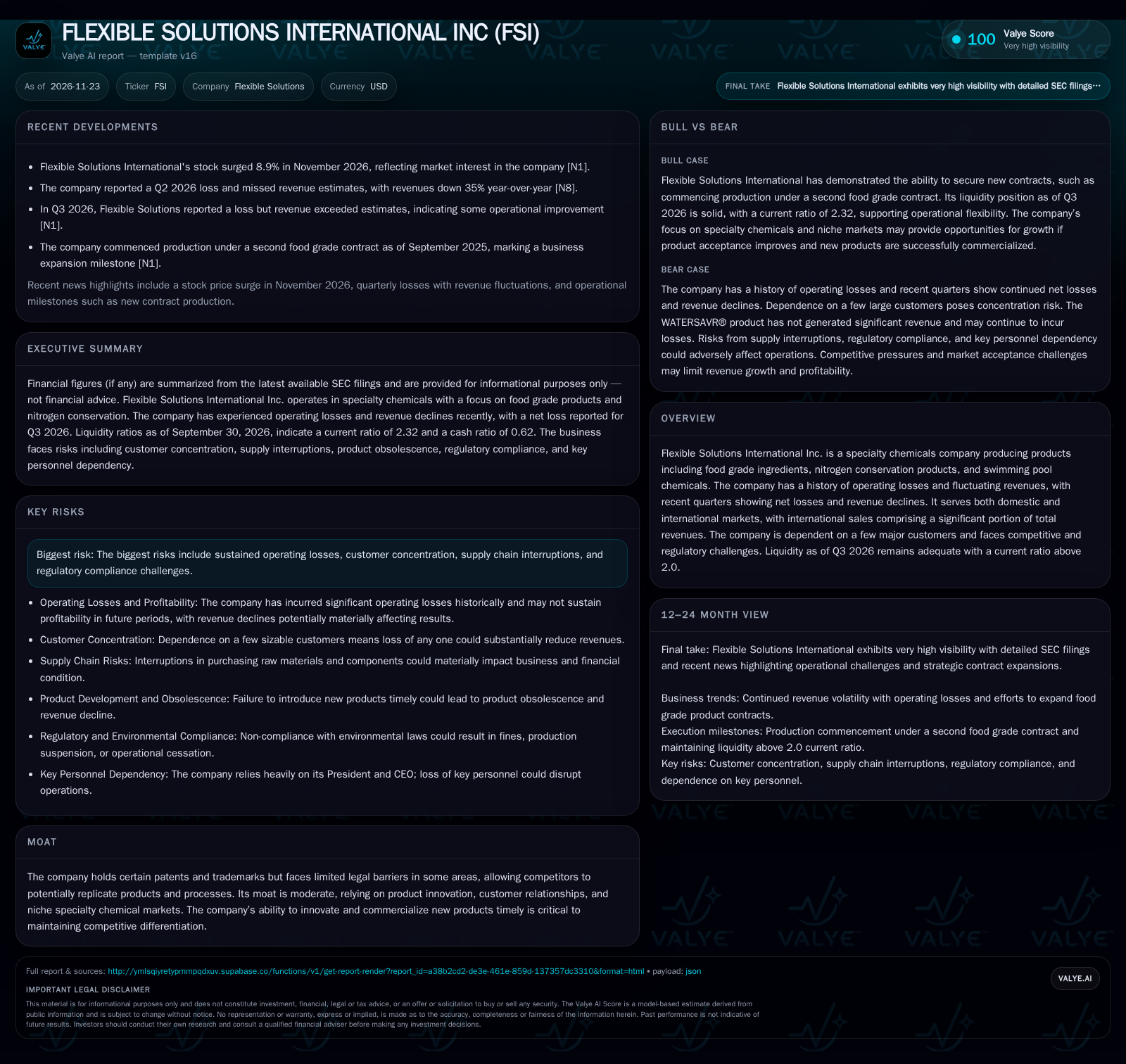
Flexible Solutions International reported a 35% year-over-year revenue decline in Q2 2026, extending a trend of operating losses. Sustained improvement likely requires successful product innovation and customer diversification, with downside risk if these efforts stall. [S2] [N8]
Flexible Solutions International, a specialty chemicals producer focused on food grade ingredients, nitrogen conservation products, and swimming pool chemicals, is navigating a challenging period marked by substantial revenue decline and ongoing net losses. The company’s ability to return to growth will likely depend on more effective product innovation, expansion into new customer segments, and resilience in the face of industry volatility.
Revenue Slide and Persistent Losses Define the Current Landscape
Flexible Solutions’ Q2 2026 revenues fell 35% year-over-year to $7.4 million, a substantial contraction that compounds the company’s history of operating losses. This revenue shortfall underscores the company’s struggle to sustain product demand or grow market share in its core segments. The company reported cash and liquidity metrics for the period; these figures do not by themselves establish operating runway, investment capacity, financial flexibility, or financing capacity. International sales represented 16% of 2025 revenues, highlighting both the opportunity and risk associated with cross-border operations, including currency fluctuations and regulatory unpredictability. Meanwhile, the flagship WATERSAVR® product continues to generate negligible revenue, suggesting that R&D and commercialization investments have yet to yield meaningful returns. [S2] [N8]
The interplay between international sales and currency risk deserves further scrutiny. Given that international revenues constitute a modest but nontrivial portion of total sales, fluctuations in foreign exchange rates can materially impact reported top-line figures and margins. Moreover, geopolitical developments or trade policies in key markets could introduce regulatory uncertainty or disrupt supply chains, complicating forecasting and operational planning. The company’s exposure to these external factors may necessitate hedging strategies or diversification of geographic markets to mitigate volatility and sustain stable revenue streams.
How the Specialty Chemicals Model Can Create — or Destroy — Value
Specialty chemicals businesses like Flexible Solutions typically rely on differentiated products, often protected by patents or proprietary know-how, to command premium pricing and achieve above-average margins. In theory, high gross margins can be offset by substantial R&D, regulatory, and marketing expenditures, making operating leverage sensitive to volume swings. For Flexible Solutions, the sharp drop in revenue likely pressures fixed-cost absorption, raising the break-even threshold and amplifying losses. Customer concentration and product-specific risk further destabilize cash flows, as the loss or reduced order volume from a single major customer can have outsized impact.
Real operating leverage will depend on the company’s ability to commercialize higher-margin products and expand its addressable market without proportionally increasing overhead.
A critical determinant of value creation in specialty chemicals lies in the scalability of proprietary formulations and the ability to defend intellectual property. If Flexible Solutions can successfully transition from pilot-scale production to commercial-scale manufacturing without proportionally increasing costs, operating leverage could improve significantly. Conversely, failure to achieve economies of scale or to protect innovations could erode pricing power and invite commoditization. Additionally, the timing and magnitude of R&D investments must be carefully balanced against expected product lifecycle returns, as premature or excessive spending without market validation risks exacerbating losses.
Competitive Pressures, Customer Concentration, and the Fight for Differentiation
Flexible Solutions competes in a fragmented specialty chemicals sector where barriers to entry are moderate and product substitution is common. While the company holds certain patents and trademarks, the report notes that legal barriers are limited, allowing competitors to replicate products and processes if they can reverse-engineer formulations or leverage supplier relationships. The company’s reliance on a handful of major customers exposes it to significant bargaining power risk—large buyers can demand price concessions or switch to alternative suppliers if product performance or pricing slips.
Broader market trends also present challenges: larger specialty chemical manufacturers benefit from economies of scale in procurement, regulatory compliance, and R&D, while nimble niche players may out-innovate incumbents if they identify emerging application areas more quickly. For Flexible Solutions, the ability to maintain customer relationships and differentiate through performance, service, or sustainability features could determine whether it carves out defensible niches or cedes share to better-capitalized or more agile competitors.
Customer concentration not only affects bargaining power but also influences strategic flexibility. High dependency on a few customers may limit the company’s ability to pursue aggressive pricing or product development initiatives tailored to broader market needs. Furthermore, the ease with which competitors can replicate products places a premium on continuous innovation and customer service excellence. Flexible Solutions’ ability to embed itself within customers’ supply chains through reliability, customization, or sustainability credentials could serve as a competitive moat. However, failure to differentiate on these dimensions may accelerate customer attrition, especially as larger competitors leverage scale advantages.
A Turnaround Hinges on New Product Adoption and Customer Diversification
A favorable outcome for Flexible Solutions would likely require successful commercialization of new or improved specialty chemical products—either by finally unlocking revenue from WATERSAVR® or introducing other high-margin offerings that resonate with industry or consumer buyers. Expansion into less concentrated customer segments could reduce revenue volatility and give the company greater pricing power. Upside could also come from forging strategic partnerships or licensing deals that bring in non-dilutive capital and broaden market access.
Evidence confirming this scenario would include a reversal of the revenue decline—preferably with growth attributable to new product lines—improved gross margins, and disclosures of major customer wins or expanded distribution agreements. A trend toward reduced customer concentration and increased international penetration, without a corresponding jump in regulatory or supply chain expense, would further bolster the case for sustained recovery.
Strategic partnerships could play a pivotal role in accelerating commercialization and market penetration. Collaborations with established industry players might provide access to distribution networks, co-development resources, or regulatory expertise, reducing time-to-market and capital requirements. Licensing arrangements, in particular, could generate recurring revenue streams without significant operational burden, enhancing financial resilience. Additionally, expanding into adjacent market segments or applications where the company’s specialty chemicals offer unique benefits could diversify revenue sources and reduce exposure to cyclical demand patterns inherent in core markets.
Stagnation Persists Without a Breakthrough Product or Customer Base Expansion
The most plausible medium-term outcome is continued revenue volatility and operating losses if Flexible Solutions fails to achieve either significant new product traction or a broader customer base. In this scenario, the company may manage to maintain liquidity above minimum thresholds through cost containment and incremental improvements, but lacks the catalyst for renewed growth. Competitive pressures and customer concentration persist, limiting pricing power and amplifying the impact of any lost accounts.
Confirmation of this scenario would be ongoing modest or negative revenue growth, persistent net losses, and continued disclosures highlighting customer dependency and slow-moving product development pipelines. Evidence against the base case would be a material reduction in customer concentration or a clear inflection in revenue and margin trends tied to new commercial wins.
Prolonged Losses and Customer Attrition Threaten Viability
If Flexible Solutions continues to lose revenue at recent rates and fails to replenish its customer roster, the company could face accelerating losses and eventual liquidity strain.
Indicators supporting this downside would include further double-digit revenue declines, a shrinking cash balance, rising short-term borrowings, and disclosures of customer losses or product discontinuations. Regulatory or supply chain shocks—such as raw material shortages or compliance fines—could also accelerate the deterioration, especially if they coincide with weak demand.
Milestones That Will Clarify Flexible Solutions’ Commercial Trajectory
Quarterly revenue growth or contraction, with a focus on whether new product lines contribute meaningfully to top-line recovery.
Gross margin trends, particularly any improvement attributable to higher-margin or proprietary product sales (if disclosed).
Customer concentration metrics—such as the percentage of revenue from the top three customers—which would indicate diversification progress or risk persistence (if disclosed).
Updates on the commercialization status and revenue contribution of WATERSAVR® and other pipeline products.
R&D and SG&A spending as a percentage of revenue, to gauge whether fixed costs are being managed in line with revenue trends.
Disclosures regarding supply chain disruptions, raw material price volatility, or regulatory compliance costs that could impact gross margins and operating stability.
Executive turnover, particularly involving the President and CEO, given the company’s acknowledged key personnel dependency.
Disclaimer: This is research-only, informational analysis and not investment advice. It may include AI-generated interpretation and general industry context. Always verify important details using primary sources.

Comments