
Revium Rx.: Nanoparticle Ambitions, Preclinical Hurdles, and the Stakes of Translating Platform Promise
Revium Rx. is building a portfolio of nanoparticle-based therapies targeting urgent needs in antimicrobial resistance and oncology.
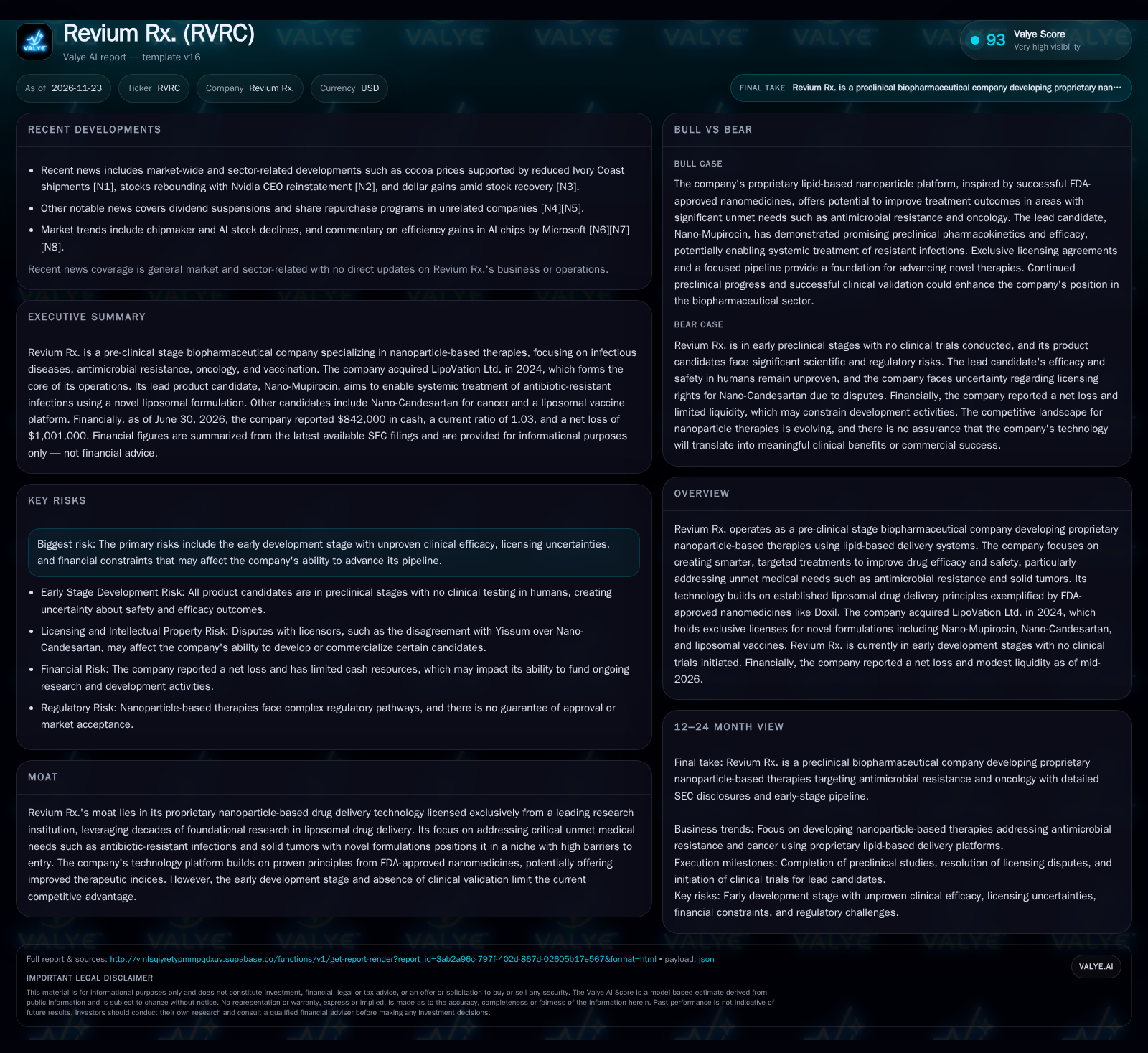
Revium Rx. is a preclinical-stage biopharma focused on nanoparticle drug delivery for resistant infections, cancer, and vaccines. Its lead asset, Nano-Mupirocin, has shown encouraging animal efficacy, but the company has not yet begun human trials and faces a licensing dispute over its secondary oncology candidate. With modest cash and a net loss as of mid-2026, Revium Rx. must resolve IP issues, advance toward clinical trials, and secure funding to realize its platform’s potential. [S1] [S2]
Revium Rx. is positioning itself at the intersection of nanomedicine innovation and urgent therapeutic need, with a pipeline targeting drug-resistant infections, cancer, and novel vaccines. While its exclusive licenses and promising animal data for Nano-Mupirocin offer early signs of platform potential, the company remains preclinical, faces a material licensing dispute, and is operating with reported liquidity position. The coming year will be critical as Revium Rx. must demonstrate translational progress, resolve intellectual property uncertainties, and secure the financing required to enter the clinic.
Where Revium Rx. Stands: Preclinical Progress, Licensing Uncertainty, and Limited Cash
Revium Rx. is a preclinical-stage biopharmaceutical company specializing in lipid-based nanoparticle drug delivery, with a focus on antimicrobial resistance, oncology, and vaccines. Its lead candidate, Nano-Mupirocin, has demonstrated improved systemic exposure and efficacy in preclinical animal studies, addressing a key limitation of traditional mupirocin by enabling potential systemic use against resistant pathogens such as MRSA and VRE. However, the company has not yet initiated any human clinical trials. The pipeline also includes Nano-Candesartan, a nanoparticle angiotensin receptor blocker for cancer, but the license for this candidate is subject to an unresolved dispute with Yissum, the technology’s originator. Financially, as of June 30, 2026, Revium Rx. reported $842,000 in cash, $1,817,000 in current assets, $1,760,000 in current liabilities, and a net loss of $1,001,000 for the period, reflecting a current ratio of 1.03 and a cash ratio of 0.48 [S1] [S2]. These facts point to a company with early scientific momentum but facing both legal and financial constraints as it seeks to advance its pipeline.
Potential Economics of Nanoparticle Drug Development: High Stakes, High Fixed Costs
The economics of Revium Rx.’s business model are defined by the capital-intensive, high-risk nature of preclinical biopharmaceutical development. The upfront costs are largely fixed, driven by research, licensing, preclinical studies, and patent expenses, while variable costs remain modest until clinical trials commence. If successful in translating its nanoparticle platform into approved therapies, the company could benefit from premium pricing in markets with urgent unmet needs—particularly for systemic antibiotics addressing resistant pathogens and for oncology indications with limited alternatives.
The commercial potential for Nano-Mupirocin is notable if the product can demonstrate safety and efficacy in humans, as systemic antibiotics for multidrug-resistant infections command significant pricing power and may be eligible for regulatory incentives such as orphan status or priority review. However, the path to monetization is long: clinical trials, regulatory approvals, and manufacturing scale-up all require substantial additional capital. Revium Rx. currently lacks sufficient funding to initiate or sustain clinical programs, making access to dilutive equity, partnerships, or grants essential for business continuity and value creation. Operating leverage could be significant post-approval, as the marginal cost of producing nanoparticle formulations tends to be lower relative to the high fixed R&D and regulatory burden, but this dynamic only materializes if a product reaches the market.
Assessing the Moat: Proprietary Platform, Unproven in Clinic, and Facing Established Players
Revium Rx. draws its potential competitive advantage from exclusive licenses to proprietary nanoparticle drug delivery technologies, building on decades of research in liposomal medicine. Its focus on indications with limited treatment options, such as antibiotic-resistant infections and certain cancers, targets markets where clinical innovation can create defensible niches and command premium pricing. The company’s platform is inspired by established nanomedicines like Doxil and leverages advances in lipid nanoparticle technology seen in mRNA vaccines.
However, the competitive landscape is rapidly evolving. Large pharmaceutical companies and well-funded biotechs are investing heavily in both antimicrobial resistance and nanoparticle drug delivery. Without clinical validation, Revium Rx.’s technology remains unproven relative to existing nanomedicines and pipeline competitors. The unresolved licensing dispute over Nano-Candesartan also threatens to narrow the company’s oncology ambitions. Until human data is available and IP risks are resolved, Revium Rx.’s moat is more potential than realized, and switching costs or network effects are not yet established.
How Platform Validation Could Unlock Value: From Animal Data to Clinical Proof
The most favorable scenario for Revium Rx. involves successful translation of its preclinical results into human clinical trials, beginning with Nano-Mupirocin. If the company can secure sufficient funding and regulatory clearance to launch first-in-human studies, and if early clinical data confirm improved systemic exposure, safety, and efficacy in treating resistant infections, the platform’s credibility would be significantly enhanced. This could attract strategic partners, non-dilutive grant funding, or licensing deals, supporting further pipeline development.
Confirmation of this scenario would require public disclosure of positive Phase 1 safety and pharmacokinetic results, successful resolution of the Nano-Candesartan licensing dispute, and evidence of new capital inflows—whether from equity, partnerships, or grants. Demonstrating that the nanoparticle technology enables systemic use of potent antibiotics without unacceptable toxicity would also position Revium Rx. as a leader in addressing antimicrobial resistance.
Early Development Realities: Incremental Progress, Ongoing Uncertainty
The most plausible near-term outcome is incremental progress through advanced preclinical studies while the company seeks to resolve its IP dispute and raise additional capital. In this scenario, Revium Rx. may publish further animal data, file additional patents, and continue preparing regulatory submissions, but the timeline to human trials is likely to be extended by funding and licensing constraints.
Supporting evidence would include continued preclinical study announcements, updates on patent filings or IP negotiations, and successful—if modest—fundraising. Falsification would be signaled by a failure to advance projects, depletion of cash without securing new funding, or a material setback in the licensing dispute that limits pipeline scope.
What Could Stall the Platform: Funding Shortfalls and Unresolved IP Risk
The adverse scenario for Revium Rx. features a combination of financial and legal setbacks: the company is unable to raise sufficient capital to support ongoing development, and the Nano-Candesartan licensing dispute remains unresolved or is lost, narrowing the pipeline and undermining strategic flexibility. Without new funding, the company may be forced to halt or delay preclinical work, lose key personnel, or enter a distressed transaction.
Confirmation of this scenario would include public disclosures of cash depletion, layoffs or operational cutbacks, lack of progress in IP negotiations, or the lapse of exclusive rights to key pipeline assets. Failure to advance to clinical trials would further erode confidence in the company’s long-term viability.
Milestones That Will Define Revium Rx.’s Trajectory
Initiation and completion of IND-enabling studies for Nano-Mupirocin, with clear preclinical safety and efficacy data disclosed.
Public updates or resolutions regarding the Nano-Candesartan licensing dispute with Yissum, clarifying pipeline rights and scope.
Announcements of successful capital raises, whether via equity, grants, or strategic partnerships, sufficient to fund clinical trial initiation.
Disclosure of patent filings, new IP grants, or expanded licensing agreements that strengthen the company’s competitive position.
Evidence of regulatory engagement, such as pre-IND meetings with the FDA or other agencies, indicating progress toward clinical entry.
Updates on the SARS-CoV-2 liposomal vaccine platform, including animal study results and patent status, if disclosed.
Any changes in leadership, strategic focus, or cost structure in response to financial constraints or operational challenges.
Disclaimer: This is research-only, informational analysis and not investment advice. It may include AI-generated interpretation and general industry context. Always verify important details using primary sources.

Comments