
Varex Imaging: Strategic Value, Technological Depth, and the Implications of the Teledyne Merger
Varex Imaging stands at the crossroads of industrial and medical X-ray technology, with a pending $1.1 billion cash acquisition by Teledyne set to reshape its future. The company's innovation-driven business, strong OEM relationships, and diversified global reach are balanced against modest recent profitability and the operational challenges of integration.
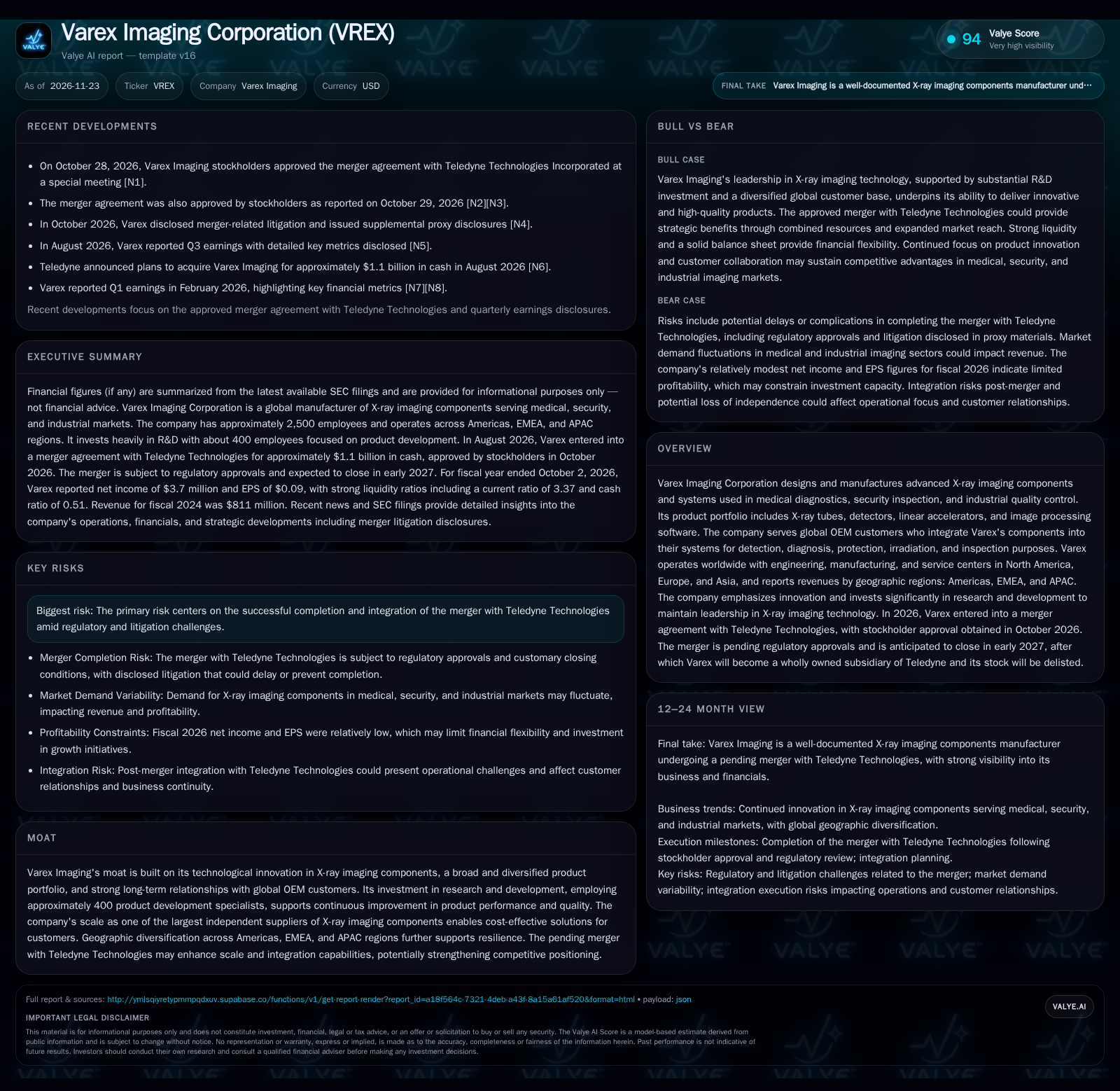
Varex Imaging is a global leader in X-ray imaging components for medical, security, and industrial markets. The upcoming $1.1 billion Teledyne acquisition highlights the strategic value of its technology, scale, and customer network. While Varex’s innovation and geographic breadth offer resilience, recent net income remains modest, and post-merger integration could reshape its economics and competitive stance [S1] [N6].
Varex Imaging Corporation, a global supplier of X-ray imaging components, is on the cusp of a transformative change as Teledyne Technologies moves to acquire the company for $1.1 billion in cash. Known for its deep portfolio spanning X-ray tubes, detectors, and imaging software, Varex’s international footprint and commitment to R&D have positioned it as a critical supplier to OEMs in medical, security, and industrial markets. However, its modest recent profitability, coupled with the operational and strategic uncertainties inherent in a major acquisition, frame the stakes for both near-term execution and long-term value creation.
Merger Terms and Recent Performance Reframe Varex’s Strategic Outlook
The most significant current development is Varex Imaging’s agreement to be acquired by Teledyne Technologies for approximately $1.1 billion in cash, with the transaction expected to close in early 2027 pending regulatory and customary approvals. Each Varex share will be converted into $18.90 in cash, and the company’s common stock will be delisted upon completion [S1] [N6].
Operationally, Varex reported $811 million in revenue for fiscal 2024 and net income of $3.7 million for the fiscal year ended October 2, 2026, resulting in basic and diluted EPS of $0.09. As of the end of that fiscal year, Varex had $94.8 million in cash and a current ratio of 3.37, indicating a strong near-term liquidity position but also highlighting that profitability remains thin relative to its revenue base [S1].
The company’s R&D investment is notable, with approximately 400 employees dedicated to product development, reinforcing its strategic emphasis on innovation. Recent disclosures also include merger-related litigation and supplemental proxy statements, reflecting the complex regulatory and shareholder environment surrounding the transaction [N4].
Revenue Drivers, Cost Structure, and the Economics of Scale in Imaging Components
Varex’s business model is built on supplying high-performance X-ray imaging components—primarily to OEMs who integrate these into finished systems for healthcare, security, and industrial applications. Pricing power in this market tends to be modest, as OEM customers often have significant bargaining leverage and procurement cycles can be long. However, Varex’s broad product portfolio and reputation for reliability help mitigate some price competition, especially in specialized subsystems where switching costs and qualification cycles are high.
Volume and mix are critical: demand in medical imaging is driven by healthcare infrastructure investment, replacement cycles, and regulatory changes, while industrial and security applications depend on capital spending and global trade flows. Variable costs include raw materials (such as specialty glass, metals, and electronics), labor, and logistics, while fixed costs are dominated by R&D, specialized manufacturing, and global service infrastructure.
Operating leverage is present but constrained by the need for continual R&D investment and the cyclical nature of capital equipment markets. The company reported cash and liquidity metrics for the period; these figures do not by themselves establish operating runway, investment capacity, financial flexibility, or financing capacity. [S1]
How Varex’s Technology and Customer Relationships Shape Its Role in a Consolidating Market
Varex’s competitive position is anchored in its technological expertise, breadth of product offering, and long-standing OEM partnerships across geographies. As one of the largest independent X-ray component suppliers, it occupies a niche between integrated system companies and smaller, more specialized players. This allows Varex to offer cost-effective, high-quality solutions while maintaining the flexibility to serve diverse customer requirements.
Its moat is supported by high switching costs for OEMs—arising from product qualification, system integration, and regulatory compliance—especially in medical and security markets. However, this advantage is counterbalanced by the risk of customer consolidation and the potential for vertical integration by larger OEMs or conglomerate suppliers.
Teledyne’s acquisition may strengthen Varex’s competitive position by enabling greater scale, broader cross-selling, and deeper integration with adjacent imaging and sensor technologies. Still, the transition could risk customer attrition if OEMs perceive increased overlap or reduced independence. Competitive threats also include advances in alternative imaging modalities (e.g., ultrasound, MRI, or non-ionizing sensors) and the emergence of new suppliers from Asia with aggressive pricing and improving quality.
Integration Synergies and Product Innovation Drive Margin Expansion
A favorable scenario would see Teledyne leveraging Varex’s technology, customer base, and international footprint to drive both revenue growth and margin improvement. Integration could yield procurement savings, manufacturing efficiencies, and access to Teledyne’s complementary sensor and imaging platforms, enabling the creation of bundled offerings that command higher value per system.
In such a scenario, evidence would include early realization of cost synergies, sustained or increased R&D output (as measured by patent filings, new product launches, or OEM design wins), and successful cross-selling to Teledyne’s broader customer set. Margin improvement would be confirmed by a rising gross margin, increased operating leverage, and higher net income relative to pre-merger levels.
This upside case would be reinforced if the combined entity is able to accelerate innovation cycles, capture share in growth verticals such as advanced industrial inspection or next-generation medical imaging, and maintain high retention among key OEM customers.
Operational Continuity with Incremental Gains, but Margin Constraints Persist
The most plausible near-term path is one of operational continuity: Varex continues to supply its OEM customers, now as part of Teledyne, with gradual process integration and back-office consolidation. Revenue growth is likely to track underlying demand in healthcare, security, and industrial markets, while cost synergies take time to materialize.
Under this scenario, profitability remains modest as integration costs and ongoing R&D investment offset incremental efficiency gains. Confirmation would come from steady revenue retention, stable gross margins, and the absence of major customer defections or supply disruptions. Conversely, evidence of integration delays, customer churn, or reduced product development activity would suggest a weaker base outcome.
The overall impact is incremental rather than transformative, with the primary benefit being enhanced stability and access to Teledyne’s broader technological and financial resources.
Integration Challenges, Customer Attrition, and Competitive Erosion Undermine Value
A negative scenario could unfold if post-merger integration proves more disruptive than anticipated: delays in harmonizing systems and processes, cultural clashes, or loss of key personnel could impact operational performance and customer service levels. If major OEM customers perceive a conflict of interest or lose confidence in Varex’s independence, they may accelerate dual-sourcing or switch to alternative suppliers.
Competitive threats from low-cost Asian manufacturers or technological substitution (e.g., emerging non-X-ray modalities) could combine with internal execution issues to compress margins and erode market share. Evidence of this downside scenario would include declining revenue from existing customers, margin compression, unexpected restructuring charges, or a spike in warranty/service issues.
Litigation or regulatory challenges related to the merger could further distract management and delay value realization, compounding operational headwinds.
Signals That Will Determine the Strategic Payoff from the Teledyne-Varex Combination
Progress and timeline of regulatory approvals for the Teledyne acquisition, including any material conditions or delays.
Retention and satisfaction of key OEM customers post-merger; a useful metric would be customer concentration or revenue retention by top accounts if disclosed.
Gross margin trends and operating leverage in the first full year under Teledyne ownership.
R&D output as measured by new product launches, patent filings, or OEM design wins.
Integration costs and realized synergies versus initial expectations, if disclosed.
Employee turnover rates, particularly among technical and commercial personnel in the first 12-18 months post-acquisition.
Incidence and outcome of merger-related litigation or regulatory disputes.
Disclaimer: This is research-only, informational analysis and not investment advice. It may include AI-generated interpretation and general industry context. Always verify important details using primary sources.

Comments