
ALICO INC: Land-Driven Value Creation After Citrus, But Reliance on Sales and Concentrated Tenancy Raise Execution Stakes
ALICO’s post-citrus transformation centers on Florida land monetization through leasing, royalties, and development—yet the dependence on land sales and a single major tenant underpins continued revenue volatility and strategic risk.
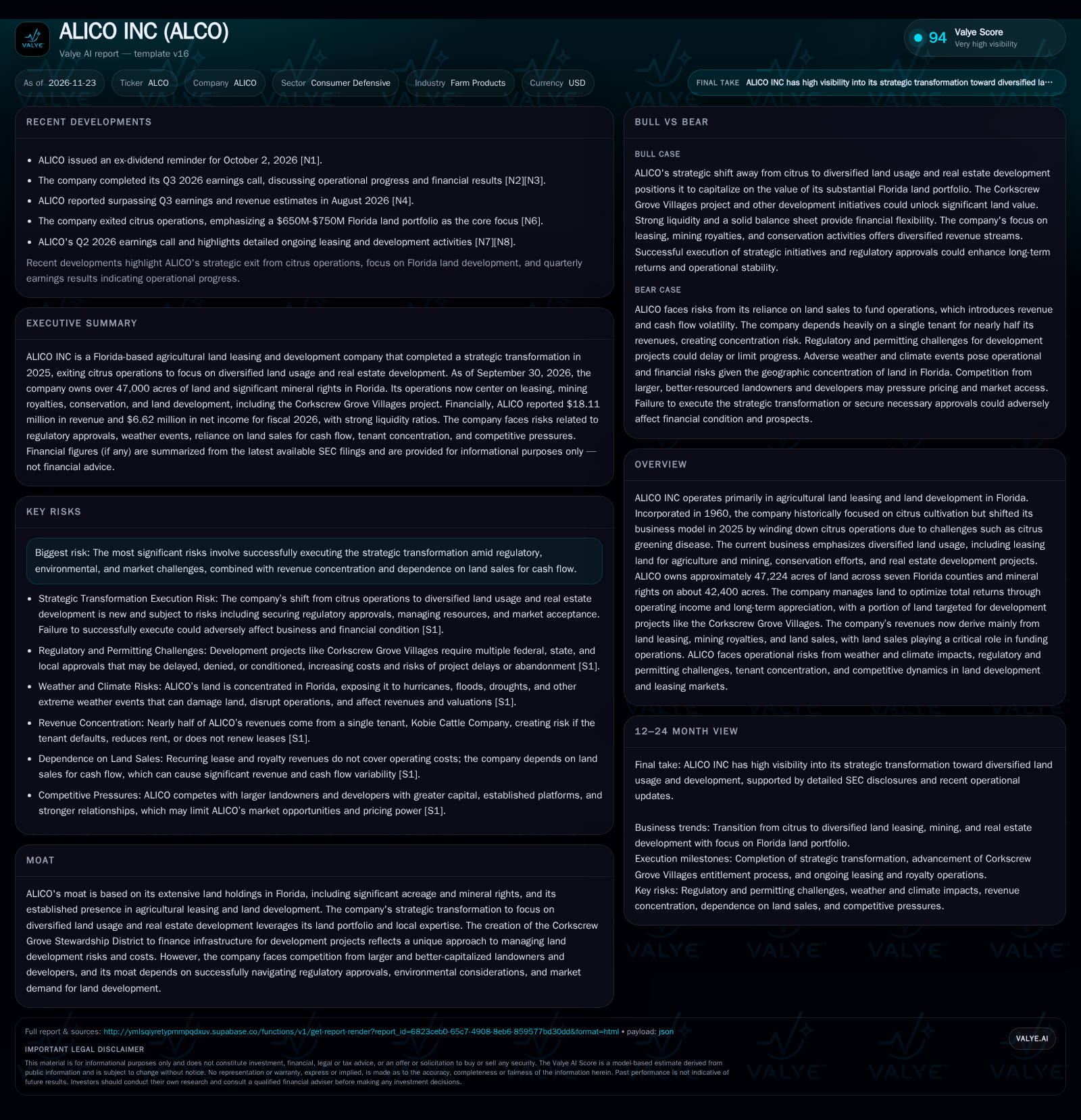
ALICO INC has shifted its business model from citrus farming to diversified land leasing and development, anchored by a large Florida land portfolio. While the company now generates revenue from leasing, mining royalties, and real estate projects, it remains reliant on land sales to cover operating costs. ALICO’s financial health is currently strong, but tenant concentration and regulatory hurdles for major projects like Corkscrew Grove Villages present ongoing challenges to sustainable, recurring cash flows. The company’s future hinges on successful development execution and the ability to diversify both tenant base and revenue sources. [S1] [N6]
ALICO INC’s 2025 strategic shift away from citrus farming marked a pivotal transition into land-centric value creation, leveraging its substantial Florida acreage for leasing, resource extraction, and real estate development. The company’s latest financials show positive net income and reported liquidity position, but the business model remains highly dependent on land sales and a single major tenant for cash flow. As ALICO pursues ambitious projects like Corkscrew Grove Villages, its long-term prospects will depend on regulatory success, tenant diversification, and the ability to generate recurring income streams sufficient to support operations—even as competition and Florida’s environmental risks persist.
Post-Citrus Transition: Land Monetization and Revenue Concentration Define the Current Landscape
ALICO INC finalized its exit from citrus operations in 2025, pivoting to a business model centered on leasing, mining royalties, and land development. As of September 30, 2026, the company owns approximately 47,224 acres of land in Florida and manages about 42,400 acres of mineral rights, with 42,966 acres leased and 3,745 acres available for further leasing or alternative use. Despite this asset base, recurring leasing and royalty revenues do not currently cover operating costs—land sales continue to bridge the funding gap, causing revenue and cash flow volatility. The company reported $18.11 million in revenue and $6.62 million in net income for FY26, with a reported cash position ($52.65 million). Notably, Kobie Cattle Company, a single tenant, accounted for roughly 47.4% of total revenues for the year, underscoring significant concentration risk as ALICO seeks to stabilize and grow its post-citrus cash flows. [S1] [N6]
Land Leasing, Royalties, and Sales: The Economics of Asset Monetization and Volatility
ALICO’s revenue model is now a blend of agricultural and other land leasing, mining royalties, and episodic land sales. Leasing agreements typically provide stable, if modest, recurring income, but the company’s disclosures confirm that these do not yet cover fixed operating costs. Mining royalties add another stream, but are dependent on third-party operator activity, commodity pricing, and permitting. The most material cash inflows come from land sales, which by nature are lumpy and non-recurring—creating inherent variability in both top-line and cash flow metrics.
Operating leverage is limited under this structure: fixed costs for land management, conservation compliance, and development planning persist, while recurring revenues remain insufficient for full coverage. Land development projects, such as Corkscrew Grove Villages, require up-front capital for entitlements and infrastructure, often funded via special districts or proceeds from sales. Until a critical mass of leasing and royalty agreements is achieved—or development projects yield recurring income—ALICO’s economics will be dictated by the timing and pricing of land sales. This structure exposes the company to both upside from land appreciation and downside from unfavorable market or regulatory conditions.
How ALICO’s Land Portfolio Stacks Up Against Larger Landowners and Capital-Heavy Rivals
ALICO’s primary asset is its extensive, contiguous land portfolio in Florida, which provides optionality for various use cases—agricultural leasing, mining, conservation, and residential or commercial development. The company’s local expertise and long-standing relationships offer some competitive insulation, particularly in navigating regulatory and permitting environments unique to Florida.
However, ALICO competes with regional and national landowners, private equity-backed entities, and infrastructure investors with greater capital, more diversified tenant bases, and established development platforms. These competitors can outbid ALICO for tenants, offer more attractive lease terms, or accelerate development timelines. Furthermore, market access and pricing power are constrained by ALICO’s reliance on a few large tenants and the need to secure multi-year approvals for development projects. In this context, ALICO’s advantage is its land bank and local operating history, but its moat is vulnerable to shifts in capital flows, tenant preferences, or regulatory changes.
Unlocking Land Value: What Success in Development and Leasing Would Look Like
The most favorable scenario for ALICO is one in which regulatory approvals for projects like Corkscrew Grove Villages are secured on schedule, enabling phased development and infrastructure investment via the company-controlled special district. As residential, commercial, or mixed-use projects come online, ALICO could capture both immediate land sale proceeds and longer-term recurring income from ground leases, property management, or shared infrastructure fees. Diversification of the tenant base—reducing exposure to single-tenant risk—would help stabilize leasing revenue.
Confirmation of this scenario would come from: multi-year lease agreements with additional tenants, public milestones in the entitlement and permitting process, successful infrastructure financing through the special district, and disclosure of recurring development-related income streams exceeding fixed operating expenses. Evidence would also include a declining dependence on land sales for cash flow and a reduction in tenant concentration.
Balancing Land Sales with Leasing: ALICO’s Most Likely Near-Term Trajectory
The most plausible trajectory for ALICO over the next 12–24 months is continued reliance on a combination of land leasing, mining royalties, and opportunistic land sales to fund operations. Regulatory approvals for major development projects are likely to be incremental and protracted, with partial entitlements and phased infrastructure investment. Leasing revenues may grow modestly as remaining acreage is brought under contract, but tenant concentration—especially with Kobie Cattle Company—will persist as a risk.
This scenario would be confirmed by ongoing land sale disclosures, steady or only gradually increasing leasing and royalty income, and periodic updates on development project milestones without transformative revenue inflection. Falsification would require evidence of either a rapid acceleration in recurring income or significant setbacks in permitting or tenant retention.
When Land Sales Stall: What Could Go Wrong for ALICO’s Cash Flow and Growth Ambitions
The principal downside risk is a scenario in which land sales slow due to unfavorable market conditions, regulatory delays, or environmental opposition—causing a cash flow shortfall that is not offset by recurring leasing or royalty income. The loss or non-renewal of the Kobie Cattle Company lease would exacerbate this risk, given the tenant’s outsized revenue contribution.
Additional adverse developments could include major weather events damaging land assets, increased competition from large, well-capitalized developers driving lease rates down, or negative publicity affecting reputation and project approvals. Confirmation of downside would come from missed or delayed land sale closings, tenant departures, stalled development milestones, or a material decline in reported revenue and net income.
Milestones That Will Shape ALICO’s Land Monetization Thesis
Progress in the Corkscrew Grove Villages entitlement and permitting process, including public filings, regulatory approvals, or infrastructure financing launches.
Disclosure of new, multi-year lease agreements with diversified tenants—especially those that reduce reliance on Kobie Cattle Company.
Quarterly breakdown of recurring leasing and royalty revenue versus operating expenses, if disclosed, to assess progress toward breakeven.
Updates on land sale activity, including volume, pricing, and whether sales are opportunistic or reflect underlying demand shifts.
Evidence of mining royalty growth or diversification of royalty sources, especially if tied to new operators or commodities.
Resilience and response to adverse weather events or environmental incidents affecting land value or operational continuity.
Reputation management, including any ESG-related disclosures or community engagement efforts that could affect regulatory or market access.
Changes in competitive dynamics, such as entry of large-scale landowners or infrastructure investors into ALICO’s core regions.
Disclaimer: This is research-only, informational analysis and not investment advice. It may include AI-generated interpretation and general industry context. Always verify important details using primary sources.

Comments