
Symbotic’s $22B Backlog: Can Automation Scale Beyond Walmart Anchors and Fulfillment Hurdles?
Symbotic’s $22.3 billion backlog and growing deployments at major retailers highlight its leadership in warehouse automation—but customer concentration, deployment complexity, and integration risks may limit how much of this potential converts to durable, diversified earnings.
Symbotic Inc. enters late 2026 with a $22.3 billion backlog, primarily anchored by Walmart and its Exol joint venture, and reported modest profitability for the year. The company’s automation platform combines robotics, AI software, and next-gen storage to address supply chain inefficiencies for large retailers. Its business model depends on complex, capital-intensive deployments with high switching frictions but faces risks from customer dependence, execution challenges, and rapid competitive innovation. The question is whether Symbotic can leverage its patent portfolio and recent acquisitions to diversify revenue and maintain technical leadership as automation demand expands.
Symbotic Inc. stands as a leader in automating the modern warehouse, with a $22.3 billion backlog and a presence at marquee retailers like Walmart. Its end-to-end platform—combining robotics, AI-enabled software, and advanced storage—addresses the acute challenges of labor scarcity, SKU proliferation, and omni-channel fulfillment. While the backlog suggests years of revenue visibility, the company’s heavy reliance on a few customers and the technical complexity of its deployments pose material hurdles to translating this pipeline into stable, diversified cash flows. The next phase of Symbotic’s story will hinge on execution and broadening its customer base as warehouse automation becomes more mainstream.
Symbotic’s Backlog and Financial Snapshot: Why They Matter Now
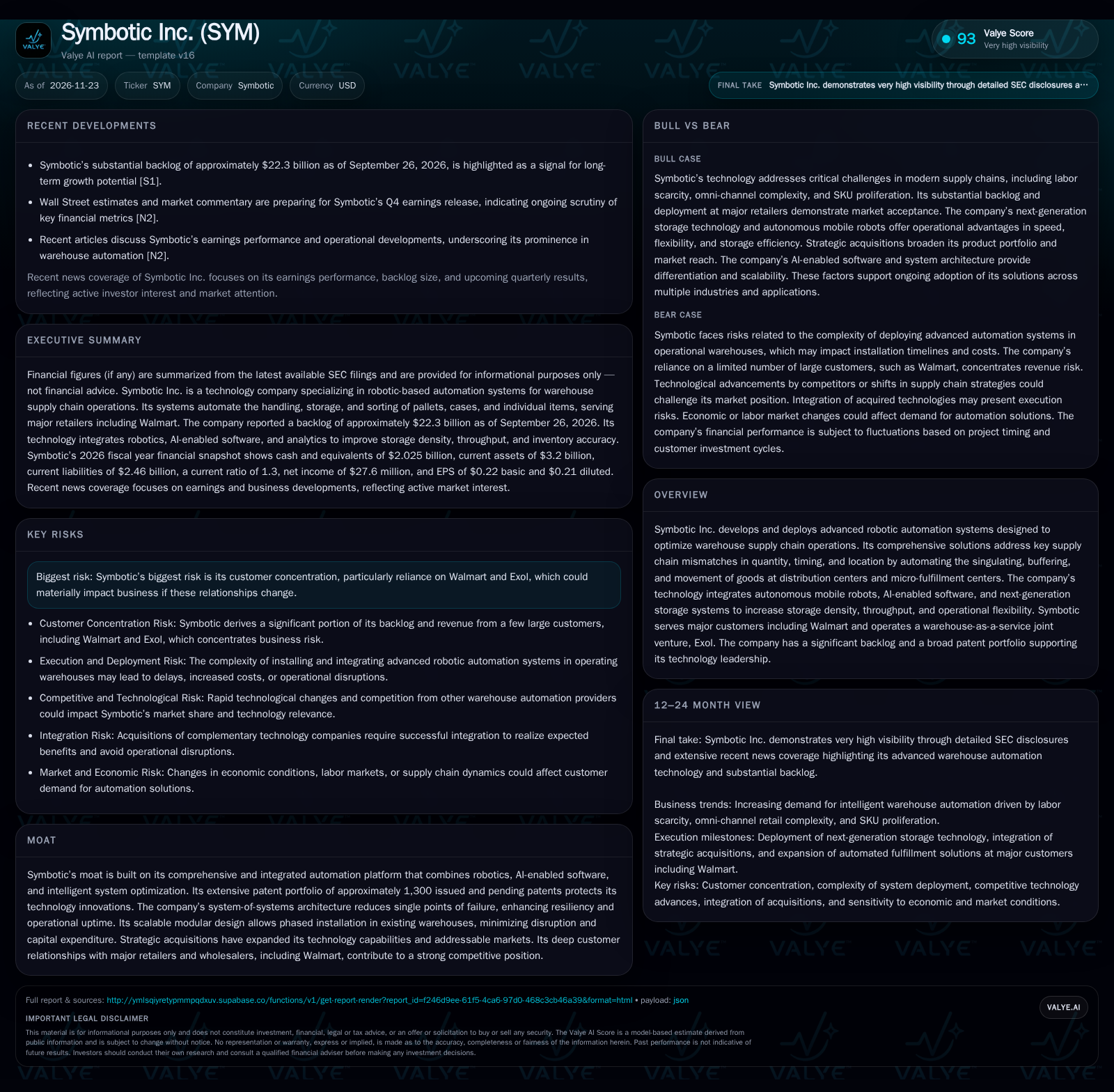
As of September 26, 2026, Symbotic reported a backlog of approximately $22.3 billion, with the majority tied to agreements with Walmart and the warehouse-as-a-service joint venture, Exol [S1]. This backlog is material, representing multi-year revenue visibility and market confidence in the company’s technology. Symbotic posted fiscal 2026 net income of $27.6 million and basic EPS of $0.22, with cash and equivalents of $2.025 billion and a current ratio of 1.3 [S1]. The company’s business has recently expanded through acquisitions aimed at local fulfillment and e-commerce automation, reflecting a push to address broader market needs [S1]. These facts set the stage for analyzing whether Symbotic’s current momentum will translate into durable, diversified growth or remain concentrated and execution-sensitive.
The Economics of Warehouse Automation: Fixed Commitments, Variable Payoffs
Symbotic’s economic model is built around large, capital-intensive automation deployments for major distribution centers and micro-fulfillment hubs. Revenue is likely recognized over long-term implementation contracts, with substantial upfront engineering, hardware, and installation costs, followed by ongoing software and service components. This structure creates high fixed costs and significant operating leverage: successful deployments can drive strong incremental margins, but delayed or over-budget projects can erode profitability.
The company’s backlog, if converted on schedule, would provide multi-year revenue streams, but the actual margin profile depends on execution efficiency and the mix of hardware, software, and recurring service revenue. Hardware and installation are typically lower-margin, while software and analytics—especially if delivered as ongoing subscriptions—could provide higher-margin, recurring cash flows. Symbotic’s expansion into automated local fulfillment and e-commerce suggests an attempt to capture higher-value, software-driven business, but the economics of these newer offerings are not yet fully visible in reported results [S1].
The company reported cash and liquidity metrics for the period; these figures do not by themselves establish operating runway, investment capacity, financial flexibility, or financing capacity. The critical question is whether Symbotic can scale its model and shift its revenue mix toward higher-margin, repeatable software and services as automation adoption deepens.
Technical Leadership and Customer Anchors: Moat or Moment?
Symbotic’s competitive position is underpinned by its 1,300-strong patent portfolio, proprietary system architecture, and deep integration with large retailers’ supply chains [S1]. Its combination of robotics, AI-enabled software, and modular, scalable storage distinguishes it from traditional warehouse automation vendors and newer robotics startups. The company’s technology enables high storage density, system resiliency, and operational flexibility—critical advantages for omni-channel and e-commerce fulfillment.
However, Symbotic’s moat is not unassailable. The warehouse automation market is dynamic, with incumbents (integrated automation vendors), robotics-focused startups, and e-commerce-native solution providers all investing heavily in AI, robotics, and fulfillment software. Symbotic’s heavy reliance on Walmart and a handful of large customers exposes it to revenue concentration risk: the loss or slowdown of a major customer could materially impact results. The company’s recent acquisitions (Fox Robotics, ARMS Innovations, cellumation) aim to broaden its addressable market and technological depth, but successful integration and commercialization are not guaranteed [S1].
Switching costs are high for entrenched systems, but large customers may seek multi-vendor strategies, and rapid advances in AI or robotics could erode today’s technical lead. The question is whether Symbotic’s platform and relationships will enable it to expand beyond its current anchors and defend share as automation becomes a mainstream supply chain investment.
If Symbotic Converts Backlog and Diversifies, Margin Expansion Could Follow
The most favorable scenario for Symbotic is one where it successfully executes on its $22.3 billion backlog, converting orders to revenue on time and on budget, while expanding its customer base beyond Walmart and Exol. If the company leverages its acquisitions to deliver new fulfillment and e-commerce solutions, it could increase the mix of high-margin, recurring software and analytics revenue. This would drive operating leverage, improve profitability, and reduce dependence on a few large customers.
Evidence supporting this scenario would include: accelerating revenue growth across a broader set of customers, an increasing share of software/service revenue in total sales, growing deployments in e-commerce and micro-fulfillment segments, and a declining share of backlog tied to any single customer. Successful integration of acquired technologies and evidence of multi-year renewals or expansions by new customers would further validate the thesis.
Execution Strengths Offset by Customer Dependence and Integration Hurdles
The most plausible path for Symbotic is steady conversion of its existing backlog, with continued strong relationships at Walmart and Exol anchoring revenue for the next several years. The company will likely see moderate expansion into e-commerce and micro-fulfillment, but customer concentration remains high and new segments contribute incrementally. Margin improvement is gradual, constrained by the complexity and cost of large-scale deployments and the time required to integrate new acquisitions.
In this scenario, Symbotic’s reported results show stable or modestly improving profitability, but revenue remains lumpy due to project timing and customer investment cycles. Confirmation would come from sustained backlog, limited customer churn, and incremental wins outside the core customer base. Falsification would be signaled by major project delays, cost overruns, or a sharp drop in backlog tied to a key customer.
When Backlog Is Not Destiny: What Could Derail Symbotic’s Trajectory
A negative scenario would materialize if Symbotic faces significant execution challenges—such as deployment delays, cost overruns, or technical integration failures—leading to revenue deferrals, margin compression, or even contract losses. Customer concentration risk crystallizes if Walmart or Exol slow or cancel deployments, or if a major competitor wins a critical contract.
Additionally, rapid advances by competing automation vendors or a shift in customer technology strategies could erode Symbotic’s backlog and market relevance. If integration of recent acquisitions fails to yield new revenue streams or operational synergies, the company’s diversification efforts could stall. Evidence for this scenario would include missed project milestones, rising installation or support costs, a shrinking backlog, or public loss of a major customer.
Milestones That Will Reveal the Durability of Symbotic’s Growth
Revenue diversification: Track the percentage of revenue and backlog attributable to customers other than Walmart and Exol. A useful metric would be the share of new contracts coming from outside the core customer base, if disclosed.
Software and services mix: Monitor the proportion of revenue derived from software, analytics, and recurring service contracts versus hardware and installation. An increasing mix would support the margin expansion thesis.
Backlog conversion rates: Watch the pace at which backlog is converted into recognized revenue, and whether project deployments are completed on schedule and within budget.
Gross margin trends: Evaluate changes in gross margin, particularly as new fulfillment and e-commerce solutions are rolled out. Margin improvement would indicate successful mix shift and execution.
Deployment milestones: Assess the number and scale of live systems at new customers, and the successful integration of acquired technologies into commercial offerings.
Customer concentration: Monitor any changes in the customer concentration profile, especially any announcements regarding major contract renewals, expansions, or losses.
Integration progress: Follow updates on the operational and commercial integration of Fox Robotics, ARMS Innovations, and cellumation. Evidence of cross-selling or new market entry would help test the acquisition thesis.
Competitive wins or losses: Track announcements of new contracts or lost bids, particularly in e-commerce and micro-fulfillment, to gauge Symbotic’s competitive traction.
Disclaimer: This is research-only, informational analysis and not investment advice. It may include AI-generated interpretation and general industry context. Always verify important details using primary sources.

Comments